North of the Retiro park lies the grid of grand apartment blocks and flagship boutiques where Madrid dresses up. A guide to the Salamanca district and the park beside it: where to shop, where to walk and where to pause.
In this story · 5 sections
Madrid's old centre is a tangle of medieval lanes and Habsburg squares. Walk north-east of the Puerta de Alcalá, though, and the city changes character: wide, straight streets, apartment buildings with wrought-iron balconies and glazed miradors, doormen in uniform and some of the best shopping in Spain. This is the Salamanca district, and beside it lies the Retiro, the great park where Madrileños of every kind spend their Sundays. Together they make an ideal day in the elegant city.
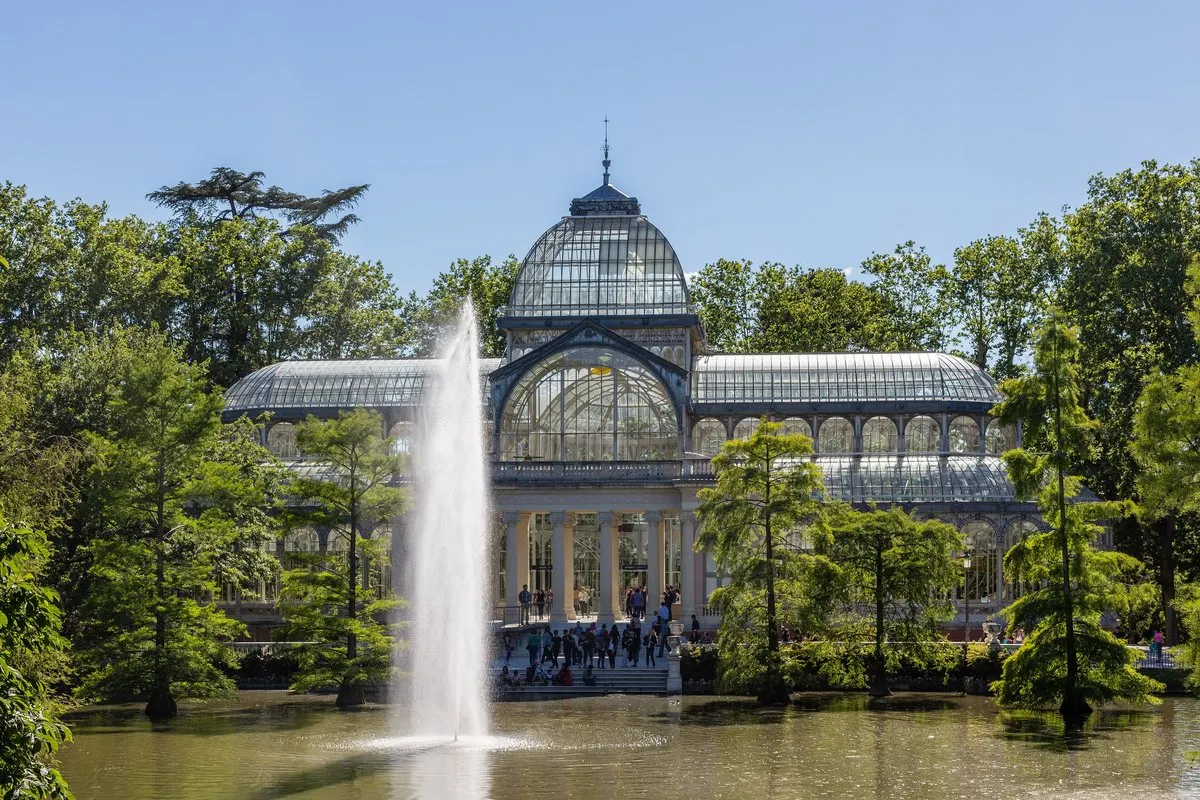
Palacio de Cristal
Pavilion and gallery · Retiro
© OpenStreetMap contributors · OpenFreeMap
- Address
- Parque del Buen Retiro, 28009 Madrid
- Salamanca district
- Laid out from the 1860s; about 150,000 residents
- Main street
- Calle de Serrano, luxury flagships
- Museums
- Museo Arqueológico Nacional, Museo Lázaro Galdiano
- Retiro park
- About 1.4 km²; public since 1868
- Don't miss
- Palacio de Cristal (1887)
A glass and iron pavilion of 1887 by Ricardo Velázquez Bosco, now used for contemporary art installations.
01A marquess and his grid
In the mid-nineteenth century Madrid was still enclosed by a wall built in 1625 under Philip IV. When the walls came down in the 1860s, the financier José de Salamanca y Mayol, the 1st Marquess of Salamanca and one of the richest men of his day, developed a new quarter on a grid to the north-east. It bears his name, and it was conceived from the start as a residential district for the prosperous. Today it is one of Madrid's 21 districts, home to about 150,000 people, and still the city's most polished address.
02Calle de Serrano and the shopping streets
The spine of the district is Calle de Serrano, which begins at the Puerta de Alcalá and runs north across the district. Its first houses went up in 1863; it was originally called Bulevar Narváez and was renamed after General Serrano, who lived on the street, following the revolution of 1868. Today it is lined with the flagship stores of the great international luxury houses, alongside Spanish names in fashion, leather and jewellery.
Insider tipFree to enter when open; check exhibition dates before you go.
The streets that cross it, among them Calle de José Ortega y Gasset, Calle de Goya and Calle de Claudio Coello, are just as rewarding, with smaller boutiques, galleries and antique dealers. Shops generally open late in the morning and stay open into the evening, so there is time for a long lunch in between.
03Museums of the quarter
Two museums on Calle de Serrano are worth breaking off for. At the southern end, the Museo Arqueológico Nacional holds Spain's national archaeological collections, including the Iberian sculpture known as the Lady of Elche. Further north, the Museo Lázaro Galdiano occupies the former home of a collector and publisher, its rooms filled with paintings, enamels, jewellery and objects from many centuries, with works by Goya among them. It is intimate and rarely busy.
04The Retiro: from royal retreat to public park
South of the district, the Parque del Buen Retiro covers about 1.4 square kilometres at the edge of the city centre, near the Puerta de Alcalá and the Prado. It began as a royal retreat attached to a monastery and grew in the 1630s into the gardens of a palace for Philip IV. It belonged to the monarchy until 1868, when it became a public park after the Glorious Revolution. In 2021 it was inscribed by UNESCO as a World Heritage site together with the Paseo del Prado.
Its centrepiece is the Estanque Grande, the large boating lake, overlooked by the monument to King Alfonso XII with its semicircular colonnade and equestrian statue. Hire a rowing boat for half an hour; it is one of Madrid's simplest pleasures.
05The Palacio de Cristal and the Fallen Angel
The park's most beautiful building is the Palacio de Cristal, a glass and iron pavilion inspired by London's Crystal Palace. It was designed by Ricardo Velázquez Bosco and built in 1887, with its own small lake, for the Philippine Islands Exhibition, when it displayed plants from the archipelago. Today it hosts contemporary art installations, and the light inside is magical on a sunny day. Velázquez Bosco also designed the nearby Palacio de Velázquez, another exhibition space.
In the south of the park, beside the rose garden, the Fountain of the Fallen Angel, erected in 1922, shows Lucifer tumbling from heaven, a sculpture by Ricardo Bellver inspired by Milton's Paradise Lost.
For the art museums on the park's western edge, read our guide to the Golden Triangle of Art among the Metro Mode destinations, our Madrid guide (in Swedish), and our travel section in English.