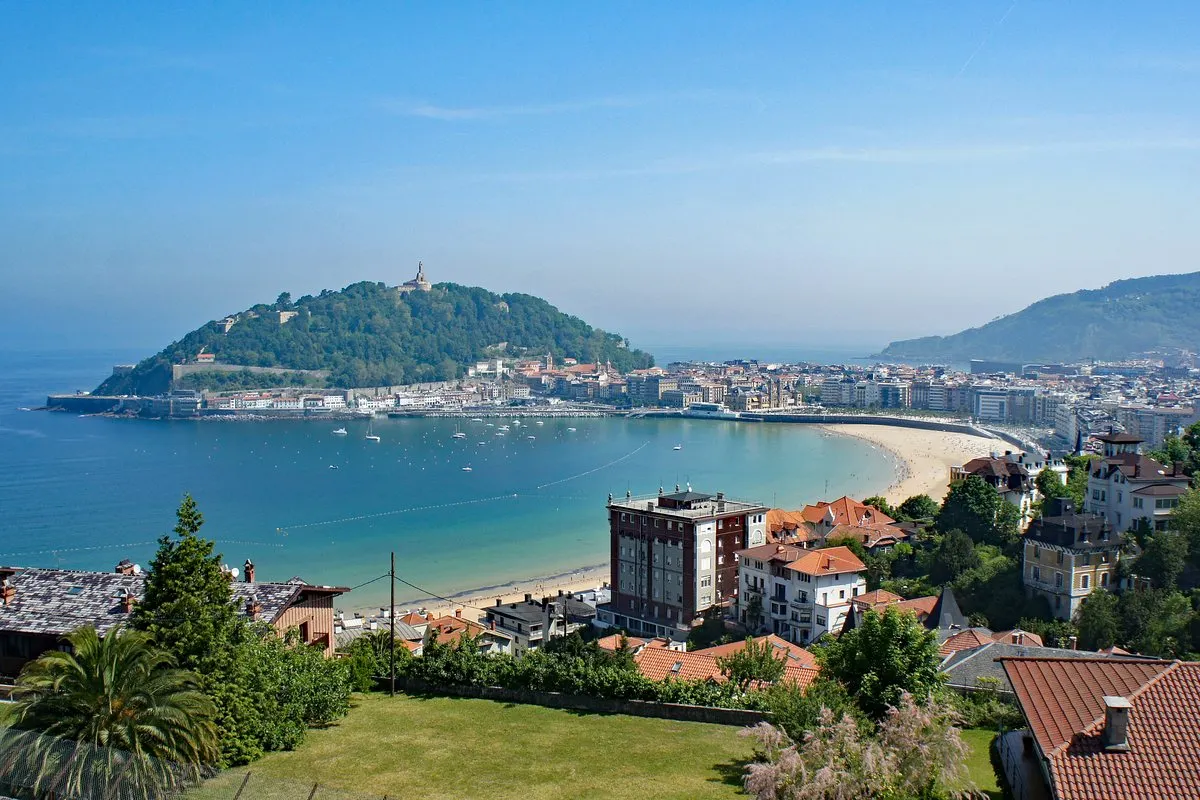
A royal summer resort on a shell-shaped bay, framed by two green hills, with Chillida's iron sculptures at one end and a surf beach at the other. A guide to San Sebastián's promenade, viewpoints and old quarter.
In this story · 5 sections
Few cities have a setting as perfect as San Sebastián. Known in Basque as Donostia, the capital of the province of Gipuzkoa sits on the Bay of Biscay, about 20 kilometres from the French border, wrapped around a shell-shaped bay with an island in its mouth and a green hill at each end. It is a city of fewer than 200,000 people with the poise of a capital: Belle Époque boulevards, a royal palace, an international film festival and some of the best food in Europe. It was European Capital of Culture in 2016.
Paseo de La Concha
Promenade and beach · Centro
© OpenStreetMap contributors · OpenFreeMap
- Address
- Paseo de La Concha, 20007 Donostia / San Sebastián
- Region
- Gipuzkoa, Basque Country
- Population
- About 188,000 (2024)
- Beaches
- La Concha, Ondarreta, Zurriola
- Viewpoints
- Monte Igueldo and Monte Urgull
- Film festival
- Every September, since 1953
A crescent of sand and a promenade with a white wrought-iron railing, between Monte Urgull and Monte Igueldo.
01A royal summer resort
San Sebastián's elegance dates from the nineteenth century, when sea bathing became fashionable. After the old walls came down, the city was rebuilt on a grid in a neoclassical Parisian style, and the architect José Goicoa designed several of its finest buildings, among them the Miramar Palace and the La Concha promenade. From 1885 Queen Maria Cristina, widow of Alfonso XII, spent every summer here with her court, staying at the Miramar Palace, and aristocrats, diplomats and artists followed.
02La Concha and its promenade
The bay of La Concha is the city's heart. Its long crescent of pale sand, protected by the island of Santa Clara, is one of the most celebrated urban beaches in Europe. Above it runs the promenade with its white wrought-iron railing and old lampposts, the classic place for an evening paseo. Walk west past the Miramar Palace and its gardens to Ondarreta beach, then on to the end of the bay.
Insider tipThe best light is at sunset; walk west to the Comb of the Wind.
There, set into the rocks at the foot of Monte Igueldo, is The Comb of the Wind, three massive iron sculptures by Eduardo Chillida, installed with the architect Luis Peña Ganchegui between 1975 and 1977. When the sea is up, waves burst through blowholes in the plaza around them. It is one of the great works of public art of the twentieth century.
03Two hills, two views
Monte Igueldo, at the western end, is reached by an old wooden funicular that climbs to a small, old-fashioned amusement park and the city's most famous view: the whole bay, the island and the town laid out below. Come in the late afternoon, when the light softens. At the other end of the bay, Monte Urgull rises above the old town, with paths through the woods to the ruins of its castle and a statue of the Sacred Heart at the summit. On its slopes lies the English Cemetery, where British soldiers who died here in the nineteenth century are buried.
04The Parte Vieja
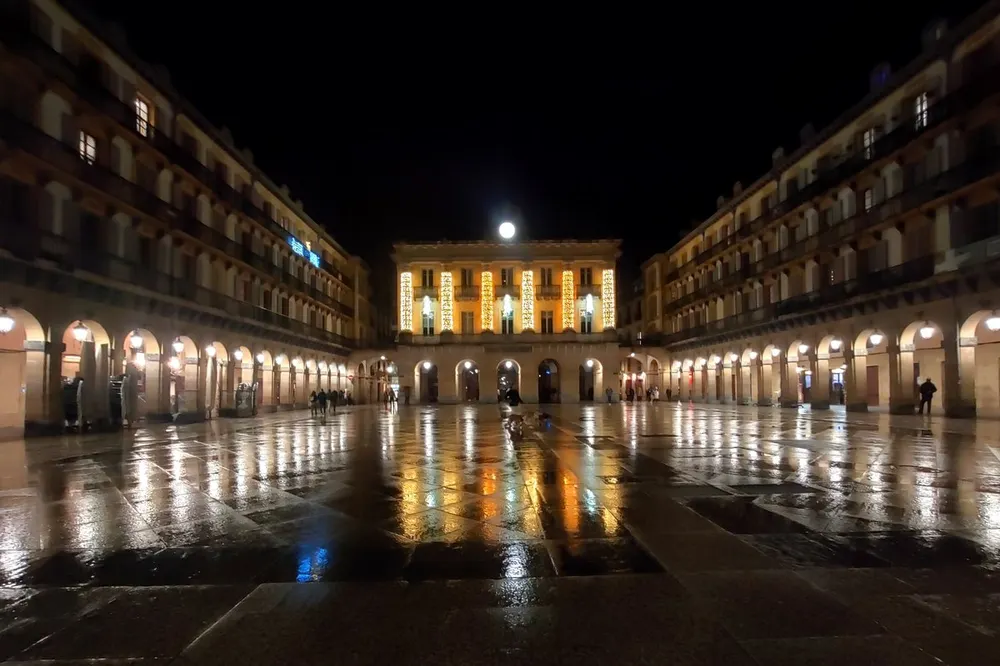
Tucked between Monte Urgull and the river, the old town, the Parte Vieja, is a compact grid of narrow streets where the city goes out to eat. Its centre is the arcaded Plaza de la Constitución, whose balconies still carry the numbers from the days when the square served as a bullring. Nearby, the Baroque basilica of Santa María del Coro faces the length of a street towards the cathedral of the Buen Pastor, and the San Telmo Museum, in a former convent, tells the story of Basque society.
05Gros, the Kursaal and Zurriola
Cross the river Urumea and you reach the district of Gros, younger and more relaxed. Rafael Moneo's Kursaal, two translucent glass cubes opened in 1999, houses the auditorium and congress centre where the San Sebastián International Film Festival, founded in 1953, holds its galas each September. Beyond it, Zurriola beach faces open ocean and is the city's surfing beach.
For where to eat, find our guide to pintxos and Basque fine dining among the Metro Mode destinations, browse our travel section in English, and read why Swedes are buying everyday homes in Spain (in Swedish).