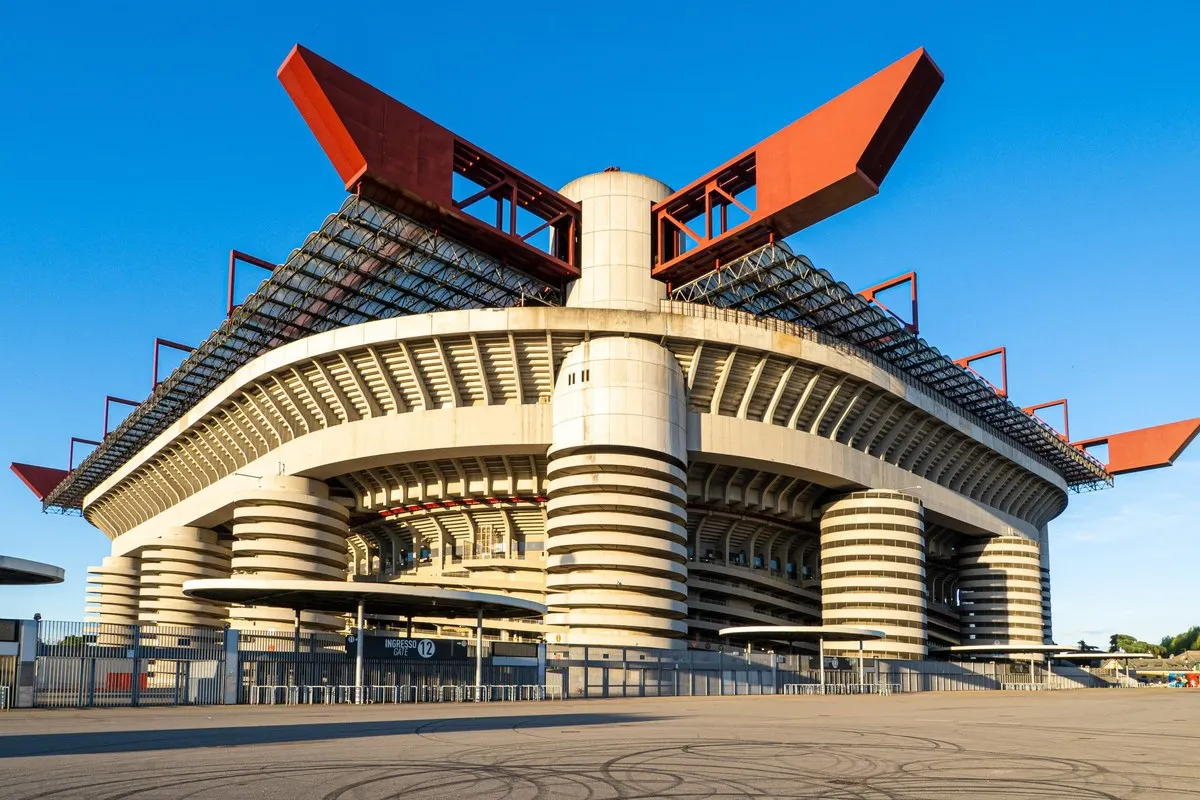
Opened in 1926, shared by Inter and AC Milan and the stage for the opening ceremony of the 2026 Winter Olympics, the Stadio Giuseppe Meazza is one of football's great grounds. Now that the clubs have bought it and planned a new stadium next door, here is how to see it while you can.
In this story · 4 sections
Through the season the Stadio Giuseppe Meazza belongs to two clubs in turn. Inter play here, so do AC Milan, and when they meet in the Derby della Madonnina – named after the gilded Virgin on top of the Duomo – the two curves compete with choreographies that fill the stands. With 75,817 seats it is the largest stadium in Italy, and the Milanese call it La Scala del calcio, the La Scala of football.
It is also living on borrowed time, which makes now a good moment to go.
Stadio Giuseppe Meazza (San Siro)
Stadium · San Siro, Milan
© OpenStreetMap contributors · OpenFreeMap
- Address
- Piazzale Angelo Moratti, 20151 Milano
- Opened
- 19 September 1926 (Inter 6, Milan 3)
- Capacity
- 75,817 seats, the largest in Italy
- Named after Giuseppe Meazza
- 2 March 1980
- Third tier and towers
- 1987–1990, for the 1990 World Cup; eleven towers
- European finals
- 1965, 1970, 2001, 2016
- Olympic opening ceremony
- 6 February 2026
- Sold to AC Milan and Inter
- November 2025, €197 million
- New stadium
- Foster + Partners and Manica; about 71,500 seats; 2030 at the earliest
Italy's largest stadium, opened in 1926 and rebuilt for the 1990 World Cup, with a museum of both clubs inside.
01Built by Milan, named after an Inter hero
The idea came from Piero Pirelli, president of AC Milan, who chose a site beside the San Siro racecourse, opened in 1920. Building began in 1925 and the stadium was inaugurated on 19 September 1926, when 35,000 spectators watched Inter beat Milan 6–3. It was Milan's ground at first; the city bought it in the 1930s, and it later became home to both clubs. A second ring, designed by the engineers Armando Ronca and Ferruccio Calzolari, followed between 1948 and 1955.
On 2 March 1980 the stadium was named after Giuseppe Meazza, twice a World Cup winner, in 1934 and 1938, who spent most of his career at Inter and later managed the club. That is why Inter supporters have tended to call it the Meazza, while for Milan's it has always been San Siro.
02The towers and the red girders
The silhouette everyone knows dates from the renovation of 1987 to 1990 for the World Cup. A third tier was added on three sides, resting on eleven concrete towers wrapped in spiral ramps; four of them, at the corners, carry the roof with its protruding red girders. San Siro staged the opening ceremony of that World Cup, European Cup and Champions League finals in 1965, 1970, 2001 and 2016, and on 6 February 2026 the opening ceremony of the Milano Cortina Winter Olympics.
Insider tipSee a match while you still can – the stadium's days are numbered.
03The last chapter
In 2019 the two clubs announced that they wanted to replace it. After years of argument, the city council approved the sale on 30 September 2025, and in November 2025 AC Milan and Inter bought the stadium and the land around it for €197 million. The city cited rising maintenance costs and the fact that UEFA no longer considered the stadium for major international matches such as Champions League finals.
Foster + Partners and Manica are designing the replacement next door: an oval stadium of about 71,500 seats, without the famous red girders, which the clubs say will be ready by 2030 at the earliest. Once it opens, most of San Siro is due to be demolished in 2031 or 2032, with part kept for a commercial and entertainment area that may include a museum.
04How to visit
The best way to see San Siro is full, on a match day: tickets are sold by the clubs, and for the derby they go quickly. On other days, the museum opened inside the stadium in 1996 tells the story of both clubs through shirts, trophies, boots and memorabilia, and guided tours take in the stands. Times change around fixtures, so check before you go. The stadium has its own metro station, San Siro Stadio, on line M5.