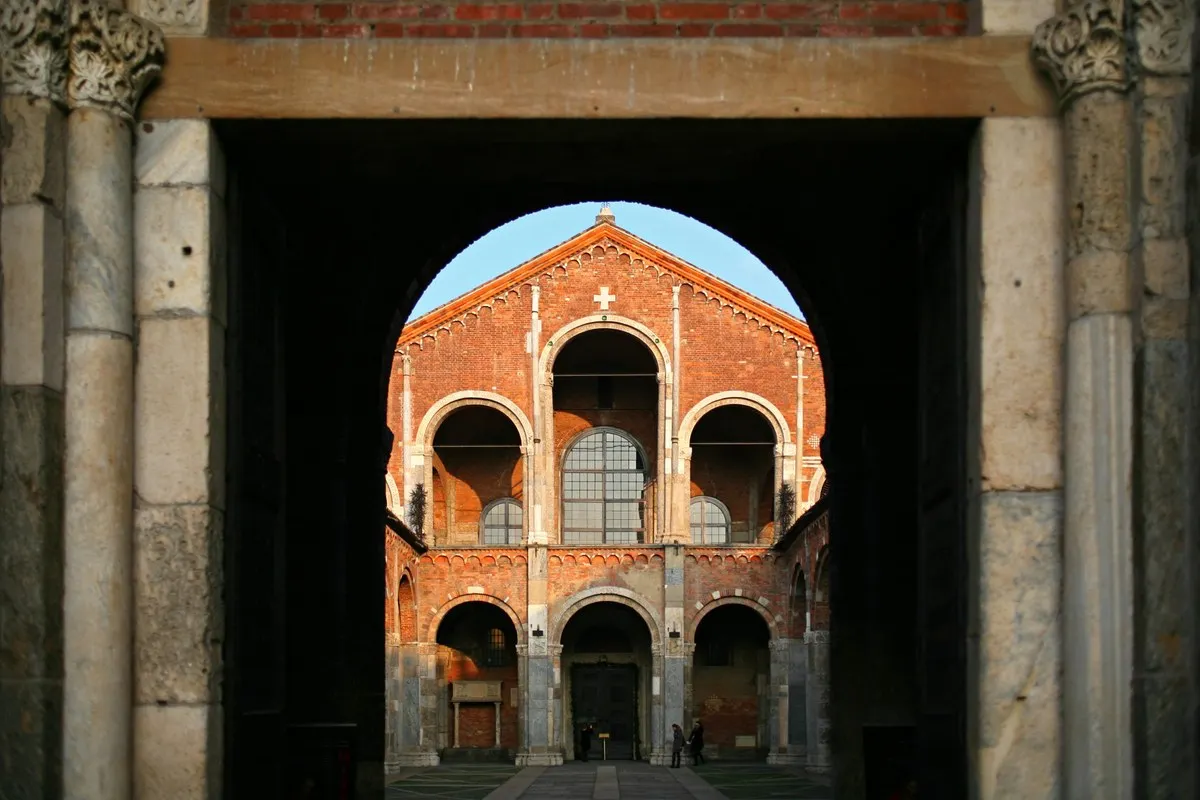
Founded by Saint Ambrose in the 380s and rebuilt in the twelfth century, the basilica of Milan's patron saint is one of the great Romanesque churches of northern Italy: a ninth-century golden altar, a pulpit set on a Roman sarcophagus, and the saint himself in the crypt.
In this story · 4 sections
When Ambrose became bishop of Milan in the fourth century, he built a ring of churches around the city. This one, begun between 379 and 386, stood outside the Roman walls in an area where martyrs of the Roman persecutions had been buried, and was first called the Basilica Martyrum. After his death it took his name, and Ambrose – Ambroeus in Milanese – became the city's patron saint.
The city grew up around the basilica, which became a centre of religious life for both a community of canons and, from 789, a Benedictine monastery. Today it sits in a quiet square west of the centre, and for many Milanese it, rather than the Duomo, is the true heart of the city.
Basilica di Sant'Ambrogio
Church · Sant'Ambrogio, Milan
© OpenStreetMap contributors · OpenFreeMap
- Address
- Piazza Sant'Ambrogio 15, 20123 Milano
- Founded
- 379–386, by Saint Ambrose, as the Basilica Martyrum
- Present church
- Romanesque, begun c. 1080; nave c. 1128; vaults c. 1140
- Golden altar
- Volvinius, 824–859
- Bell towers
- Monks' tower, 9th century; canons' tower, 12th century
- Apse mosaic
- Early 13th century
- Crypt
- 9th century; remains of Ambrose, Gervasius and Protasius
- Feast day
- 7 December, with the Oh bej! Oh bej! fair until the following Sunday
Founded by Saint Ambrose in 379–386 and rebuilt in Romanesque style: the golden altar of Volvinius, the Ciel d'Oro chapel and the saint's crypt.
01The church you see today
The present church is Romanesque, begun around 1080: the nave dates from about 1128 and its rib vaults from about 1140. It is built of brick in different colours, with stone and white plaster, and it is entered through an arcaded atrium where, in the early Church, those preparing for baptism waited during part of the Mass. The façade has two tiers of loggias; from the upper one the bishops blessed the people.
The two bell towers tell of two communities sharing one church. The ninth-century Torre dei Monaci belonged to the monks, who used it to call the faithful to their Mass; the canons were not allowed to ring bells until they had finished their own tower, on the north side, in the twelfth century.
02Inside
Halfway down the nave on the left, the twelfth-century pulpit stands on a ninth-century predecessor and, below that, a Roman sarcophagus of the fourth century traditionally called the sarcophagus of Stilicho. At the end of the nave, under a ciborium on four red porphyry columns, is the golden altar made by Volvinius between 824 and 859, covered in gold and silver reliefs; the apse above it shimmers with an early thirteenth-century mosaic of Christ Pantocrator between the saints Gervasius and Protasius.
Insider tipCome on 7 December for the feast and the start of the Oh bej! Oh bej! fair.
Off the right aisle, the chapel of San Vittore in Ciel d'Oro – 'in the golden sky' – was originally a free-standing chapel, perhaps older than the basilica itself, built to hold the relics of Saint Victor, and its dome is covered in gold mosaic. The crypt beneath the altar, built in the ninth century, holds the remains of Ambrose, Gervasius and Protasius in a silver urn.
03Bramante, the war and the Devil's Column
In 1492 the Benedictines commissioned Donato Bramante to renovate the rectory, and on 4 August 1528 the city's noble and popular factions signed the 'Peace of Saint Ambrose' here. In August 1943 Allied bombing badly damaged the apse and the buildings around it. Outside, beside the church, stands a white marble column with two holes in it: tradition says the Devil made them with his horns when he failed to tempt the saint.
047 December
The feast of Sant'Ambrogio, on 7 December, is Milan's own holiday, and the evening the Teatro alla Scala opens its season. It also starts the Oh bej! Oh bej!, the city's oldest Christmas fair, which runs until the following Sunday with sweets, decorations, antiques and bric-à-brac. Tradition dates it to 1510; it was held beside the basilica from 1886 until 2006, when it moved to the area around the Castello Sforzesco.