In this story · 6 sections
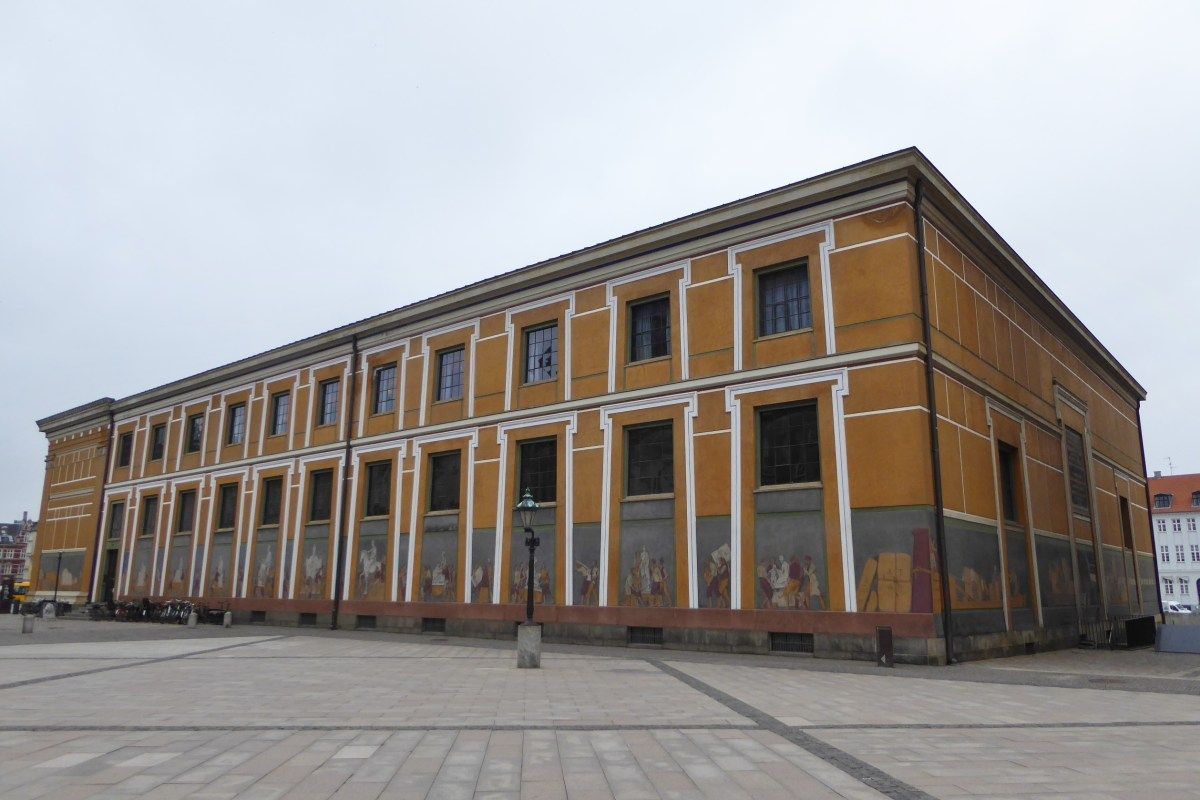
On the small island of Slotsholmen, beside Christiansborg Palace, stands a building unlike any other in Copenhagen: a museum raised entirely for one artist, and containing his grave. Thorvaldsens Museum was built between 1839 and 1848 to house the lifetime output of Bertel Thorvaldsen (1770–1844), the Copenhagen-born sculptor who spent more than four decades in Rome producing neoclassical marbles for popes, princes and the English aristocracy. Architect Michael Gottlieb Bindesbøll gave the building trapezoidal portals, an interior courtyard painted with palms and crocodiles, and a brightly coloured façade inspired by the excavations at Pompeii and Herculaneum. It opened as Denmark's first public museum building, four years after Thorvaldsen's death, and nothing in the collection may be added to or removed from it: the rooms still hold exactly what the sculptor gave to his native city.
Thorvaldsen Museum
Sight · Slotsholmen, Indre By
© OpenStreetMap contributors · OpenFreeMap
- Address
- Bertel Thorvaldsens Plads 2, 1213 København K
- Open
- Tue–Sun 10:00–17:00, closed Mondays (Oct 2026)
- Tickets
- Adults 110 kr; under 18 free; free Wednesdays (Oct 2026)
- Built
- 1839–1848
- Architect
- Michael Gottlieb Bindesbøll
- Telephone
- +45 21 68 75 68
- Website
- thorvaldsensmuseum.dk
- Style
- Danish historicism / Neoclassicism
- Collection
- Thorvaldsen's sculptures, antiquities and painting collection
- Highlights
- Jason with the Golden Fleece; Thorvaldsen's tomb
- Nearest station
- Gammel Strand (M3/M4)
Denmark's first public museum, raised beside Christiansborg Palace to house one sculptor's life's work and his grave.
01The story
Bertel Thorvaldsen left Copenhagen on a travel stipend in 1796 and did not return for good until 1838, by which time he was among the most sought-after sculptors in Europe. Bertel Thorvaldsens Plads is a public square dedicated to Denmark's illustrious neoclassical sculptor, Bertel Thorvaldsen (1770–1844), and when he finally sailed home his arrival was treated as a state occasion: his success abroad had made him a source of national pride, crowds lined the streets, King Christian VIII joined the celebrations, and Thorvaldsen was granted freedom of the city.
He had already agreed to give his life's work to Denmark. It was built to house the collection of sculpture that the celebrated Danish Neoclassical sculptor Bertel Thorvaldsen presented to his native country in 1837. The grounds behind Christiansborg Palace Chapel, where the four-winged royal carriage yard had stood, were donated by Frederick VI to the museum, and architect M.G. Bindesbøll constructed Denmark's first art museum from 1839 to 1848. He reused the existing walls from the carriage yard and added a large entrance hall with five high, sloping portals that form the main façade.
Thorvaldsen never saw the finished building. Thorvaldsen himself did not live to see the completed museum, as he died four years before its inauguration. During construction he had asked to be laid to rest within it, and he expressed his wish to be buried there so that he could rest eternally surrounded by his work; although he died four years before the museum opened, his request was honoured. His grave, a simple bed of roses, lies at the centre of the courtyard he never walked into alive.
02What you see
The building's colour is its first surprise. Bindesbøll had travelled widely as a young man: as a young man he had been on several study trips to Southern Europe, where he was inspired by the excavations in Pompeii and Herculaneum, which had revealed that the Greeks painted their sculptures and temples in strong colours, an idea he brought from antiquity to Copenhagen. The result met resistance at first: the museum's bright coloured surfaces naturally met with resistance in neoclassical Copenhagen.
Insider tipClosed Mondays; courtyard currently shut for facade restoration (Oct 2026).
Three of the four outer walls carry a long painted frieze telling the story of the sculptor's own homecoming. Three of the four external walls are decorated by a frieze created by the Danish painter Jørgen Sonne; the work began in 1846 and was completed in 1850, after the museum itself had already opened. On the roofline, a victory monument shows the goddess of victory riding in a quadriga pulled by four horses, created for the museum by H.W. Bissen, who had worked as an apprentice of Thorvaldsen in Italy.
Inside, the courtyard is painted in motifs quite unlike anything else in the city: the building is built around an inner courtyard where the artist is buried, notable for being painted in Egyptian motifs, with tall date palms, lions and crocodiles prowling among exotic birds and plants. The galleries themselves are equally considered: every room in the museum has a unique ceiling decoration in the grotesque style, so that the setting changes with each group of statues.
Don't miss
Don't miss
- 01
Jason with the Golden Fleece, Thorvaldsen's 1803 breakthrough marble, in Room 5
- 02
The sculptor's grave, a simple rose bed at the centre of the Egyptian-painted courtyard
- 03
Jørgen Sonne's painted frieze of Thorvaldsen's 1838 homecoming, wrapped around three façades
- 04
H.W. Bissen's Victory quadriga on the roofline
- 05
Horace Vernet's 1833 portrait of Thorvaldsen, acquired from the artist's own bequest
03The highlights
The single work most visitors seek out is Jason with the Golden Fleece, the life-size marble that made Thorvaldsen's name. Thorvaldsen's first success was the model for a statue of Jason, finished in 1801 and highly praised by Antonio Canova, and in 1803 he received the commission to execute it in marble from Thomas Hope, a wealthy English art-patron. The marble took a quarter of a century to complete: the marble Jason was not finished until 25 years later, as Thorvaldsen quickly became a busy man. It entered the museum long after his death, when it was purchased at auction from the Hope family collections on 23 July 1917; it now stands at 242 cm tall in Room 5 on the museum's main floor.
Among the paintings is a portrait the sculptor kept for himself. The two met in Italy and became friends while Horace Vernet was Director of the French Academy in Rome, and they agreed to each produce a depiction of the other, the painting showing Thorvaldsen with the bust he had produced of Vernet; the Copenhagen version was acquired in 1844 through a bequest from the artist.
Upstairs, Thorvaldsen's own eye as a collector is on view: antiquities bought not for rarity but for inspiration. His antiquities collection is quite interesting in this context, with pieces selected for their form and style rather than historical importance or provenance — they constituted a library of inspiration for the sculptor.
04Visiting
In October 2026 the museum's own site states opening hours as Tuesday to Sunday, 10:00–17:00, closed Mondays and on 24, 25 and 31 December and 1 January. Admission for adults is 110 kr, with free entry for under-18s, free entry for pensioners on Tuesdays, and free entry for everyone on Wednesdays. A 1+1 annual pass at 320 kr gives the holder and one guest a year of free entry to the Museum of Copenhagen, Thorvaldsens Museum and Nikolaj Kunsthal.
A new exhibition on Thorvaldsen's own painting collection, Liv, Længsel & Landskab, is currently on show. The museum's courtyard is temporarily closed while the building's facades undergo a major restoration, so check the current state of works before planning a visit around the tomb.
05Getting there
The address is Bertel Thorvaldsens Plads 2, 1213 København K, on the island of Slotsholmen beside Christiansborg Palace. The closest stop is Gammel Strand on the Copenhagen Metro's City Circle Line (M3/M4), a five-minute walk from the square; Kongens Nytorv station is about ten minutes on foot.
06Around it
Christiansborg Palace, seat of the Danish Parliament, is next door, and the canal-side houses of Gammel Strand face the museum across Slotsholmens Canal, with Thorvaldsens Museum and Christiansborg Palace seen across the canal on the island of Slotsholmen. The National Museum of Denmark and the pedestrian street Strøget are both within a short stroll, making Slotsholmen an easy base for an afternoon of museum-hopping before crossing back towards Nyhavn.