In this story · 3 sections
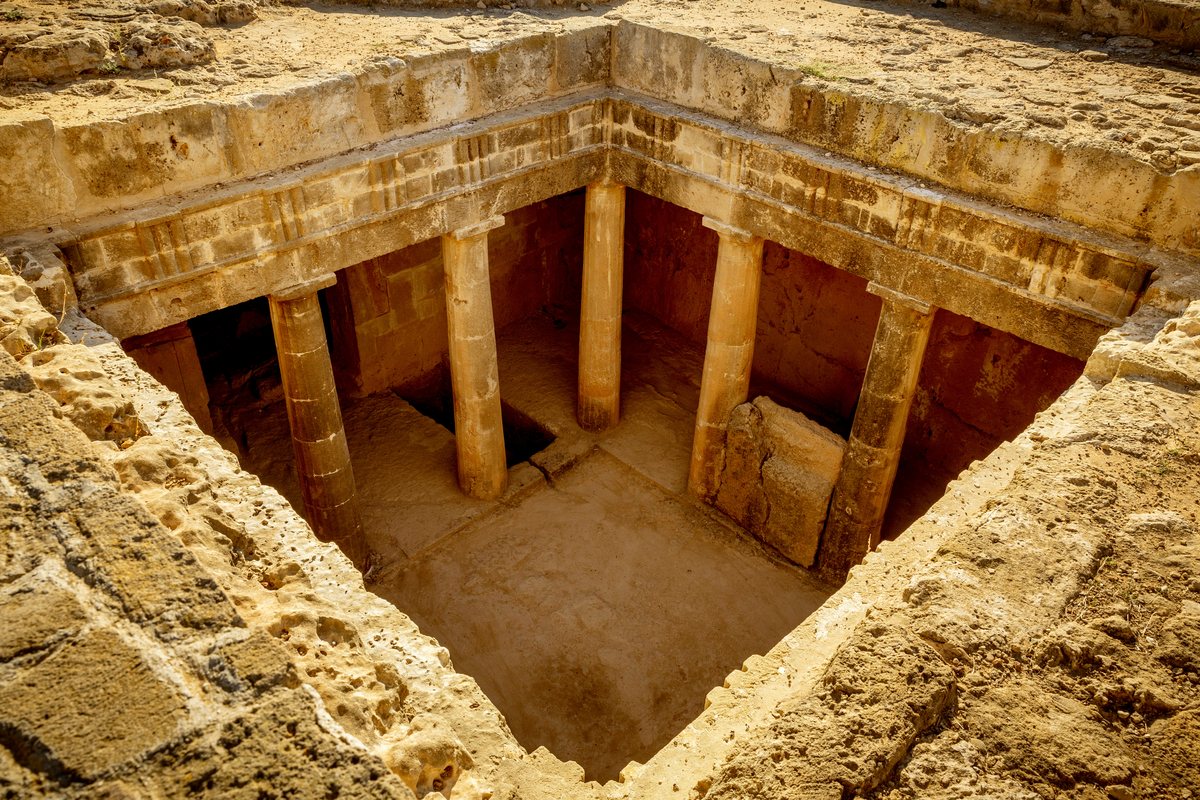
The Tombs of the Kings lie close to the sea, about two kilometres north of Paphos harbour, and at first there is little to see but stone and sky. Then the ground opens. Cut down into the solid rock are courtyards ringed with Doric columns, with burial chambers opening off their sides – tombs built to look like the houses of the living, for people who expected to be remembered. Many date from the 4th century BC, and the necropolis was used for burials until the 3rd century AD, through the Hellenistic and Roman periods. Despite the name, no kings were buried here. The tombs belonged to Paphos's aristocrats and high officials, and it is their size and splendour that earned them their title. Today they form part of the Archaeological Park of Kato Paphos, inscribed on the UNESCO World Heritage List in 1980 together with Nea Paphos and Kouklia.
Tombs of the Kings
Archaeological site · Kato Paphos
© OpenStreetMap contributors · OpenFreeMap
- Address
- Tombs of the Kings Avenue, Kato Paphos, Cyprus
- Open
- 16 Apr–15 Sep daily 08:30–19:30; 16 Sep–15 Apr daily 08:30–17:00; closed 25 Dec, 1 Jan, Orthodox Easter Sunday
- Entry
- €2.50
- Tickets
- €2.50; 20% off for groups of more than 10; monument cards €8.50 (1 day), €17 (3 days), €25 (7 days)
- Time needed
- One to two hours
- Best time
- At opening, or in the late afternoon when the light is low
- Getting there
- Tombs of the Kings Avenue, about 2 km north of Paphos harbour
- UNESCO
- Part of Paphos, inscribed 1980
- Telephone
- +357 26 306 217
- Website
- visitcyprus.com (Deputy Ministry of Tourism); mcw.gov.cy/da (Department of Antiquities)
Underground tombs carved from solid rock, some built like houses around Doric-columned courtyards, used from the 4th century BC to the 3rd century AD. Part of the Paphos UNESCO World Heritage Site.
01The story
The Department of Antiquities attributes the funerary monuments to the Ptolemies and describes their architecture as a blend of Greek, Egyptian and Macedonian elements, with its closest parallels in Alexandria and Macedonia, Cyprus Inform reported in May 2026. Stamped handles of Rhodian amphorae placed with the dead help archaeologists date the burials.
The site has been dug over for a long time. Luigi Palma di Cesnola, the American consul to Cyprus, led the first excavations in 1870; Menelaos Markides, curator of the Cyprus Museum, ran the first scientific ones in 1915; and from the late 1970s Sophocles Hadjisavvas, later director of the Department of Antiquities, directed systematic excavations. Much had already been lost, probably to grave robbers and the seaside location. Tomb 8, first excavated in 1979, held 18 burials and evidence of a cremation in a lead urn, and the excavation report links it to the Ptolemaic dynasty and to the last king of Cyprus, who is said to have taken his own life when Rome occupied the island – the nearest the site comes to a royal burial.
02What you see
The tombs are carved out of solid rock rather than built, and some copy a house: a peristyle atrium open to the sky, surrounded by columns, with the burial chambers leading off it. Some are decorated with Doric pillars, and some had frescoed walls. Tomb 8, as the Department of Antiquities describes it, is laid out around a central block of rock, with an open courtyard, four symmetrical wings and a burial chamber behind a Doric façade. Recent works have added elevated walkways that let you read the plan of the tombs from above and transparent flooring over remains below; the culture ministry has said protective shelters are still needed.
Insider tipOpen daily; €2.50. Partially wheelchair accessible (view from above only).
Don't miss
Don't miss
- 01
The colonnaded courtyards, best understood from above before you go down
- 02
Tomb 8, with its four symmetrical wings around a block of living rock
- 03
The burial chambers cut into the courtyard walls, opening like rooms off a hall
- 04
The new walkways and the glass floor over the excavated remains
- 05
The mosaics of the Archaeological Park of Kato Paphos, a short way south
03How to visit
The site is open every day of the year except Christmas Day, New Year's Day and Greek Orthodox Easter Sunday: from 08:30 to 19:30 between 16 April and 15 September, and from 08:30 to 17:00 between 16 September and 15 April. Entry is €2.50, according to the Deputy Ministry of Tourism, with 20 per cent off for organised groups of more than ten; the Department of Antiquities' museum and monument cards, valid for one, three or seven days, cost €8.50, €17 and €25. Hours and fees can change without notice.
Access is partial for wheelchair users, who can see the tombs from above only. The Archaeological Park of Kato Paphos, with the mosaic floors of the Houses of Dionysos, Theseus, Aion and Orpheus, charges its own €4.50 entry.