Helsinki is the EU's northernmost capital, a Unesco City of Design and the city that has topped an index of sustainable destinations three years running. It is also small enough to see in a single day: Engel's Empire-style square, a sea fortress on eight islands, a library that has become the city's living room and a church blasted out of the rock.
In this story · 6 sections
Helsinki – Helsingfors in Swedish – is Finland's capital and largest city, on the Gulf of Finland, and a bilingual municipality with Finnish and Swedish as official languages. It is the EU's northernmost capital and the world's northernmost metropolitan region with more than a million inhabitants. The city was World Design Capital in 2012, was named a Unesco City of Design in 2014 and topped the Global Destination Sustainability Index in 2024, 2025 and 2026. The day below can be done on foot, with a boat trip in the middle.
01Morning: Senate Square and the cathedral
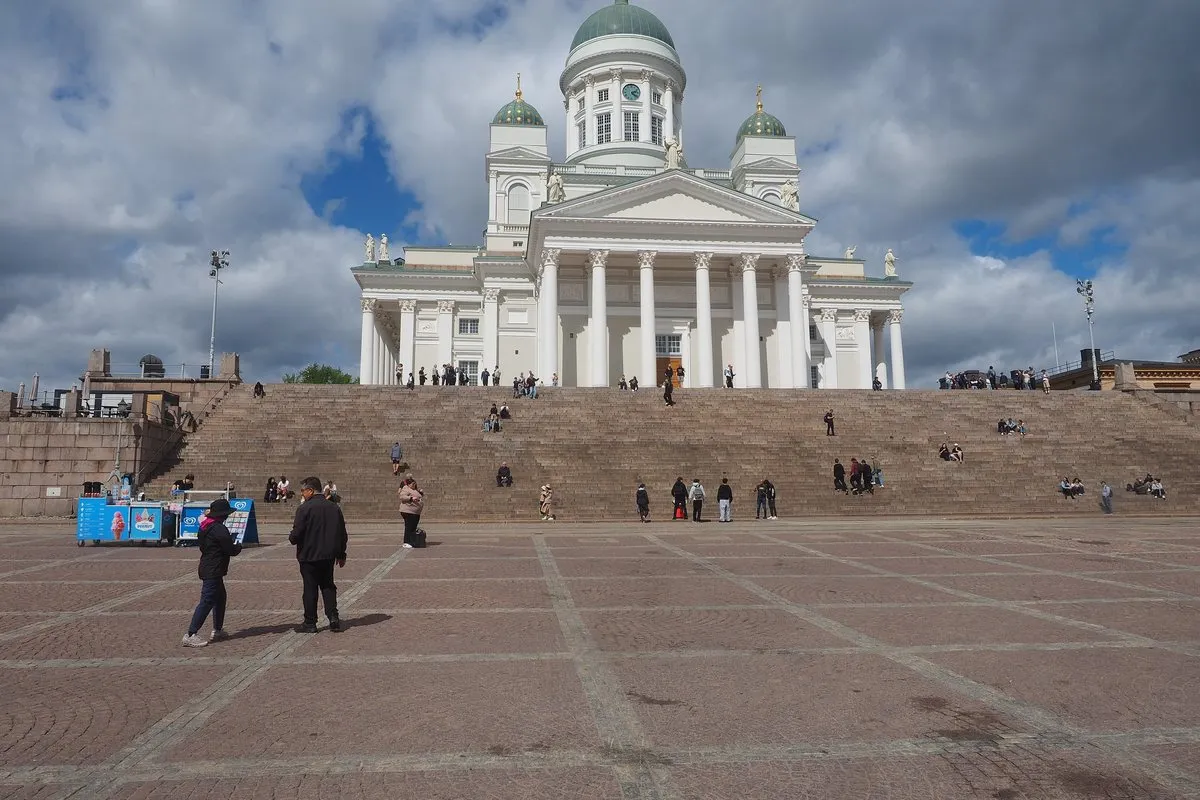
When Helsinki became Finland's capital in 1812, under Russian rule, the architect Carl Ludvig Engel was commissioned to give the city a monumental centre. The crowning feature of his Senate Square is the cathedral, built in 1830–1852 as a tribute to Tsar Nicholas I and known as St Nicholas' Church until independence in 1917. It is neoclassical, with a tall green dome surrounded by four smaller ones, and is laid out as a Greek cross with a colonnade and pediment on every side. Its nickname is the White Church, but the facade is in fact painted in three almost identical shades of pale grey. The interior has a Lutheran austerity, with room for around 1,300 people and statues of Luther, Melanchthon and the Finnish reformer Mikael Agricola.
02Late morning: Esplanadi and Market Square
Walk down to Esplanadi, the strip of park between Erottaja and Market Square, with Pohjoisesplanadi and Eteläesplanadi on either side. In the middle stands the statue of the national poet Johan Ludvig Runeberg, made by his son Walter Runeberg. Engel's first theatre building in the city, the forerunner of Svenska Teatern, went up in a corner of the park in 1827. On the north side is Hotel Kämp, founded in 1887 as Finland's first luxury hotel, closed in 1967 and reopened in 1999 behind a reconstructed facade. Stockmann and the restaurants Savoy and Olo are also on the edges of the park.
03Midday: Suomenlinna
From Market Square the ferry runs to Suomenlinna – Sveaborg in Swedish – a sea fortress on eight islands, six of them fortified, south-east of the centre. Building began in 1748 under the Swedish crown as a defence against Russia, led by Admiral Augustin Ehrensvärd and following Vauban's principles for star forts, adapted to a cluster of rocky islands. Despite its reputation as the "Gibraltar of the North", the fortress surrendered after a two-month siege on 3 May 1808, paving the way for Russia's conquest of Finland in 1809.
In 1918 the fortress was given the Finnish name Suomenlinna, Finland's Castle. It remained under military control until 1973 and has been a World Heritage Site since 1991. Five of the islands are linked by bridges or a sandbank, so you can walk between the bastions. People still live on the islands.
04Afternoon: Oodi and Amos Rex
Back on the mainland, head for Töölönlahti bay and Oodi, the central library, next to the Music Centre and Kiasma. ALA Architects won the competition in 2012 against 543 other entries, and the library opened in December 2018 as a gift marking the centenary of Finland's independence. It is more than a library – with studios for recording, film and games, a cinema and a large balcony – and in 2025 it had more than 2.7 million visits and around 1,200 free events. In 2019 Time named it one of the World's Greatest Places.
A stone's throw away, beneath the square by the Glass Palace on Mannerheimintie, is Amos Rex, a private museum of contemporary art and media installations that opened in 2018 and draws around 250,000 visitors a year. It has its roots in the Konstsamfundet foundation, set up by the publisher Amos Anderson in 1940.
05Late afternoon: the Rock Church
In Töölö stands the Temppeliaukio Church, designed by the brothers Timo and Tuomo Suomalainen and consecrated in 1969. Instead of building a church on top of the rock, the architects blasted the church space out of the granite and left much of the rock face intact. The space is covered by a copper-clad dome ringed by a wide band of skylights. The church has around 750 seats, is used for services and, thanks to its acoustics, for concerts, and welcomed a record 938,000 visitors in 2019.
06Evening: a sauna by the harbour
A day in Helsinki ends in the sauna. Allas Sea Pool on Katajanokka, next to Market Square, opened in September 2016 with three pools built out over the sea – one for children, one heated and one filled with seawater – plus saunas and a café. Its roof terrace, with 1,500 places, is the largest in the city, with views of the cathedral, the harbour and the ferries. The pool is designed to stay open all year round.
More Nordic destinations can be found among Metro Mode's destinations. Also read how Copenhagen became one of the world's great food cities, take the Stockholm archipelago by boat and book a table among Stockholm's Michelin restaurants.