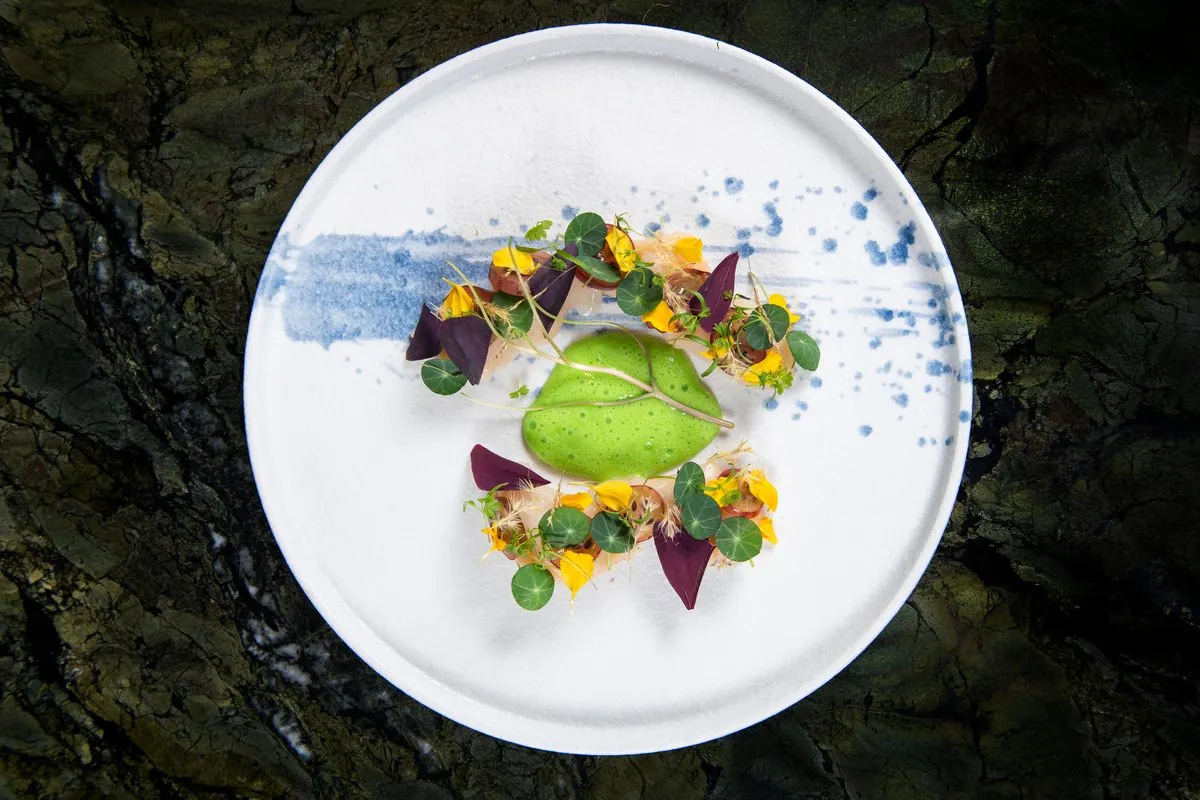
Twenty years ago, to the outside world Nordic food meant herring and potatoes. Then twelve chefs wrote a manifesto in Copenhagen, a warehouse by the harbour became the world's best restaurant and the city earned the Nordic region's first three Michelin stars. The story of the New Nordic cuisine – and where it stands today.
In this story · 6 sections
Copenhagen is today one of the cities mentioned most often whenever the world's restaurant scene is discussed, and it has happened fast. The New Nordic cuisine – a culinary movement that has developed in the Nordic countries since the mid-2000s – is built on local, natural, seasonal ingredients, old techniques such as marinating, smoking and salting, and a pursuit of what its founders called purity, simplicity and freshness. It has left its mark both on the city's restaurants and on how Danes cook at home.
01The 2004 manifesto
In November 2004 the chefs René Redzepi and Claus Meyer called a meeting in Copenhagen with chefs and food people from across the Nordic region. Twelve chefs signed a manifesto for the New Nordic cuisine, based on Meyer's draft: local agriculture, the region's farming traditions, environmentally friendly production, and food with a clear Nordic identity among the world's great cuisines. The following year the Nordic Council of Ministers' agriculture and food ministers backed the movement with the New Nordic Food programme, which received €3 million in 2006.
Claus Meyer, entrepreneur and TV chef with the programme Meyers Køkken on DR1 from 1991 to 1998, is often named as the founder of the philosophy, but the movement was collective from the start. In Sweden, Magnus Nilsson has carried it forward with his work documenting and reviving traditional cooking across the Nordic region.
02Noma – the warehouse at Grønlandske Handels Plads
Noma – a contraction of nordisk mad, Nordic food – opened in 2003 in an 18th-century warehouse at Strandgade 93 in Christianshavn, when the building became the cultural centre Nordatlantens Brygge. For two centuries fish, herring, whale oil and hides from Greenland, Iceland, the Faroe Islands and Finnmark had been stored here. The restaurant became the laboratory for the manifesto's ideas, with wild ingredients, fermentation and drying, and was named the world's best restaurant by Restaurant Magazine in 2010, 2011, 2012, 2014 and 2021.
In 2018 Noma moved to Refshalevej 96. In January 2023 Redzepi announced that the restaurant would leave the traditional restaurant format; the last period of regular dinners was a ten-week season in Kyoto that ended on 18 December 2024. Noma continues as a food laboratory with temporary residencies. In March 2026 The New York Times published an investigation in which former employees accused Redzepi of abusing staff, and that same month he stepped down from his leading role.
03Geranium – three stars in a football stadium
Rasmus Kofoed has won bronze, silver and gold at the Bocuse d'Or – bronze in 2005, silver in 2007 and gold in 2011. He opened Geranium with Søren Ledet in Kongens Have in 2007 and earned a star in 2008, but was forced to close when an investor went bankrupt. In 2010 the restaurant reopened on one of the office floors of the Parken football stadium in Østerbro. On 24 February 2016 Geranium became the first Danish restaurant to receive three Michelin stars – at the same time as Maaemo in Oslo, making them the first in the Nordic region. In 2022 Geranium was named the world's best restaurant by The World's 50 Best Restaurants.
04Alchemist – the meal as theatre
Not everyone followed the manifesto. Rasmus Munk opened Alchemist in 2015 with fifteen seats and a menu of 45 dishes that mixed art, science and social issues. In 2019 the restaurant moved into 2,200 square metres in the Royal Danish Theatre's former scenery workshop on Refshaleøen, where the main dining room is a planetarium dome with no daylight. Seven months after opening it received two Michelin stars, and on The World's 50 Best Restaurants it placed eighth in 2024 and fifth in 2025.
05Kong Hans Kælder – where it all began
The New Nordic cuisine did not come out of nowhere. Kong Hans Kælder, in a whitewashed medieval vault beneath one of Copenhagen's oldest buildings just off Kongens Nytorv, opened in 1976 as the city's first French-inspired gourmet restaurant and won Copenhagen's first Michelin star in 1983. Redzepi worked here before Noma. The restaurant received its second star in September 2021 and today serves classic French cuisine with Nordic touches.
06Booking a table in Copenhagen
The most talked-about restaurants are booked well in advance, directly with the restaurant, and the menus follow the seasons. The Guide Michelin's current selection and The World's 50 Best Restaurants list are updated every year and are the surest way to see which kitchens are at the top right now. The manifesto's ideas can also be seen far beyond the starred kitchens – in bakeries, wine bars and on the home stove.
More Nordic destinations can be found among Metro Mode's destinations. Across the water in Sweden, read our guide to Stockholm's Michelin restaurants and our stay at Ett Hem, the villa in Lärkstaden.