In this story · 5 sections
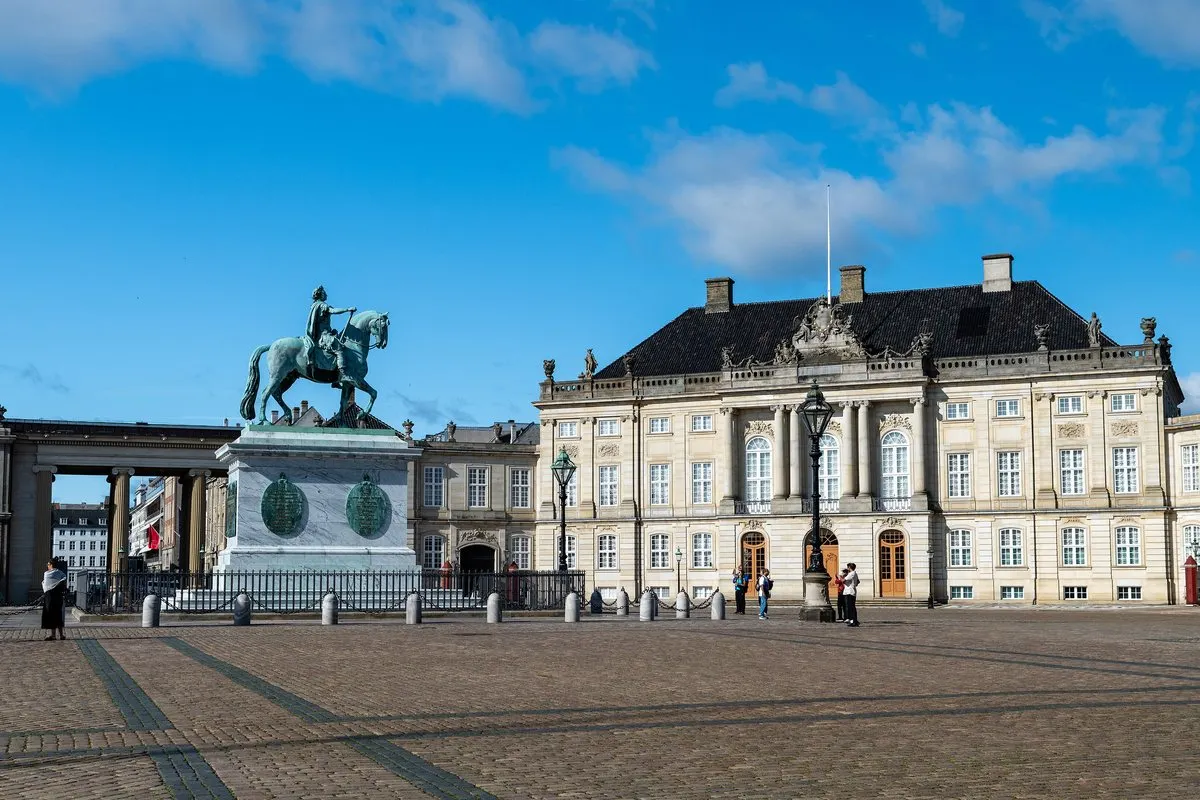
Amalienborg is the home of the Danish royal family in Copenhagen: four palaces with identical classical façades and Rococo interiors, set around an octagonal square with an equestrian statue of Frederick V at its centre. The palaces lie at the heart of Frederiksstaden, the 18th-century district, on an axis that runs from the Marble Church to the Opera House on the far side of the harbour.
Amalienborg
Palace · Frederiksstaden
- Address
- Amalienborg Slotsplads, Copenhagen
- Built
- 1750–1760
- Architect
- Nicolai Eigtved
- Christian VII's Palace
- Guests, receptions and ceremonies
- Christian VIII's Palace
- Royal apartments
- Frederik VIII's Palace
- King Frederik X and Queen Mary
- Christian IX's Palace
- Queen Margrethe II
Four Rococo palaces around an octagonal square; changing of the guard at noon.
01Frederiksstaden – a planned royal district
Frederiksstaden was launched by Frederick V to mark the 300th anniversary of the House of Oldenburg on the Danish throne. The royal architect Nicolai Eigtved designed the four palaces of Amalienborg, built between 1750 and 1760 for four distinguished noble families from the royal circle. Frederiksgade aligns the square with Frederik's Church, known as the Marble Church, and with the Copenhagen Opera House across the harbour, built in 2001–04.
02From noble mansions to royal palaces
When Christiansborg Palace burned in 1794, the royal family bought the four mansions; they moved into the first, Christian VII's Palace, in December 1794. Today Frederik VIII's Palace is the home of King Frederik X and Queen Mary, and Christian IX's Palace has been the home of Queen Margrethe II since 1967. Christian VII's Palace has been used since 1885 for guests, receptions and ceremonies and is open to the public at times, and Christian VIII's Palace contains apartments for members of the royal family.
03The Frederick V statue and the changing of the guard
The equestrian statue of Frederick V in the middle of the square is by the French sculptor Jacques Saly; work began in 1753 and it was unveiled in 1771, five years after the king's death. Every day the Royal Life Guards march from Rosenborg Castle at 11.30 and change the guard at Amalienborg at noon.
04Amaliehaven and the harbour
Between the palaces and the harbour lies Amaliehaven, a garden given in 1983 by the A.P. Møller and Chastine McKinney Møller Foundation, designed by the Belgian architect Jean Delogne with a fountain by Arnaldo Pomodoro.
05How to visit Amalienborg
Arrive before noon for the changing of the guard, then walk up Frederiksgade to the Marble Church and down through Amaliehaven to the harbour, facing the Opera House. Read Metro Mode's Copenhagen guide (in Swedish), browse Metro Mode Travel, and find more city guides among metromode.co's destinations.