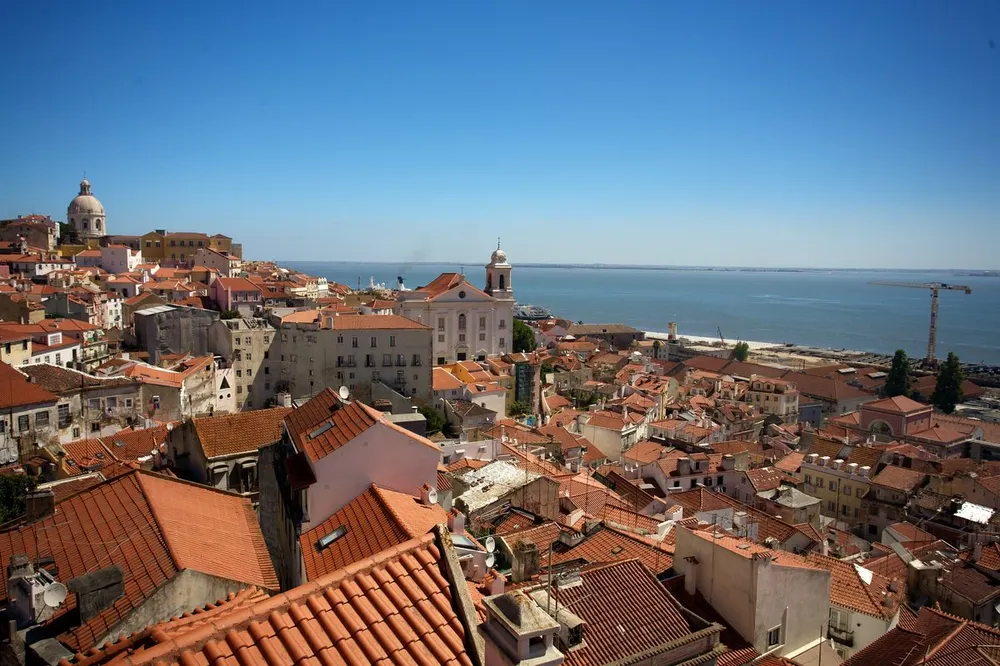
After the earthquake of 1755, Lisbon rebuilt its centre on a rational grid opening onto the river. Above it, Chiado became the city's literary and fashionable quarter. A walk from Praça do Comércio through the Baixa and up to the cafés of Chiado.
In this story · 5 sections
On the morning of 1 November 1755 an earthquake, followed by a tsunami and fires, destroyed much of Lisbon. What rose in its place in the low-lying centre was one of the most rational cities of the Enlightenment: the Baixa Pombalina, a grid of straight streets between the river and the Rossio. On the hill to the west, the Chiado became the meeting place of writers, the address of the smartest shops and the home of Lisbon's café society. Walking from one to the other is the best introduction to the city's heart.
Praça do Comércio
Square · Baixa
© OpenStreetMap contributors · OpenFreeMap
- Address
- Praça do Comércio, 1100-148 Lisboa
- Rebuilt
- After the earthquake of 1755, by the Marquis of Pombal
- Main square
- Praça do Comércio, about 175 × 175 m
- Chiado fire
- 25 August 1988; rebuilt by Álvaro Siza
- Bookshop
- Bertrand, opened 1747
- Cafés
- Martinho da Arcada, A Brasileira
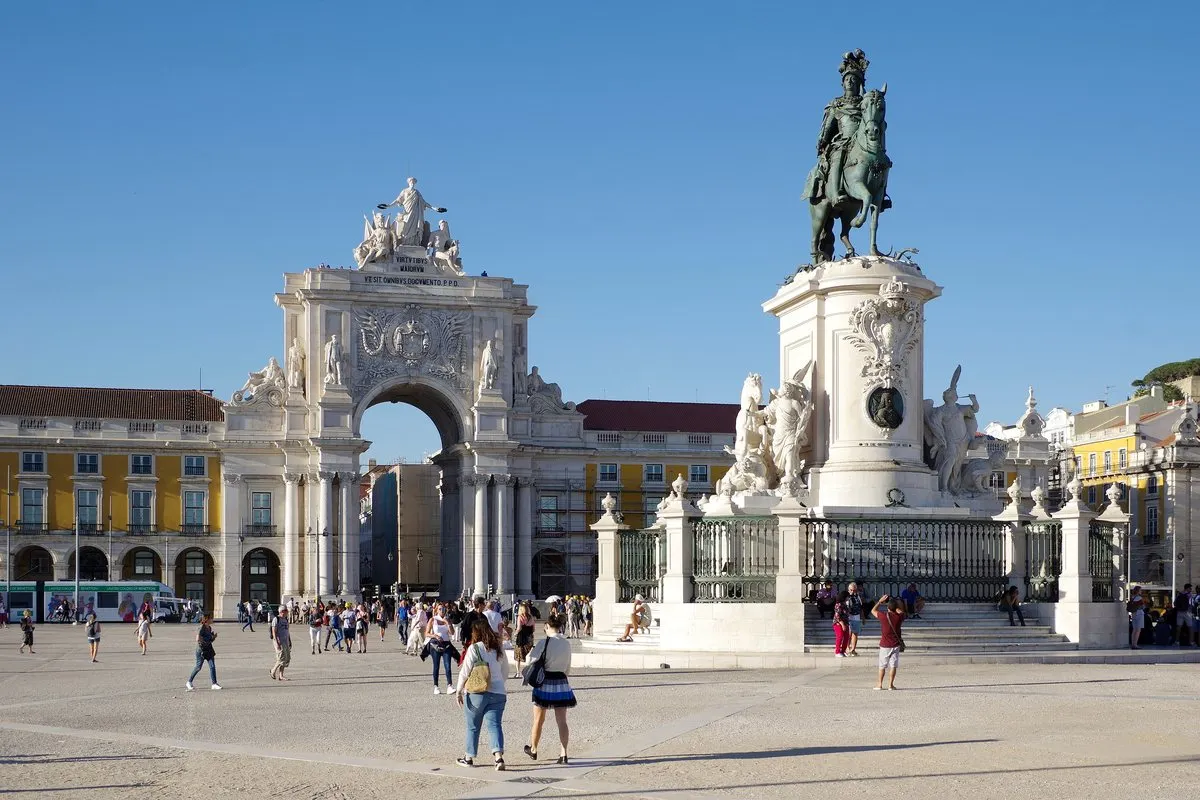
The former Palace Yard, rebuilt after 1755 with arcades on three sides, the statue of King José I and the Rua Augusta Arch.
01Praça do Comércio
Start by the water. The Praça do Comércio, still called Terreiro do Paço, the Palace Yard, by Lisboetas, is one of the largest squares in Portugal, about 175 metres on each side, open to the Tagus on its southern edge. The royal Ribeira Palace stood here until the earthquake. In its place the Marquis of Pombal, the king's chief minister, laid out a monumental square framed on three sides by arcaded yellow buildings, which have long housed government ministries.
At its centre rises the equestrian statue of King José I, and on the northern side the triumphal Rua Augusta Arch leads into the Baixa. A lift inside the arch takes you to a terrace at the top with a view along the grid and over the river. Under the arcades, the Martinho da Arcada café, open since the eighteenth century, was a favourite of the poet Fernando Pessoa.
02The Pombaline grid
Walk north up the pedestrianised Rua Augusta. The Baixa is named after Pombal, who imposed strict rules on the rebuilding. It is one of the earliest examples of earthquake-resistant construction: buildings were framed with the gaiola pombalina, a symmetrical wooden lattice designed to absorb tremors, and models are said to have been tested by having troops march around them. The fire walls between buildings rise above the roofs to stop flames spreading. The streets still carry the names of the trades once assigned to them, the Rua do Ouro for goldsmiths, the Rua da Prata for silversmiths.
Insider tipGo up the Rua Augusta Arch for the view along the Baixa.
At the top lies the Rossio, the city's great square since the Middle Ages, with its wave-patterned pavement. From the Baixa, the Santa Justa Lift, an iron elevator in neo-Gothic dress, carries passengers up to the Carmo district on the hill above.
03Carmo and the ruins
The lift's upper landing connects to the Terraços do Carmo, a series of terraces completed in 2015 as the last element of Álvaro Siza's reconstruction of the area. Beside them stand the ruins of the Carmo Convent, its Gothic arches open to the sky since the earthquake, now an archaeological museum and one of the most evocative sights in the city.
04Chiado: fire and renewal
In the early hours of 25 August 1988 a fire broke out at the Grandella department store on Rua do Carmo and spread through eighteen buildings, destroying historic shops and two department stores. It was the worst disaster to strike the city since the earthquake. The following year the architect Álvaro Siza Vieira, later a Pritzker Prize winner, was asked to lead the reconstruction. He kept the façades and character of the old streets while reorganising what lay behind, and Chiado recovered to become one of the most desirable districts in Portugal.
05Bookshops and cafés of Rua Garrett
Chiado's main street, Rua Garrett, is lined with old shopfronts. The Bertrand bookshop opened in 1747 and claims to be the oldest operating bookshop in the world. Nearby, the Art Nouveau café A Brasileira has a bronze statue of Fernando Pessoa seated at a table outside. The district's theatres, the São Carlos opera house and the national museum of contemporary art are all within a few minutes' walk, and the steep streets of the Bairro Alto rise just beyond.
For more of the city, read our Lisbon guide (in Swedish), find our guides to Alfama and Belém among the Metro Mode destinations, and browse our travel section in English.