From this stretch of the Tagus, Vasco da Gama sailed for India. Belém holds Lisbon's two UNESCO monuments, a monumental tribute to the navigators and the bakery that made the custard tart famous. A day by the river, in the right order.
In this story · 5 sections
In 1497 Vasco da Gama set sail from the shore at Belém on the voyage that opened the sea route to India. The riverside parish west of central Lisbon has been bound up with Portugal's maritime history ever since. Its monuments, built with the wealth of the spice trade in the exuberant Manueline style, are among the finest in the country, and together with a cluster of modern museums and one famous bakery they make for a full and rewarding day.
Mosteiro dos Jerónimos
Monastery · Belém
© OpenStreetMap contributors · OpenFreeMap
- Address
- Praça do Império, 1400-206 Lisboa
- UNESCO
- Jerónimos Monastery and Belém Tower, 1983
- Style
- Manueline, early 16th century
- Tombs
- Vasco da Gama and Luís de Camões
- Sweet stop
- Pastéis de Belém, since 1837
- Allow
- A full day
A sixteenth-century monastery funded by the spice trade, with the tombs of Vasco da Gama and Camões and a celebrated two-storey cloister.
01The Jerónimos Monastery
Start with the masterpiece. The Jerónimos Monastery was founded in the early 1500s for the Order of Saint Jerome, near the spot from which da Gama departed, and paid for by a tax on the profits of the annual India fleets. It is one of the most prominent examples of the late Gothic Manueline style: stone carved with ropes, armillary spheres, sea creatures and exotic plants, a celebration in limestone of an empire built on the sea.
The church is free to enter and contains, since 1880, the carved tombs of Vasco da Gama and of the poet Luís de Camões, whose epic The Lusiads celebrated the voyage, a few metres from the tombs of kings Manuel I and John III. The two-storey cloister, with its lace-like arcades, requires a ticket and is the highlight of the visit. Go early; the queue lengthens through the morning.
02Pastéis de Belém
A short walk east along the main street, the bakery known as Pastéis de Belém has sold its custard tarts since 1837. The recipe descends from the monks of the Jerónimos, who, like many religious houses, used egg whites to starch their habits and turned the leftover yolks into sweets. After the monasteries were dissolved in the 1830s, the recipe passed to the bakery, which still guards it. Every pastel de nata in the world descends from these. Eat them warm, with cinnamon and icing sugar, at a table in the tiled back rooms rather than queuing for takeaway.
Insider tipClosed on Mondays. The church is free; the cloister is ticketed.
03The Monument to the Discoveries
Cross under the road to the riverfront and the Padrão dos Descobrimentos, a great stone prow carved with the figures of Henry the Navigator and the explorers, cartographers and missionaries of the age. It was inaugurated in 1960, five hundred years after Prince Henry's death. Take the lift to the top for a view over the river, the 25 de Abril bridge and the vast compass rose and world map inlaid in the pavement below.
04The Belém Tower
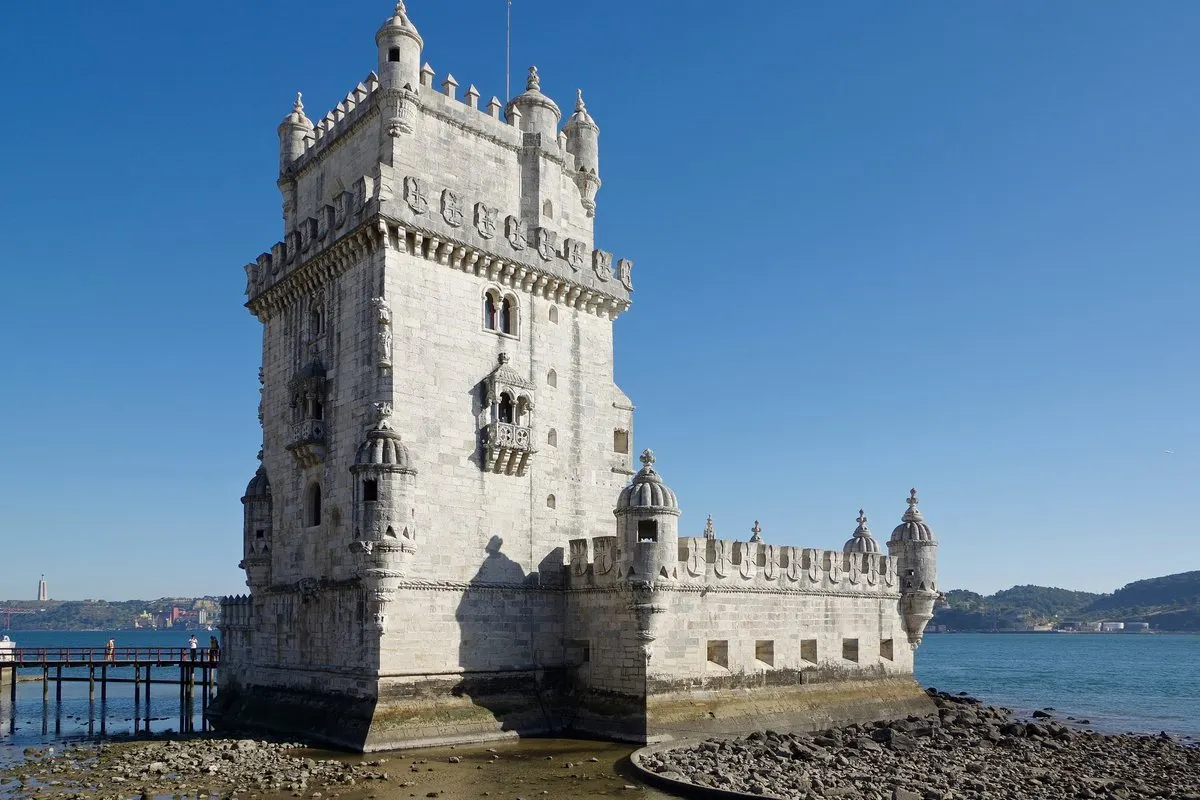
Walk west along the river to the Belém Tower, the symbol of Lisbon. Built in the sixteenth century of local lioz limestone, it served as a fortress, a ceremonial gateway to the city and a point of embarkation for explorers. It combines a bastion with a four-storey tower 30 metres high, decorated with Manueline rope-work, shields and Moorish-inspired watchtowers. It was built on a small island near the shore, not in the middle of the river as is sometimes claimed. Even if you do not climb its narrow stairs, it is best seen from the water's edge in the late afternoon.
05Modern Belém: MAAT and the Coach Museum
Belém is not only about the past. A little to the east, MAAT, the Museum of Art, Architecture and Technology, occupies a sinuous building by Amanda Levete beside an old power station, and you can walk over its curving roof for a view of the river. The National Coach Museum displays an extraordinary collection of royal carriages, and the Centro Cultural de Belém hosts exhibitions and concerts.
For the rest of the city, read our Lisbon guide (in Swedish), find our guides to Alfama and the Baixa among the Metro Mode destinations, and browse our travel section in English.