In this story · 4 sections
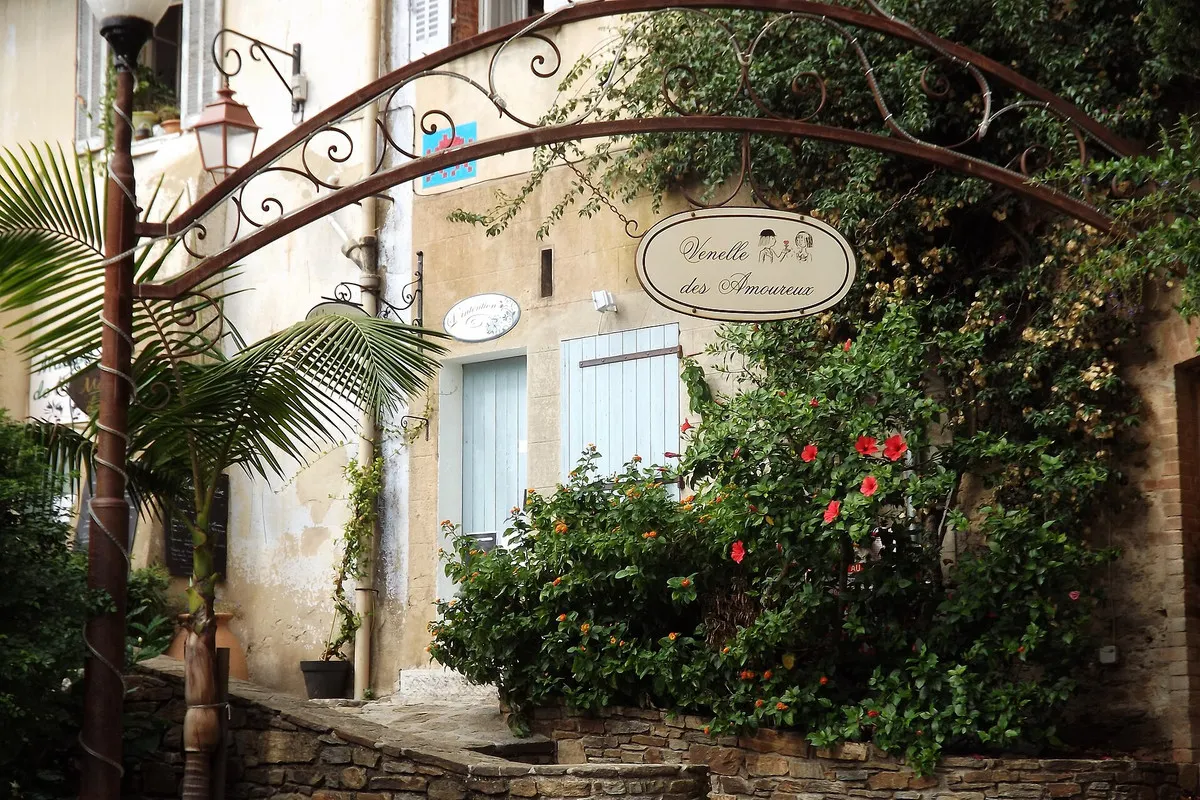
Bormes-les-Mimosas lies at the southern tip of the Massif des Maures, its territory running from the mountain crests down to Cap Bénat, which points out to sea towards the Hyères islands. The old village clings to a south-facing hillside at 154 metres, below the ruins of its castle. It is often likened to a Provençal nativity scene: old houses under rose-coloured tiles, flower-hung lanes, ramparts and a panorama over the plain to the Îles d'Or.
Until 1913 neighbouring Le Lavandou was its fishing quarter. Today the two form a single small urban area, with Bormes as its centre.
4 places
© OpenStreetMap contributors · OpenFreeMap
- 01Église Saint-Trophymesee · Vieux village
- 02Chapelle Saint-François-de-Paulesee · Vieux village
- 03Parc du Cigalousee · Vieux village
- 04Fort de Brégançonsee · Brégançon
- Chapelle Notre-Dame de Constance
- 1926
- Castle ruins of the lords of Fos
- 1931
- Chapelle Saint-François-de-Paule
- 1963
- Fort de Brégançon and its islet
- 1968
- Église Saint-Trophyme
- 1973
Why the mimosa
The commune was renamed Bormes-les-Mimosas on 15 February 1968 because of the many mimosa trees growing on its land. Botanists will note that the fluffy yellow pompoms are Acacia dealbata, not the true Mimosa. Whatever the name, the village celebrates them with a Corso fleuri, a parade of flower floats, in February when the trees are in bloom, and with Mimosalia, a weekend of rare plants and gardens at the end of January.
Ligurians, Saracens and the lords of Fos
Around 400 BC a Ligurian tribe from Italy, the Bormani, settled on the coast near Cabasson and lived by fishing and trading salt, iron and lead. In the ninth century, harried by Saracen pirates, the people moved up into the hills. From the 13th century until the Revolution the village was ruled by five dynasties of lords, the most powerful being the lords of Fos, whose castle ruins crown the old village.
The name itself is older still: Bormes is thought to come from Bormo, a Gaulish healing god of hot springs. Bormes was liberated on 17 August 1944, after the Provence landings between Le Lavandou and Saint-Raphaël.
Walking the old village
Climb through the Rue de l'Horloge, the Rue des Contours and the Montée des Écureuils to the ruins of the castle of the lords of Fos, listed since 1931. The church of Saint-Trophyme has been listed since 1973. The Chapelle Saint-François-de-Paule was built in 1560 in honour of the Calabrian hermit Francesco of Paola, said to have delivered the village from plague in 1481 on his way to the deathbed of Louis XI; the painter Jean-Charles Cazin is buried in its cemetery. Higher still, the Chapelle Notre-Dame de Constance crowns the hill above the village.
Brégançon and the beaches
On its islet off the coast stands the Fort de Brégançon, a state residence used as the official holiday home of the President of the French Republic, mostly in summer. It has been classified, together with its rock, since 1968; it is not to be confused with the nearby Château de Brégançon wine estate.
Down on the coast, the Favière quarter has a marina, and beyond it stretch the beaches of La Favière, Cabasson, L'Estagnol and Pellegrin. Garden lovers should look for the Parc du Cigalou and the Parc Gonzalez, an Australian botanical garden. The 17th-century Château de Léoube, owned by the British businessman Anthony Bamford, is also in the commune.
Église Saint-Trophyme
The village church, listed in 1973
The parish church at the heart of the old village.
Montée du Docteur-Berenguier, 83230 Bormes-les-Mimosas
Insider tipStart your walk up to the castle ruins here.
Chapelle Saint-François-de-Paule
The plague chapel of 1560
Built for the hermit said to have saved the village from plague in 1481.
Place Saint-François, 83230 Bormes-les-Mimosas
Insider tipThe painter Jean-Charles Cazin is buried beside it.
Parc du Cigalou
Botanical garden in the village
A garden that hosts the Mimosalia plant fair in late January.
Parc du Cigalou, 83230 Bormes-les-Mimosas
Insider tipCombine with the walk through the lanes.
Fort de Brégançon
The president's summer fort
A state residence on its islet, classified as a historic monument in 1968.
Sentier littoral, 83230 Bormes-les-Mimosas
Insider tipSeen from the coast; access is restricted.
Neighbourhood and property data for Bormes-les-Mimosas and Hyères is on VERA PI, and more coast stories are on metromode.co.