Behind the Jesuit palace that holds Milan's great picture gallery lie a botanical garden from 1774, an observatory and a library founded by Maria Theresa. Around it, the lanes of Brera keep the scale of the old artists' quarter.
In this story · 5 sections
Brera takes its name from braida, a word for open, uncultivated ground at the edge of the medieval city. The quarter grew around a single building, the Palazzo di Brera: a monastery of the Humiliati that became a Jesuit college in 1572 and was rebuilt to designs by Francesco Maria Richini, with work starting in 1627, halted by the plague of 1630 and resumed only in 1651. When the Jesuits were suppressed in 1773, Maria Theresa of Austria turned the palace into a house of learning. A library, a botanical garden and an Academy of Fine Arts joined the observatory already there, and the artists drawn to the academy made the streets around it one of the most characteristic corners of Milan.
Most visitors come for the paintings, and they are right to. But the palace and the lanes around it reward a slower day: a courtyard, a garden, an observatory, a modern wing and a market that fills one street once a month.
Pinacoteca di Brera
Art museum · Brera, Milan
© OpenStreetMap contributors · OpenFreeMap
- Address
- Via Brera 28, 20121 Milano
- Opened
- 15 August 1809
- Building
- Palazzo di Brera, rebuilt to designs by Francesco Maria Richini from 1627
- Courtyard
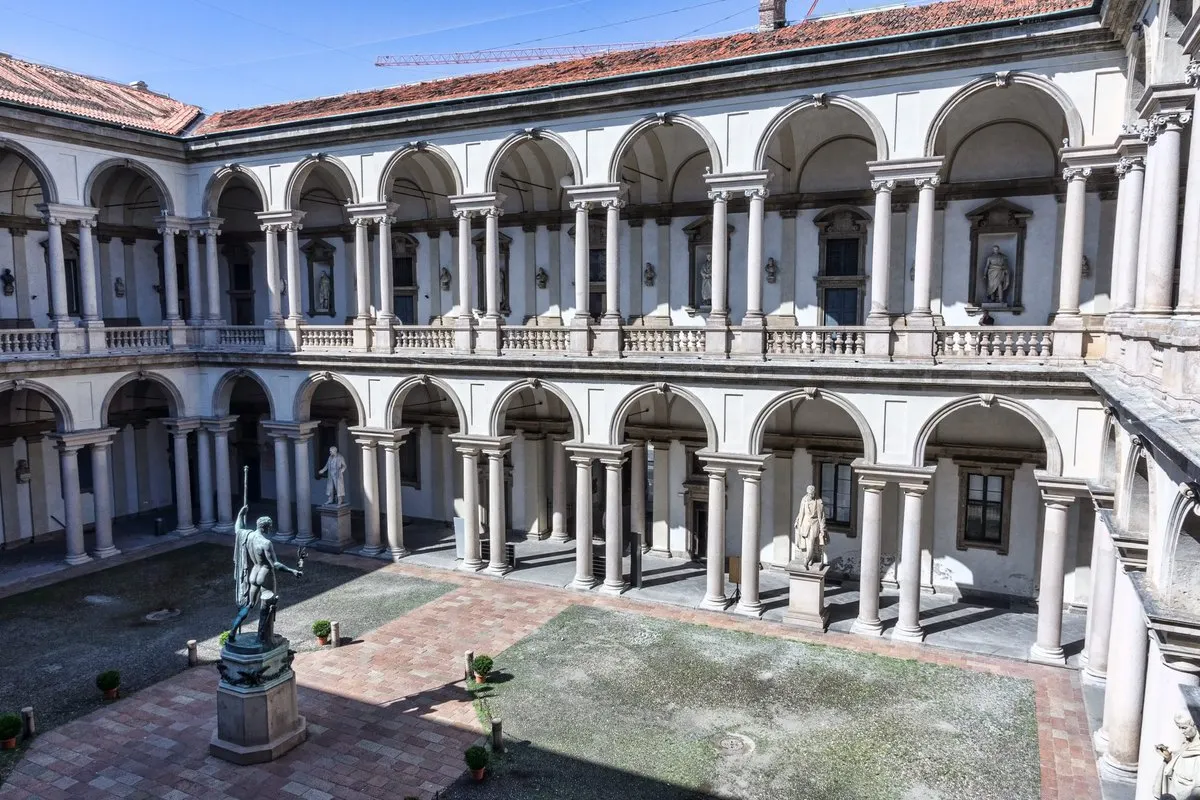
- Canova's Napoleon as Mars the Peacemaker, bronze cast 1811, placed 1859
- Modern wing
- Palazzo Citterio, opened 8 December 2024
- Neighbours
- Observatory (1764), Biblioteca Braidense (1773), botanical garden (1774), Academy of Fine Arts (1776)
Italian painting from the thirteenth to the twentieth century – Mantegna, Piero, Raphael, Caravaggio, Hayez – with Canova's bronze Napoleon in the courtyard, the botanical garden behind and Palazzo Citterio down the street.
01The courtyard and Napoleon
Go in through Giuseppe Piermarini's entrance on Via Brera, completed in 1780, and you arrive in Richini's courtyard, two storeys of arcades on paired columns. At its centre stands Napoleon as Mars the Peacemaker, a bronze copy of Antonio Canova's statue, cast in Rome in 1811 by Francesco Righetti and his son Luigi and placed here in 1859. The emperor is naked but for a cloak, a figure of victory in his hand; the stairs to the gallery rise behind him.
02The Pinacoteca
The picture gallery began as a teaching collection for the academy and grew in the Napoleonic years, when paintings from churches and convents across northern Italy were brought to Milan. The Reale Pinacoteca opened on 15 August 1809, Napoleon's birthday, in halls made from the nave of the deconsecrated church of Santa Maria in Brera, and became independent of the academy in 1882. The key painting of the early collection was Raphael's Marriage of the Virgin, and it is still a reason to come.
Insider tipCome on a weekday morning, and leave time for the botanical garden behind the palace.
So is Mantegna's Lamentation over the Dead Christ, the body seen from the soles of the feet, foreshortened with an almost brutal directness. Piero della Francesca's Holy Conversation hangs an egg from the shell of its apse above the Virgin, and Bramante, better known as an architect, is represented by his Christ at the Column. Caravaggio's Supper at Emmaus of 1606 is darker and quieter than his earlier London version. And towards the end comes Francesco Hayez's The Kiss of 1859, painted by the academy's leading Romantic; his statue stands in the little piazza outside.
03Palazzo Citterio and the twentieth century
Further down Via Brera, at numbers 12 and 14, Palazzo Citterio opened on 8 December 2024 as the gallery's modern wing, completing the long-planned Grande Brera. The renovation is by Mario Cucinella. Two collections share the building, the Jesi collection of twentieth-century art and the wider-ranging Vitali collection, more than 200 works between them, with Boccioni, Carrà, Morandi, Modigliani, Picasso and Braque. Pellizza da Volpedo's La Fiumana, the large painting of a crowd advancing, hangs where the two routes begin.
04Behind the palace: a garden, the stars, the books
The Orto Botanico di Brera was laid out in 1774 by the abbot Fulgenzio Vitman for Maria Theresa, turning an old Jesuit garden into a teaching garden for students of medicine and pharmacy. It covers about 5,000 square metres of brick-edged beds and eighteenth-century oval ponds and is run today by the University of Milan. Its patriarchs are two Ginkgo biloba more than two and a half centuries old and a Caucasian walnut, now listed as monumental trees.
The observatory was founded in 1764 by the Jesuit astronomer Roger Boscovich; Giovanni Schiaparelli worked here for four decades, and Margherita Hack from 1954 to 1964. Its astronomers laid the meridian line in the Duomo in 1786. The Biblioteca Braidense, founded by Maria Theresa in 1773, is now joined with the Pinacoteca and Palazzo Citterio in the Grande Brera.
05The lanes
The quarter is bounded roughly by Via Pontaccio, Via Fatebenefratelli, Via dei Giardini, Via Monte di Pietà and Via Ponte Vetero, and its best streets are the narrow ones: Via Fiori Chiari and Via Fiori Oscuri, Via Madonnina, Via del Carmine, Via Ciovasso. On the third Sunday of every month an antiques market fills Via Fiori Chiari. At Via Brera 32 is the Bar Jamaica, opened in 1911, where writers, painters and photographers met in the 1950s and 1960s; Luciano Bianciardi described that Brera in his novel La vita agra. During design week the quarter becomes the Brera Design District, and its courtyards fill with installations.
At a glance
Ten paintings not to miss
| Painting | Artist | Date |
|---|---|---|
| Pietà | Giovanni Bellini | c. 1460 |
| Holy Conversation | Piero della Francesca | c. 1472–1474 |
| Lamentation over the Dead Christ | Andrea Mantegna | c. 1480 |
| Christ at the Column | Donato Bramante | c. 1490 |
| Madonna della Candeletta | Carlo Crivelli | c. 1490 |
| The Marriage of the Virgin | Raphael | 1504 |
| Finding of the Body of St Mark | Tintoretto | c. 1548 |
| Supper at Emmaus | Caravaggio | 1606 |
| Last Supper | Peter Paul Rubens | 1630–1631 |
| The Kiss | Francesco Hayez | 1859 |