Leonardo's Last Supper is seen in groups of up to 40, for 15 minutes at a time, and every ticket has to be booked. How the painting survived, what to look for in your quarter of an hour, and the vineyard across the road.
In this story · 6 sections
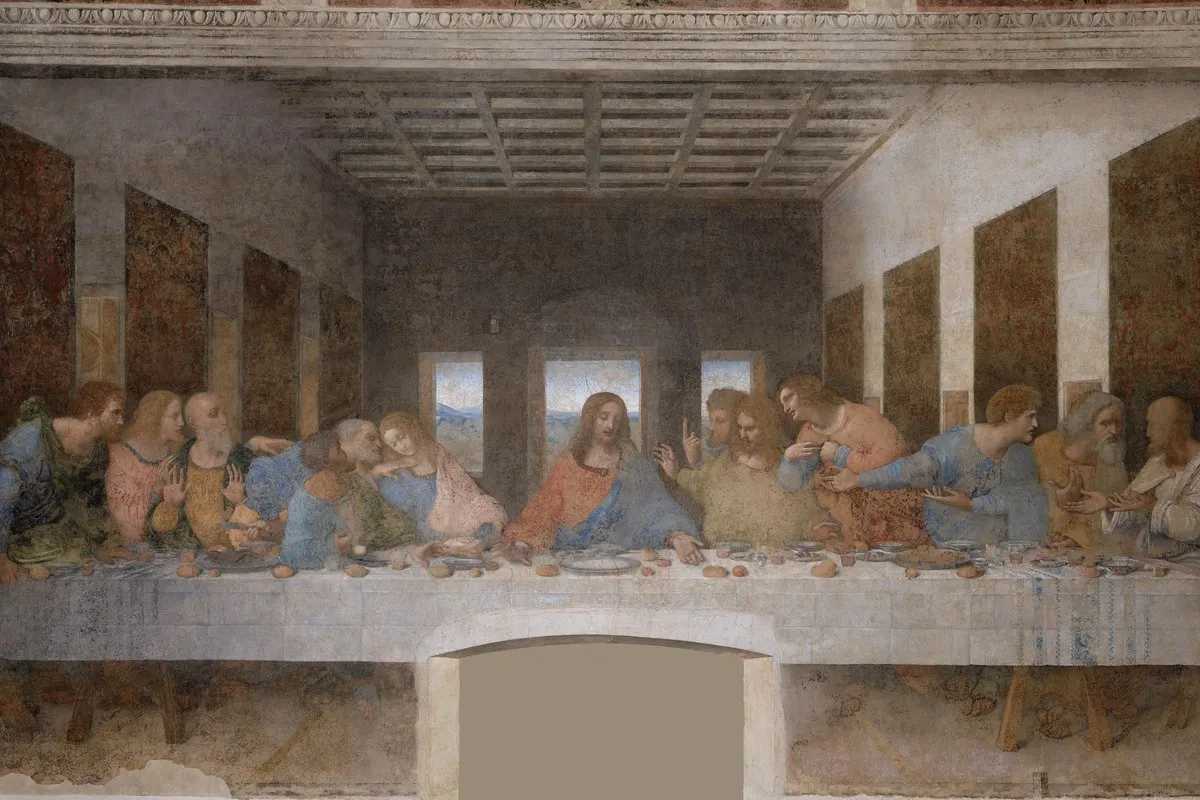
Leonardo da Vinci painted the Last Supper between about 1495 and 1498 on the end wall of the refectory of Santa Maria delle Grazie, the Dominican convent his patron Ludovico Sforza, Duke of Milan, intended to turn into a family mausoleum. It is 4.6 metres high and 8.8 metres wide, and it shows the moment, as told in the Gospel of John, just after Christ announces that one of the twelve will betray him. Few paintings have been copied, parodied and argued over more, and few have come so close to being lost.
You get fifteen minutes with it, so it pays to arrive knowing what you are looking at: why the surface looks the way it does, where to let your eye travel, and what hangs on the wall behind you.
Museo del Cenacolo Vinciano
Museum · Corso Magenta, Milan
© OpenStreetMap contributors · OpenFreeMap
- Address
- Piazza di Santa Maria delle Grazie 2, 20123 Milano
- Painted
- c. 1495–1498, by Leonardo da Vinci
- Commissioned by
- Ludovico Sforza, Duke of Milan
- Size
- 460 × 880 cm
- Technique
- Tempera on stone sealed with gesso, pitch and mastic
- Last restoration
- 1978–1999, led by Pinin Brambilla Barcilon
- Run by
- Pinacoteca di Brera, since December 2024
The convent refectory with Leonardo's Last Supper and Montorfano's Crucifixion facing it, beside Bramante's tribune and opposite Leonardo's vineyard. Timed visits of 15 minutes for up to 40 people.
01Why it is so fragile
Leonardo disliked fresco, which means painting quickly into wet plaster, one day's section at a time, with no going back. He wanted to work slowly, revise freely and get a deeper play of light and shade, so he painted in tempera on a stone wall sealed with gesso, pitch and mastic, over an undercoat of white lead. The paint never bonded properly to the damp, thin wall, and the decay began almost at once. By 1556 Giorgio Vasari described a "muddle of blots".
People made it worse. In 1652 a doorway was cut through the bottom of the wall; the bricked-up arch is still visible beneath the table, where early copies suggest Christ's feet once were. Eighteenth-century restorers repainted whole faces. In 1796 French troops used the refectory as an armoury and stable. On the night of 15 August 1943 an Allied bombing raid destroyed much of the room, but the wall with the painting, protected by sandbags, stayed standing.
02Twenty-one years of restoration
From 1978 to 1999 the restorer Pinin Brambilla Barcilon led the project that gave the painting its present appearance. Layers of earlier repainting were removed, infrared reflectoscopy, microscopic samples and Leonardo's own drawings in the Royal Collection at Windsor were used to establish what he had painted, and the areas that could not be recovered were toned in subdued watercolour so that they read as gaps rather than inventions. The refectory itself was sealed and climate-controlled, its windows bricked up. The painting returned to view on 28 May 1999, and the changes in colour and in some faces were controversial at the time. Since December 2024 the museum has been run by the Pinacoteca di Brera.
Insider tipBook as soon as your quarter opens; tickets are named and must be collected 30 minutes before your slot.
03What to look for in your quarter of an hour
Start with the geometry. Every line of the coffered ceiling and the walls runs to Christ's right cheek, the vanishing point of the whole composition, and his lowered gaze leads along his left arm to the bread. The apostles fall into four groups of three, each reacting differently: Thomas raises a finger, James the Greater throws up his arms, Philip seems to ask for an explanation.
Then find Judas. Rather than seating him alone on the far side of the table, as earlier painters did, Leonardo puts him among the others, leaning back into shadow, clutching a small bag, his elbow on the table and the salt cellar overturned beside him. Peter, angry, holds a knife; John leans towards him. The tablecloth is white with blue stripes. Above, the three lunettes carry the Sforza coats of arms.
Before your time is up, turn round. The opposite wall holds Giovanni Donato da Montorfano's Crucifixion of 1495, to which Leonardo added figures of the Sforza family in tempera. They have faded exactly as the Last Supper did, which shows how much the restoration had to work with.
04Getting a ticket
Every ticket, even a free one, has to be booked, and the museum releases them a quarter at a time. If your dates are sold out, keep checking: availability changes daily, and extra tickets for the following week go online every Wednesday at noon. Tickets carry the visitor's name, and you must collect yours at the office beside the entrance at least 30 minutes before your slot.
05The church and Bramante's tribune
Leave time for the church, a UNESCO World Heritage Site in its own right. Duke Francesco I Sforza founded the convent, and Guiniforte Solari's Gothic nave was finished by 1469. Ludovico Sforza then rebuilt the cloister and the east end as a Sforza burial church; the great domed tribune is traditionally attributed to Donato Bramante, and Ludovico's wife, Beatrice d'Este, was buried here in 1497. The Chapel of the Holy Crown is frescoed by Gaudenzio Ferrari; its Titian altarpiece was taken by French troops in 1797 and is now in the Louvre.
06Leonardo's vineyard, across the road
At Corso Magenta 65, almost opposite the church, stands the Casa degli Atellani, a fifteenth-century house that Ludovico gave to the Atellani family, his courtiers. In its garden lies the vineyard the duke gave to Leonardo. The architect Piero Portaluppi restored the house from 1919, and in 2015, the year of Milan's Expo, the vineyard was replanted with the original strain, identified with the University of Milan from root residues as Malvasia di Candia. The house has belonged to LVMH since December 2022. It makes a calm counterpoint to the timed rush across the street.
Fact file
When tickets go on sale
- September
- November, December, January
- December
- February, March, April
- March
- May, June, July
- June
- August, September, October
- Every Wednesday, 12.00
- Additional tickets for the following week, online only