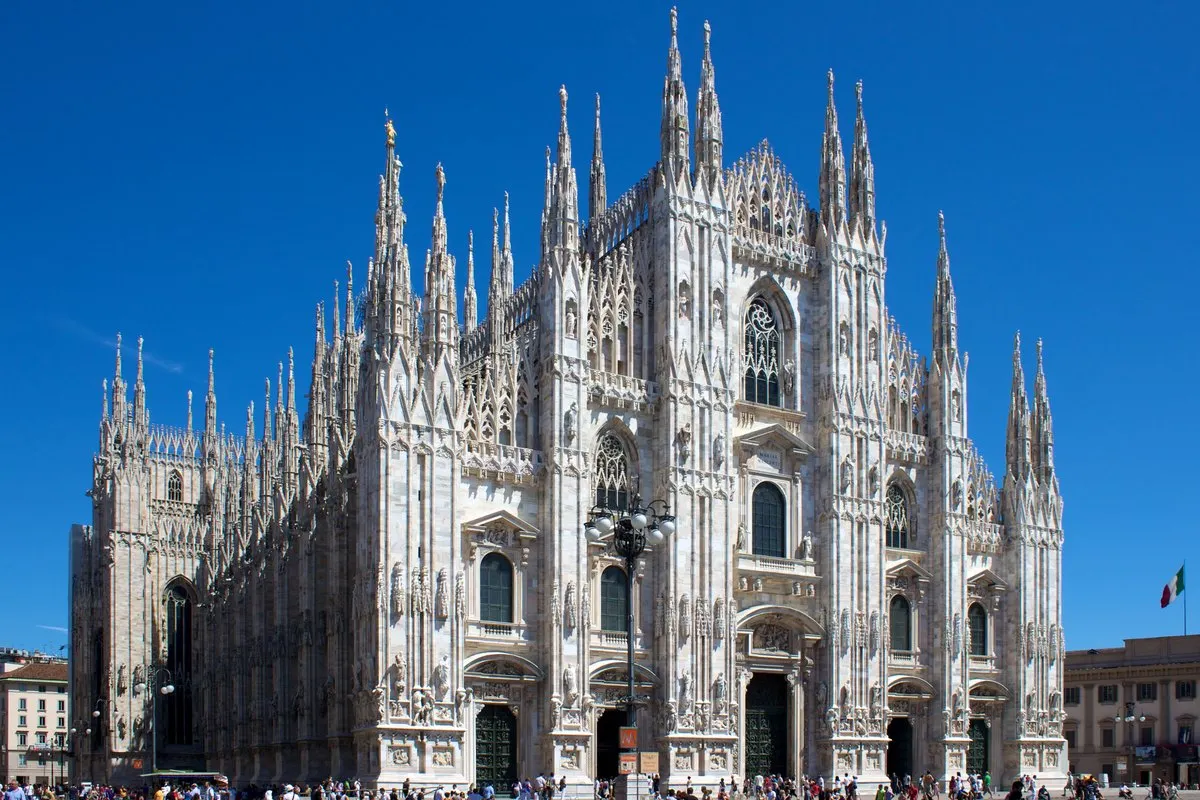
Milan Cathedral took nearly six centuries to finish, and the body founded to build it still looks after every stone. How to read the façade, what to find inside, and where to stand among the spires.
In this story · 6 sections
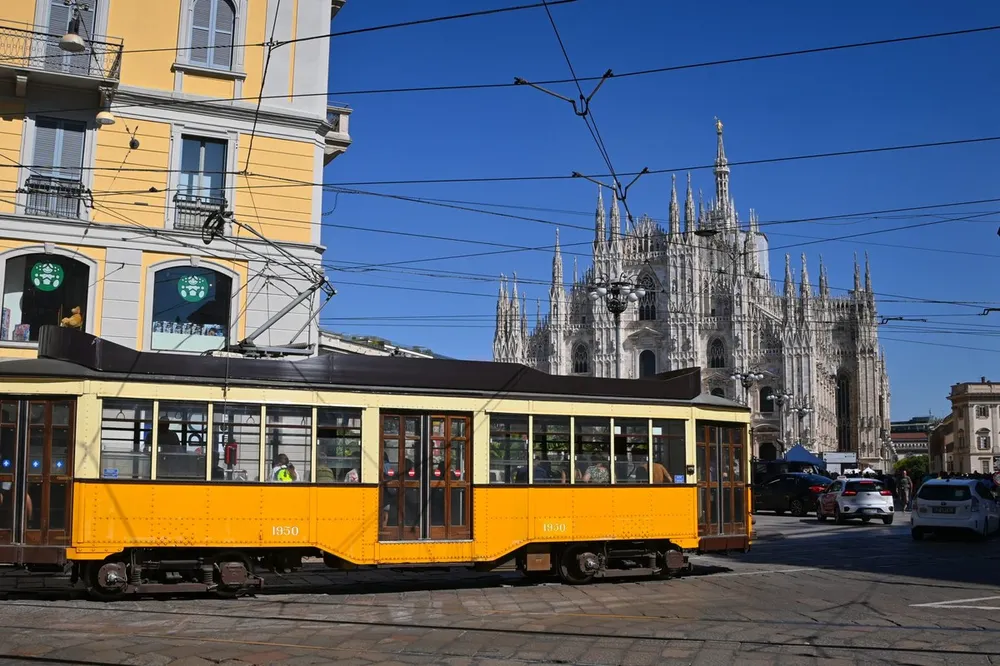
Milan's streets either radiate from the Duomo or circle it, and the plan is a clue to its age: the cathedral stands on the most central site of Roman Mediolanum, where the public basilica once faced the forum. Archbishop Antonio da Saluzzo began the present building in 1386, just as his cousin Gian Galeazzo Visconti took power, and the last portal was inaugurated on 6 January 1965. In between, the work stalled, restarted, changed style and changed masters dozens of times. The result is the largest church in the Italian Republic – a brick structure dressed entirely in marble.
Everyone sees the façade. This is about how to see the rest: what to look for inside, how to spend your time on the rooftops, and where the museum keeps the pieces that once stood a hundred metres up.
Duomo di Milano
Cathedral · Piazza del Duomo, Milan
© OpenStreetMap contributors · OpenFreeMap
- Address
- Piazza del Duomo, 20122 Milano
- Begun
- 1386, under Archbishop Antonio da Saluzzo
- Last portal
- Inaugurated 6 January 1965
- Height
- 108.5 metres to the Madonnina
- Statues and spires
- About 3,400 statues, 135 spires, 55 stained-glass windows
- Marble
- Candoglia, reserved for the cathedral since Gian Galeazzo Visconti
- Run by
- Veneranda Fabbrica del Duomo, since 1387
Milan's Gothic cathedral, begun in 1386 and completed in 1965, faced in Candoglia marble: St Bartholomew Flayed, the Trivulzio Candelabrum and the 1786 meridian line inside, terraces among 135 spires and the Madonnina above.
01A building site since 1387
The Veneranda Fabbrica del Duomo was set up in 1387 to run the construction, and it has never been wound up. It still maintains, restores and replaces the cathedral's stone, and one of Gian Galeazzo's gifts survives with it: exclusive use of the marble from the Candoglia quarry, which gives the building its pale, faintly pink colour. French engineers called in at the end of the fourteenth century pushed the design towards northern Gothic, and in 1488 both Leonardo da Vinci and Donato Bramante submitted models for the central cupola, although Leonardo later withdrew his.
The façade was the longest argument. Pellegrino Pellegrini drew a Roman-style front for Archbishop Carlo Borromeo in the 1570s; in 1649 Carlo Buzzi turned it back towards Gothic; designs by Filippo Juvarra and Luigi Vanvitelli were never built. In the end it took Napoleon, about to be crowned King of Italy, to order it finished in May 1805. It was done within seven years, and a statue of Napoleon was placed on one of the spires by way of thanks.
02What to find inside
Five broad naves are divided by 40 pillars, and the vault of the central nave rises to about 45 metres. To the left of the altar stands the cathedral's most famous statue, Marco d'Agrate's Saint Bartholomew Flayed of 1562, the martyr carrying his own skin over his shoulders like a stole. In the transept is the Trivulzio Candelabrum, whose base of vines and imaginary beasts dates from the twelfth century.
Insider tipBook the rooftops for late afternoon and leave large bags at the hotel.
Look down near the entrance for the brass meridian line laid in 1786 by astronomers from the Brera observatory. A beam of sunlight through a hole 24 metres up marked solar noon; the signal was relayed to the Castello Sforzesco, where a cannon was fired so the city could set its clocks. Look up above the apse for a small red light: it marks the place where a nail said to come from the Crucifixion is kept, brought down once a year in the Rite of the Nivola. Beneath the cathedral, the archaeological area holds the octagonal baptistery of San Giovanni alle Fonti, dating from the fourth century.
03On the rooftops
The terraces are the reason many people come, and they deserve the time. You walk on marble slabs between pinnacles and flying buttresses, close enough to see that every figure was carved as carefully as if it stood at eye level. The Fabbrica counts some 3,400 statues on the building and 135 spires. Mark Twain climbed up in 1867 and noted that the statues, which look like dolls from the street, turn out to be "the size of a large man".
04The Madonnina
Above them all is the Madonnina, a gilded copper Virgin designed by Giuseppe Perego, worked in beaten copper by the goldsmith Giuseppe Bini and fixed on top of the main spire on 30 December 1774. She is 4.16 metres tall and stands 108.5 metres above the piazza. Tradition holds that no building in Milan should stand higher, so when the Pirelli Tower, the Palazzo Lombardia and the Allianz Tower rose above her, each was crowned with a copy of the statue. The Milanese still call a day fine when the Madonnina can be seen from a distance.
05The Duomo Museum
Across the piazza, on the ground floor of the Palazzo Reale, the Museo del Duomo shows what has been taken down from the cathedral over six centuries: the Treasury, statues, stained glass, tapestries and architectural models, many of them pieces replaced after war damage. Perego's terracotta models for the Madonnina are here, and so is the statue's original iron frame, removed when she was restored in 1967. It is a quiet place to see at eye level the carving that sits, on the building, at dizzying heights.
06When to go
Book the rooftops for late afternoon, when the official tour among the spires starts at 17.00 and the marble warms in the low light. In November and December, around the feast of St Charles Borromeo, the large canvases known as the Quadroni hang along the nave, and on 4 November 2026, the Solemnity of St Charles, admission to the cathedral and the museum is free.
At a glance
Guided visits and prices
| Visit | What it includes | Price or hours |
|---|---|---|
| Duomo Tour Fast-Track | Cathedral, archaeological area and rooftops, 90 minutes | €35, reduced €23 |
| A Walk Among the Spires | Rooftops in English, 60 minutes, starting at 17.00 | €35, reduced from €12 |
| Museo del Duomo | Piazza del Duomo 12, in the Palazzo Reale | Daily except Wednesday, 10.00–19.00; last ticket 17.50 |