Capri is a limestone island of just over ten square kilometres in the Bay of Naples, where Emperor Tiberius ruled Rome and a Swedish doctor built Italy's most famous villa. The island has two towns, and they differ more than the distance would suggest.
In this story · 8 sections
Capri lies in the Tyrrhenian Sea at the entrance to the Bay of Naples, about five kilometres from the tip of the Sorrento Peninsula. The island covers 10.4 square kilometres, is made of limestone and sandstone, and its coastline is dominated by steep cliffs. It has been a destination since the days of the Roman Republic, and it has two municipalities: Capri, around the harbour and the eastern part of the island, and Anacapri, which lies on average about 150 metres higher up on the slopes of Monte Solaro. The prefix ana comes from Greek and means up.
The origin of the name is uncertain. It may come from the Greek kapros, wild boar – fossils of wild boar have been found on the island – or from the Latin capreae, goats.
8 places
© OpenStreetMap contributors · OpenFreeMap
- 01Piazzetta (Piazza Umberto I)Square · Capri
- 02Giardini di AugustoGarden and view · Capri
- 03Certosa di San GiacomoMonastery and museum · Capri
- 04Villa JovisRoman imperial villa · Monte Tiberio
- 05Belvedere di TragaraViewpoint · Punta Tragara
- 06Villa San MicheleVilla, museum and garden · Anacapri
- 07Chairlift to Monte SolaroChairlift · Anacapri
- 08Grotta AzzurraSea cave · Anacapri
- Area of the island
- 10.4 km²
- Highest point
- Monte Solaro, 589 m
- Villa Jovis
- 334 m above sea level, approximately 7,000 m²
- Scala Fenicia
- 921 steps, 1.7 km
- Villa San Michele
- 327 m above sea level
- Faraglioni
- 109, 82 and 106 metres high
The emperors' island
Emperor Augustus made Capri his private retreat, with villas, temples, aqueducts and gardens. According to Tacitus, his successor Tiberius built twelve villas on the island, and in AD 27 he moved here for good. He ruled the Roman Empire from Capri until his death in AD 37.
The largest of the villas, Villa Jovis, stands on Monte Tiberio in the island's north-eastern corner, 334 metres above sea level. The complex spreads over several terraces and around 7,000 square metres, with living quarters in the north, administration in the south, reception rooms in the east and an open courtyard in the west with views towards Anacapri. Water was hard to come by, so rainwater was collected from the roofs in a large cistern. The villa can only be reached on foot, a walk of around two kilometres uphill from Capri. Suetonius's accounts of Tiberius's excesses here are today mostly regarded as gossip, but they show how the Romans saw him.
Capri: the Piazzetta and the Gardens of Augustus
Most people arrive at Marina Grande, the island's main harbour on the north side. From there the funicular, inaugurated in 1907 after quietly opening in 1905, takes five minutes up to the centre. Before the funicular, the mule was the only alternative.
The funicular ends at Piazza Umberto I, which everyone calls the Piazzetta. The square was once the island's marketplace and lies along the old Greek city wall, the last blocks of which can be seen from the terrace. Today it is the island's social centre, often called the world's drawing room.
South of the centre lies the Certosa di San Giacomo, a Carthusian monastery founded in the 14th century by Count Giacomo Arcucci, secretary to Queen Joanna I of Naples. The large cloister is late Renaissance, the small one has Roman marble columns, and since 1974 the monastery has housed, among other things, a museum dedicated to the painter Karl Wilhelm Diefenbach.
Next to the monastery lie the Giardini di Augusto, terraced gardens laid out by the industrialist Friedrich Alfred Krupp in the early 1900s and renamed from the Krupp Gardens in 1918. From here you can see Monte Solaro, the bay at Marina Piccola and the Faraglioni in one panorama. Below winds Via Krupp, a paved footpath of hairpin bends built in 1900–1902 down to Marina Piccola. It has been closed most of the time since 1976 because of the risk of rockfall. The garden also holds Giacomo Manzù's monument to Lenin, who stayed with Maxim Gorky on the island in 1908.
The Faraglioni and the island's southern coast
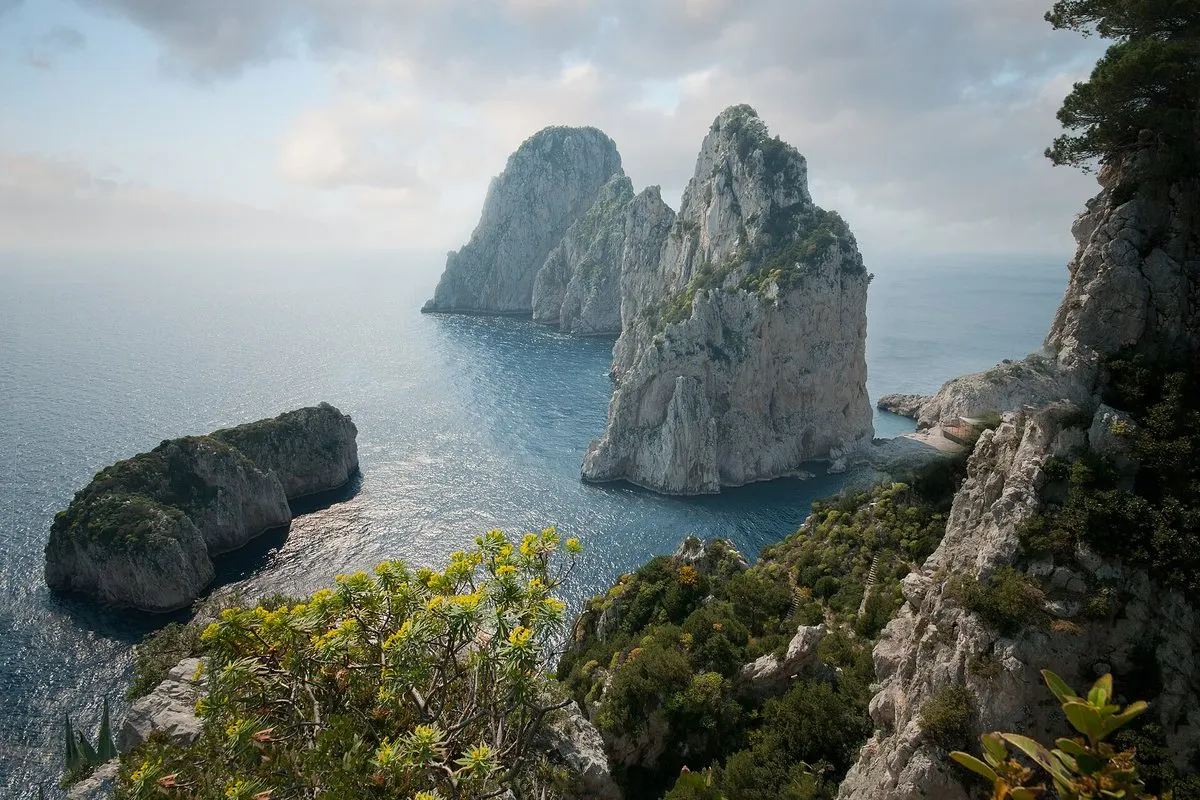
Off the south-east coast stand the three rock stacks of the Faraglioni: Stella, which is joined to the island and is 109 metres high, Mezzo at 82 metres, and Scopolo, or Fuori, at 106 metres. On Scopolo lives a blue lizard found nowhere else. The best view is from the Belvedere di Tragara, and on the east coast lies the Arco Naturale, a large natural rock arch.
Anacapri and Axel Munthe
Until 1877, when the road opened, the only way up to Anacapri was the Scala Fenicia, a stone staircase of 921 steps running 1.7 kilometres from Marina Grande. It was built by Greek colonists in the 7th or 6th century BC – the name Fenicia is a later misunderstanding – and was restored in 1998. The staircase ends right by Villa San Michele.
Villa San Michele was built at the end of the 1800s by the Swedish doctor and author Axel Munthe, on a ledge 327 metres above sea level between Capri and Anacapri. The garden has views over Capri, the harbour, the Sorrento Peninsula and Vesuvius, and is full of ancient objects from Egypt and classical antiquity. Munthe incorporated remains of Roman palaces that he had found on his land.
His memoir, The Story of San Michele, was published in 1929 and became an immediate worldwide success, translated into many languages. After Munthe's death, the villa was left to the Swedish state, and a Swedish-Italian bird observatory is now run in its grounds. The garden is part of the Grandi Giardini Italiani network.
From Piazza Vittoria in Anacapri, a chairlift runs up to Monte Solaro, the island's highest point at 589 metres, with wide views over the southern coast. Claude Debussy named one of his preludes Les collines d'Anacapri, the hills of Anacapri.
The Blue Grotto
The Grotta Azzurra on the north-west coast belongs to Anacapri. It was a nymphaeum in Roman times and became famous after 1826, when the German artist August Kopisch visited it. Light filters in through a partly submerged opening and colours the water an intense blue. The entrance is only about two metres high and wide and lies about a metre above the water when the sea is calm, so visitors must lie back in the boat while the oarsman pulls it in along a chain. Inside awaits the Duomo Azzurro, about 60 metres long and 25 metres wide.
The artists' island
From the end of the 19th century, Capri became a refuge for European artists and writers, and its reputation as a tolerant place drew many who sought a freer life. Somerset Maugham, Norman Douglas, Compton Mackenzie, Maxim Gorky and Gracie Fields lived or stayed here for long periods, and John Singer Sargent painted on the island.
More to read
Capri is at its busiest in summer – go early or late in the season if you can. Further up the Italian coast, read about Portofino, Santa Margherita and Camogli, find more destinations and all city guides on metromode.co.
Places
Piazzetta (Piazza Umberto I)
The island's social centre, at the top station of the funicular.
Insider tipThe funicular from Marina Grande takes five minutes
Giardini di Augusto
Krupp's terraced gardens overlooking the Faraglioni and Marina Piccola.
Certosa di San Giacomo
A 14th-century Carthusian monastery with two cloisters and the Diefenbach Museum.
Villa Jovis
Tiberius's largest villa, from which he ruled the empire in AD 27–37.
Insider tipOn foot only, around two kilometres uphill from Capri
Villa San Michele
Axel Munthe's villa, today owned by the Swedish state, with ancient artefacts and a view of Vesuvius.
Insider tipThe Scala Fenicia ends close by
Chairlift to Monte Solaro
From Piazza Vittoria up to the island's highest point at 589 metres.
Grotta Azzurra
The Blue Grotto on the north-west coast, famous since 1826.
Insider tipOnly visit when the sea is calm – the entrance is low