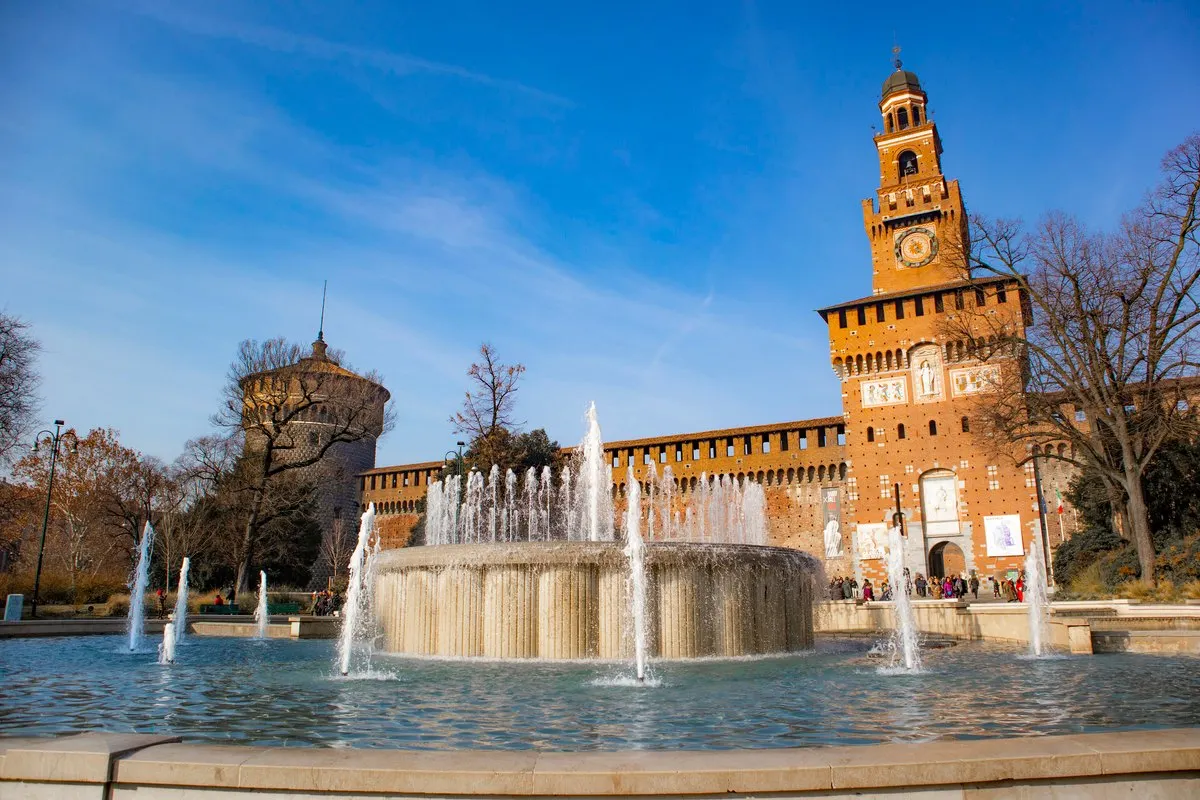
Built by the Visconti, rebuilt by the Sforza and saved from demolition by the city, Milan's castle now holds a dozen collections and Michelangelo's final sculpture. How to spend a morning inside, and the park that opens behind it.
In this story · 5 sections
Walk up Via Dante from the Duomo and the street ends at a red-brick gate tower: the Torre del Filarete, entrance to the Castello Sforzesco. The alignment is deliberate. Via Dante was cut through the medieval streets in the 1880s to give the city a promenade from cathedral to castle, at the moment Milan decided that the old fortress, which had been a barracks and nearly a building site, would become a home for its museums instead.
The courtyards cost nothing and are open from early morning. The museums inside need a ticket and a few hours. This is how to use both, and what to see first.
Castello Sforzesco
Castle and museums · Piazza Castello, Milan
© OpenStreetMap contributors · OpenFreeMap
- Address
- Piazza Castello, 20121 Milano
- First built
- 1358–c. 1370, by Galeazzo II Visconti
- Rebuilt
- From 1450, by Francesco Sforza
- Gate tower
- Torre del Filarete, 1452; rebuilt 1900–1905
- Restored
- 1891–1905, by Luca Beltrami
- Highlights
- Rondanini Pietà, Mantegna's Trivulzio Madonna, the armoury
- Owner
- City of Milan
Fifteenth-century Sforza castle restored by Luca Beltrami, with free courtyards, the civic museums, Michelangelo's Rondanini Pietà and Parco Sempione behind it.
01From Visconti fortress to Sforza court
Galeazzo II Visconti built the first castle here between 1358 and about 1370, beside a gate in the city walls, the Porta Giovia. His successors enlarged it into a square with sides of 200 metres, towers at the corners and walls up to seven metres thick, and it was destroyed by the short-lived Golden Ambrosian Republic in 1447. In 1450 Francesco Sforza, who had crushed the republic, began rebuilding it as his princely residence. In 1452 he hired the architect and sculptor Filarete to design the central tower; the tower of Bona of Savoy followed in 1476. The Lombard architect Pietro Antonio Solari drew on the castle when he worked on the Moscow Kremlin from 1485.
Under Ludovico Sforza, from 1494, the court filled with artists. Bramante painted in the Sala del Tesoro, and around 1498 Leonardo da Vinci painted the ceiling of the Sala delle Asse as a pergola of interlaced trees. The room is currently closed for restoration.
02Citadel, ruin and rescue
After the French victory at Marignano in 1515, the castle changed hands by siege; in 1521 the Filarete tower, then used as a weapons depot, blew up. Under Spanish rule it became a citadel with a garrison of up to 3,000 men and a star-shaped ring of twelve bastions three kilometres long. Napoleon's administration demolished most of the outer works, and after Italian unification the castle passed from the army to the city. When a property company proposed building over the castle grounds and the parade ground behind them, the protests that followed led to Milan's first city plan, which set the land aside as a park and the castle for culture.
Insider tipStart with the Rondanini Pietà before the groups arrive, then walk out through the park to the Arco della Pace.
The architect Luca Beltrami restored it between 1891 and 1905, and between 1900 and 1905 he rebuilt the Filarete tower from sixteenth-century drawings as a monument to King Umberto I. Allied bombs in 1943 caused severe damage, and the post-war museum rooms were designed by the BBPR partnership.
03Michelangelo's last work
The Rondanini Pietà has its own museum in the castle, opened in 2015. Michelangelo worked on it from 1552 until the end of his life: he was carving it six days before he died in 1564. In his last days he cut back the block so far that only the right arm of Christ survives from the first conception, hanging beside the elongated, almost Gothic figures of the mother and son. The name comes from the Palazzo Rondanini in Rome, whose courtyard it stood in for centuries. Walk round it slowly; it changes from every side.
04The museums
One ticket covers all the castle's civic museums. The Pinacoteca has Mantegna's Trivulzio Madonna and paintings by Foppa, Titian, Tintoretto, Canaletto and Tiepolo; the Museum of Ancient Art holds the armoury, the tapestry room and funerary monuments; and there are museums of musical instruments, applied arts, furniture and wooden sculpture, an Egyptian collection, prehistoric finds and the Bertarelli print collection. For the battlements and the underground passages, book one of the castle's guided secret routes, which leave every 20 minutes in groups of up to 25.
05Parco Sempione and the Arco della Pace
Behind the castle, the old parade ground became Parco Sempione, laid out between 1888 and 1894 by Emilio Alemagna as an English-style romantic park of 386,000 square metres. Giovanni Muzio's Palazzo dell'Arte, home of the Triennale since 1933, stands at its edge, next to the Torre Branca, built in 1932–33 to designs by Gio Ponti, Cesare Chiodi and Ettore Ferrari. At the far end rises Luigi Cagnola's Arco della Pace, begun for Napoleon in 1807, finished in 1838 and dedicated to the Congress of Vienna; Napoleon III and Victor Emmanuel II rode through it into Milan on 8 June 1859.
At a glance
Tickets and opening times
| What | When | Price |
|---|---|---|
| Castle museums | Tuesday–Sunday 10.00–17.30, last entry 16.30 | €10, reduced €5, free under 18 |
| Courtyards | Daily 7.00–19.30 | Free |
| Secret routes (battlements, underground) | Tuesday–Sunday, last entry 17.00 | €10, reduced €5 |
| Guided tour of the museums | Saturdays at 11.00 in English, no booking | €20, ticket included |
| Audioguide | Six languages, at the bookshop | €5 |