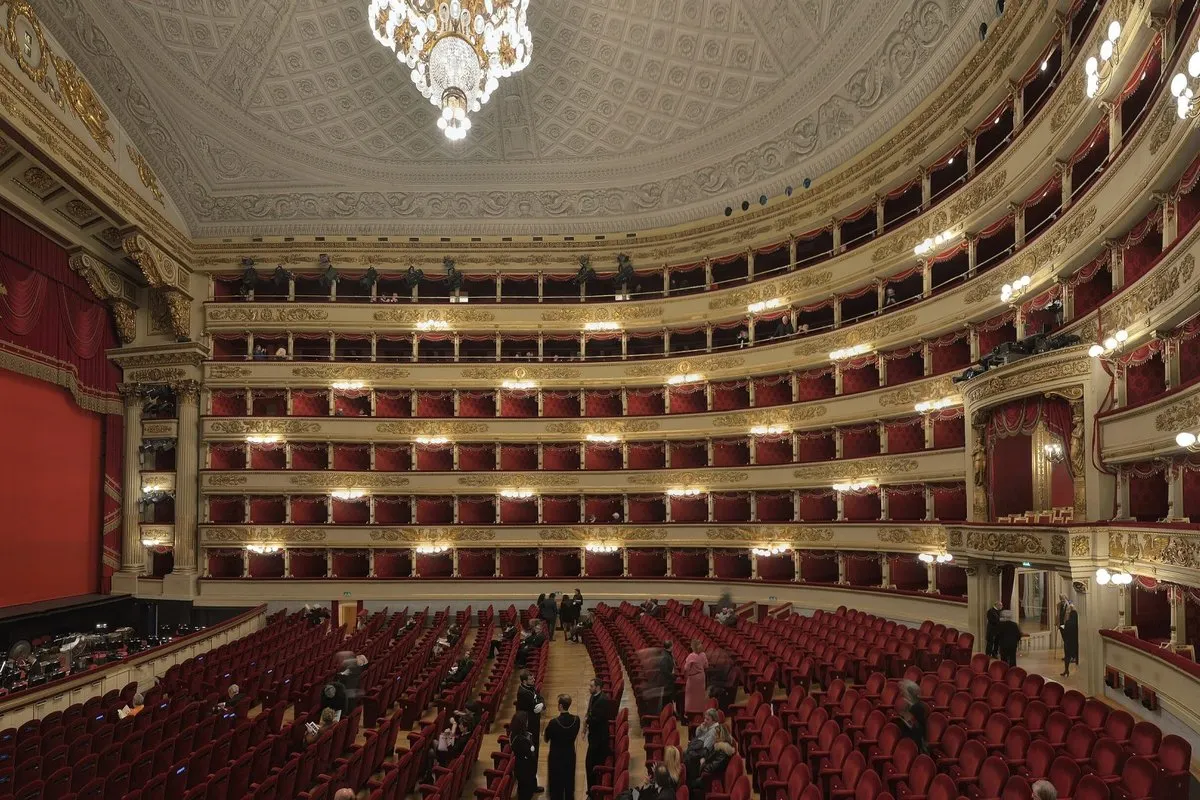
La Scala's season opens on 7 December, the feast of Milan's patron saint, and this year it opens with Verdi's Otello under a new music director. The history behind the red-and-gold auditorium, how to get a seat, and how to see the hall without one.
In this story · 6 sections
From Piazza della Scala the theatre looks almost modest: a neoclassical front with a carriage porch, facing Leonardo's statue and the Palazzo Marino across the square. Inside is one of the most famous rooms in music, a horseshoe of red-and-gold boxes rising in tiers to the gallery under the roof, where Verdi, Puccini and Bellini had their premieres and where the regulars in the cheap seats are still feared by singers.
You do not need to be an opera lover to feel it. This is about how the house came to be, what makes a night here different, and the practical side: the season, the box office, and the museum that lets you look into the hall by day.
Teatro alla Scala
Opera house · Piazza della Scala, Milan
© OpenStreetMap contributors · OpenFreeMap
- Address
- Piazza della Scala, 20121 Milano
- Opened
- 3 August 1778, with Salieri's Europa riconosciuta
- Architect
- Giuseppe Piermarini
- Reopened after the war
- 11 May 1946, concert conducted by Arturo Toscanini
- Renovated
- 2002–2004, by Mario Botta
- Season opens
- 7 December, Sant'Ambrogio
- Music director
- Myung-Whun Chung, from the 2026–27 season
Milan's opera house, opened in 1778 and rebuilt after 1943: premieres from Norma and Nabucco to Otello, Falstaff and Turandot, the loggione under the roof, and the Museo Teatrale alla Scala beside it.
01Piermarini's theatre
On 25 February 1776 a fire after a carnival gala destroyed Milan's court theatre, the Teatro Regio Ducale. Ninety wealthy Milanese who owned boxes there asked Archduke Ferdinand for a new house, and the neoclassical architect Giuseppe Piermarini drew it; his second design was approved by Empress Maria Theresa. It was built on the site of the church of Santa Maria della Scala, which was demolished and gave the theatre its name, and it opened on 3 August 1778 with Antonio Salieri's Europa riconosciuta.
The boxes were sold to pay for the building, and their owners decorated them lavishly enough to impress Stendhal. For decades the main floor had no seats, the orchestra played in full view, and the foyer doubled as a casino. Mary Shelley, at the opera in September 1840, complained that every kind of business "from horse-dealing to stock-jobbing" was done in the pit. The house was lit by oil lamps, then gas, and from 1883 by electricity.
02Verdi, Puccini and Toscanini
La Scala gave the first performances of Bellini's Norma in 1831, Verdi's Nabucco in 1842, Otello in 1887 and Falstaff in 1893, Puccini's Madama Butterfly in 1904 and Turandot in 1926. Verdi kept his operas away for years after a quarrel over Giovanna d'Arco in 1845, then came back to conduct his Requiem here on 25 May 1874. Arturo Toscanini was principal conductor three times. When Allied bombs wrecked the theatre in 1943, it was rebuilt and reopened on 11 May 1946 with a concert conducted by Toscanini, at which the young soprano Renata Tebaldi caused a sensation.
Insider tipNo ticket? Buy a museum ticket in the morning and look into the hall from a third-tier box.
03Mario Botta's renovation
After the opening run of Otello in December 2001 the theatre closed for a renovation by the Swiss architect Mario Botta, while the company moved to the new Teatro degli Arcimboldi in the Bicocca district. The stage was rebuilt and the backstage enlarged, the heavy red carpets that dulled the sound were taken out, and seat-back screens now show the libretto in Italian and English. La Scala reopened on 7 December 2004 with Riccardo Muti conducting the opera it had opened with in 1778, Salieri's Europa riconosciuta.
04The loggione
Above the boxes is the gallery, the loggione, where the cheapest seats are and the most demanding listeners sit. The loggionisti can make a career or break an evening: in 2006 the tenor Roberto Alagna walked off the stage in Aida after being booed, and his understudy went on mid-scene without time to change into costume. Performances must end before midnight, so long operas begin early.
05The 2026–2027 season
The season is the first under Myung-Whun Chung as music director, succeeding Riccardo Chailly, and it opens on 7 December 2026 with Verdi's Otello, directed by Damiano Michieletto, with Brian Jagde as Otello, Eleonora Buratto as Desdemona and Luca Salsi as Iago; a preview for audiences under 30 is given on 4 December. Later highlights include Robert Carsen's Don Giovanni, Franco Zeffirelli's La Bohème, Chailly conducting Stravinsky's The Rake's Progress, Chung returning for a new Macbeth directed by Barrie Kosky, and John Adams's Nixon in China under Kent Nagano.
06The museum and the view from the box
The Museo Teatrale alla Scala, entered from Largo Ghiringhelli beside the theatre, holds paintings, costumes, instruments and documents from the house's history. Its ticket also lets you look into the auditorium from the boxes of the third tier, as long as there is no rehearsal, performance or event under way – the closest most visitors come to the room.
At a glance
The 2026–2027 opera season
| Opera | Dates | Conductor |
|---|---|---|
| Otello (Verdi) | 7 December 2026 – 5 January 2027 | Myung-Whun Chung |
| Les Pêcheurs de perles (Bizet) | 22 January – 7 February 2027 | Henrik Nánási |
| Don Giovanni (Mozart) | 3–28 February 2027 | Thomas Guggeis |
| La Bohème (Puccini) | 16 February – 7 March 2027 | Daniel Oren |
| Anna Bolena (Donizetti) | 30 March – 16 April 2027 | Francesco Ivan Ciampa |
| The Rake's Progress (Stravinsky) | 17–30 April 2027 | Riccardo Chailly |
| Macbeth (Verdi) | 4–22 May 2027 | Myung-Whun Chung |
| Don Quichotte (Massenet) | 23 May – 14 June 2027 | Bertrand de Billy |
| I Puritani (Bellini) | 15 June – 1 July 2027 | Fabio Luisi |
| Nixon in China (Adams) | 26 June – 13 July 2027 | Kent Nagano |
| Il barbiere di Siviglia (Rossini) | 2–29 October 2027 | Giulio Cilona |