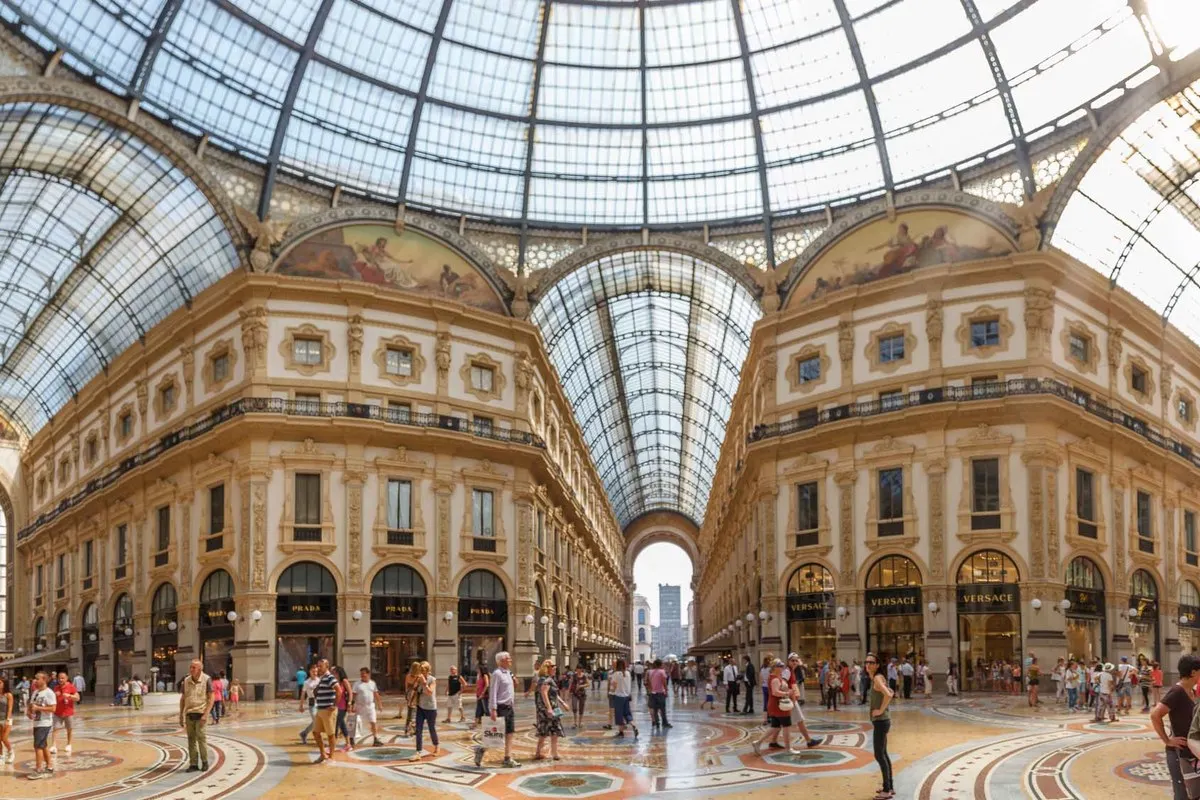
Italy's oldest working shopping arcade joins the Duomo to La Scala beneath an iron-and-glass dome 37.5 metres across. The story of Mengoni's "drawing room of Milan", the shops that have been there for a century or more, and the bull you are expected to spin on.
In this story · 5 sections
The Milanese call it simply la Galleria, and almost from the day it opened it has been known as il salotto di Milano, the city's drawing room. Two glass-vaulted arms cross in an octagon beneath a dome, joining Piazza del Duomo to Piazza della Scala, and the four storeys of stucco, caryatids and painted lunettes on either side make a street feel like an interior. It is Italy's oldest shopping arcade still in use, and the building that gave the word galleria to shopping arcades around the world.
Most people pass through it on the way to somewhere else. It is worth slowing down: for the engineering overhead, the mosaics underfoot, and the shops that have kept the same names for more than a century.
Galleria Vittorio Emanuele II
Shopping arcade · Duomo, Milan
© OpenStreetMap contributors · OpenFreeMap
- Address
- Piazza del Duomo, 20121 Milano
- Architect
- Giuseppe Mengoni, winner of the 1863 competition
- First stone
- 7 March 1865, laid by King Victor Emmanuel II
- Built
- 1865–1877; opened in 1867, before the triumphal arch was finished
- Length
- 196 metres (Duomo–Scala) and 105 metres (cross arm)
- Dome
- About 37.5 metres internal diameter
- Owner
- City of Milan, since 1869
Italy's oldest working shopping arcade, built 1865–1877: two glass-vaulted arms, a 37.5-metre dome over the octagon, the bull mosaic and shops such as Camparino, Savini, Biffi, Borsalino and Prada.
01Three competitions and a king
The idea of a new street between the cathedral and the opera house grew out of a long argument about the cramped square in front of the Duomo, which Carlo Cattaneo had opened in 1839. After Milan was freed from Austrian rule, the city named the project after Victor Emmanuel II, in part to speed up the royal decrees it needed for expropriations. The first competition, in 1860, drew so many entries that 176 were exhibited at the Brera; it produced no winner. Neither did the second, in 1861. The third, in 1863, went to Giuseppe Mengoni, on condition that he revise his design – and it was then that a single passage became a cross.
The king laid the first stone on 7 March 1865, and the arcade, built by an English company, the City of Milan Improvements Company, opened in less than three years. The company failed in 1869 and the city bought the Galleria for 7.6 million lire. The triumphal arch on Piazza del Duomo, 32 metres high and inscribed "A Vittorio Emanuele II. I Milanesi", came last. Mengoni never saw the work complete: he fell from scaffolding during an inspection.
02Iron, glass and the octagon
The long arm runs 196 metres from piazza to piazza; the cross arm, between Via Foscolo and Via Pellico, is 105 metres. Four barrel vaults about 14.5 metres wide meet under a dome with an internal diameter of around 37.5 metres, unprecedented for an arcade at the time. The ironwork was made and installed by the French firm of Henry Joret, and the ribbed glass came from Saint-Gobain. At the side entrances, painted lunettes show Science, Industry, Art and Agriculture. When it opened, the Galleria was lit by gas, and the lamps around the octagon were lit by a small mechanical locomotive the Milanese called the rattin, the little mouse, a ritual that drew crowds until electric light arrived in 1883.
Insider tipCome early to see the octagon empty, and leave by the La Scala arch.
03The bull
In the centre of the octagon, the floor mosaics laid between 1865 and 1877 show the arms of the first capitals of the new kingdom – Turin, Florence and Rome – together with Milan's. Turin's arms carry a rampant bull, and tradition says that turning three times on your heel on the bull's genitals brings good luck. So many people do it that a hole wears through and the mosaic has to be repaired; it was restored in 2017 and again in 2026.
04Bombs, rebuilding and Expo
The Allied raids of 15 and 16 August 1943 destroyed the glass roof and part of the ironwork and damaged the decoration below. After years of debate about how to rebuild, the restoration that won approval stayed faithful to the original, and it was finished in 1955 with a second inauguration on 7 December, the feast of Milan's patron saint and the opening night of La Scala. The most thorough restoration since the war ran from March 2014 to April 2015, before Expo: some 35,000 hours of work on 14,000 square metres of surface, carried out from a moving gantry instead of fixed scaffolding so the shops could stay open.
05The historic shops
In 2015 the Lombardy region recognised twelve businesses in the Galleria as historic shops, and five of them had been here since it opened. The Caffè Campari, today's Camparino, Savini, which began as the Caffè Gnocchi, and the Caffè Biffi, founded by the king's pastry chef Paolo Biffi, all date from 1867. Borsalino has sold hats here since 1883, and the Fratelli Prada opened their first shop in 1913, long before the name meant a global fashion house. By city rule, every sign in the Galleria is lettered in gold on black – a condition even McDonald's had to accept in the years it held a licence here.
The Galleria also has its painting. In 1910 Umberto Boccioni painted Riot in the Galleria, a crowd surging in front of Gaspare Campari's bar to watch two women fight, on the edge between Divisionism and Futurism. It is now in the Pinacoteca di Brera.
At a glance
The twelve historic shops (Lombardy region, 2015)
| Shop | Since | Trade |
|---|---|---|
| Libreria Bocca | 1775 | Antiquarian and new books |
| Caffè Biffi | 1867 | Café and pastry |
| Caffè Campari (Camparino) | 1867 | Bar, café and tea room |
| Centenari | 1867 | Art prints |
| Savini | 1867 | Restaurant |
| Borsalino | 1883 | Hats |
| Mejana | 1911 | Knives and scissors |
| Fratelli Prada | 1913 | Leather goods and fashion |
| Viganò | 1919 | Optician |
| Cadè | 1926 | Shirtmaker |
| Noli | 1927 | Smokers' articles |
| Rizzoli | 1949 | Bookshop of the publishing house |