Built in the 1860s to replace the city's scattered graveyards, Carlo Maciachini's cemetery became the place where Milan's great families commissioned the leading sculptors of their day. It is free to enter and one of the most rewarding walks in the city.
In this story · 5 sections
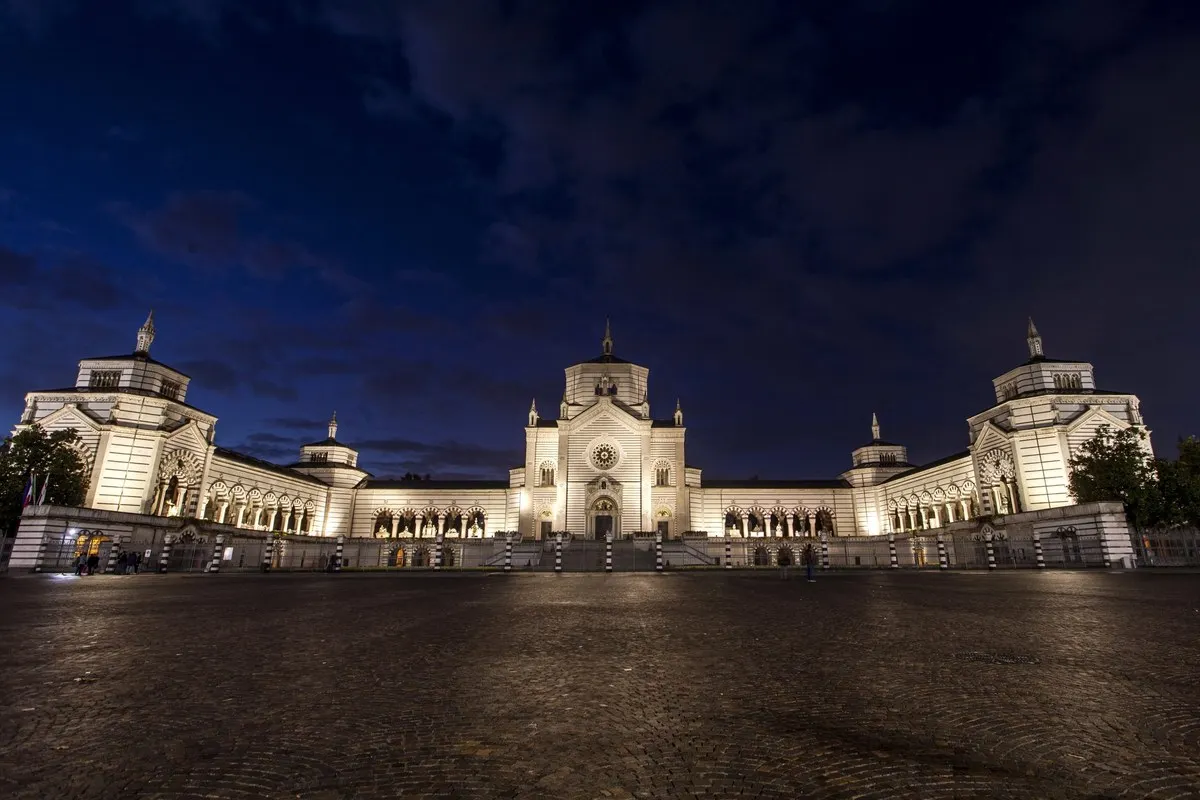
The Monumentale was planned to gather the small cemeteries scattered around Milan into a single place. Carlo Maciachini designed it and built it between 1864 and 1866 on what was then the northern edge of the city, beyond Porta Garibaldi; today it covers 25 hectares and belongs to the city. What makes it extraordinary is what followed: a century and a half in which industrial dynasties, writers, composers and engineers commissioned their tombs from the leading artists of the day.
The result is one of the great collections of Italian sculpture from the late nineteenth century to the present, laid out along tree-lined avenues and open to anyone, free of charge.
Cimitero Monumentale
Cemetery · Monumentale, Milan
© OpenStreetMap contributors · OpenFreeMap
- Address
- Piazzale Cimitero Monumentale, 20154 Milano
- Architect
- Carlo Maciachini
- Built
- 1864–1866
- Area
- 25 hectares
- Famedio
- Hall of honour; tomb of Alessandro Manzoni
- Jewish section
- Opened 1872
- Tempio Crematorio
- Opened 1876, in use until 1992
- Opening hours
- Tuesday–Sunday 08.00–18.00; closed Mondays; last entry 30 minutes before closing
- Admission
- Free
25 hectares of tombs and monuments by Italy's leading sculptors, the Famedio with Manzoni's tomb and the first crematorium in the Western world.
01The Famedio
You enter through the Famedio, the neo-medieval hall of fame in marble and stone at the centre of Maciachini's long, arcaded front. It was first intended as a church and became, while the work was under way, a pantheon for the city's most honoured citizens. At its centre lies Alessandro Manzoni, author of The Betrothed and, for Italians, the father of the modern language.
Near the entrance, a permanent exhibition of prints, photographs and maps traces the cemetery's history, and includes two battery-powered electric hearses built in the 1920s.
02A gallery of Italian sculpture
Beyond the Famedio, the avenues are lined with Greek temples, obelisks, Liberty-style aedicules and even a scaled-down Trajan's Column. Many of the tombs belong to Milan's industrial families – the Falck and the Bocconi among them – and they were made by artists including Adolfo Wildt, Gio Ponti, Arturo Martini, Agenore Fabbri, Lucio Fontana, Medardo Rosso, Giacomo Manzù, Floriano Bodini and Giò Pomodoro.
Insider tipFree entry; closed on Mondays.
Look for Arturo Toscanini's aedicule, designed by the architect Mario Labò with sculpture by Leonardo Bistolfi. It was first built for the conductor's young son Giorgio, who died of diphtheria in Buenos Aires in 1906 while travelling with his father, and its carvings of childhood and of a sea voyage recall the small coffin's journey home.
03Memory and modernity
At the centre of the cemetery stands the memorial to some 800 Milanese killed in Nazi concentration camps, by BBPR, the group of rationalist architects. The Jewish section, also designed by Maciachini, opened in 1872 to the east, with its own entrance. And the Tempio Crematorio, a Greek Revival temple, opened in 1876 as the first crematorium in the Western world; it was used until 1992 and is also a columbarium.
04Who is buried here
Signs throughout the cemetery point the way to its best-known graves. Besides Manzoni, they include the poets Alda Merini and Salvatore Quasimodo, who won the Nobel Prize in Literature in 1959; the composer Amilcare Ponchielli; the sculptor Medardo Rosso; the Formula One world champion Alberto Ascari; the publisher Ulrico Hoepli; and the art historian Philippe Daverio.
05How to visit
The cemetery is a few minutes' walk from Monumentale station on metro line M5. It is open from Tuesday to Sunday, 8am to 6pm, and closed on Mondays; entry is free, and the last visitors are let in 30 minutes before closing. Pick up a map at the infopoint, where the city also offers suggested routes and guided visits, and allow at least two hours. It remains a working cemetery, so visit with the discretion that implies.