In this story · 7 sections
A great hotel garden is not a lawn with loungers. It is a landscape with a history – laid out by an aristocrat, a famous gardener or an order of monks – that a hotel has inherited and, in the best cases, kept alive. To stay in one is to have the place almost to yourself in the early morning and late evening. These five, from the Thames to the Amalfi Coast, are among the finest in Europe, with a sixth to wait for.
5 places
© OpenStreetMap contributors · OpenFreeMap
- 01ClivedenHotel and National Trust gardens · Taplow, Buckinghamshire
- 02Gravetye ManorCountry house hotel · near East Grinstead, West Sussex
- 03Tivoli Palácio de SeteaisPalace hotel · Sintra, Portugal
- 04Buçaco PalacePalace hotel · Mealhada, Portugal
- 05Hotel Villa CimbroneVilla hotel · Ravello, Amalfi Coast
Cliveden, Buckinghamshire
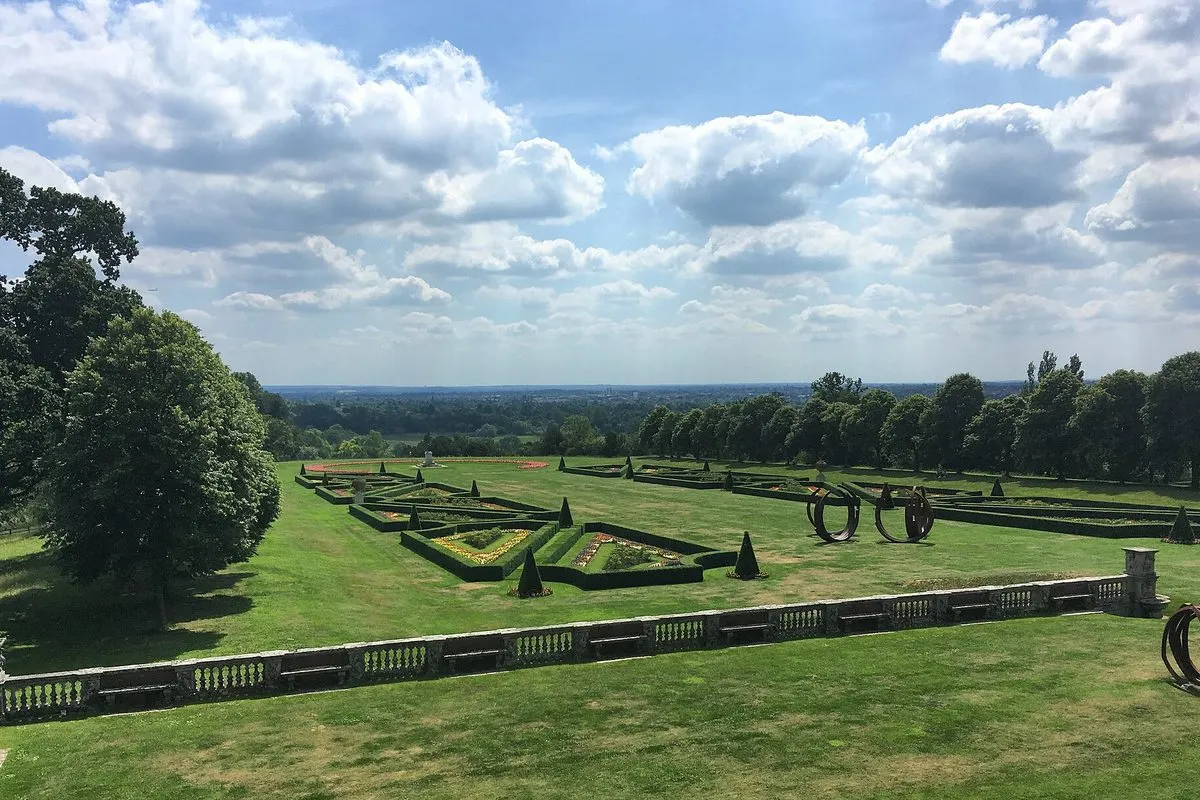
Cliveden crowns a ridge 40 metres above the River Thames, its grounds sloping down to the water. The present Italianate house was built in 1851 by Charles Barry for the 2nd Duke of Sutherland; later it became the home of the Astors, the meeting place of the Cliveden Set in the 1920s and 1930s and the setting of the Profumo affair in the early 1960s. The estate is cared for by the National Trust, and the house is leased to a company that runs it as a luxury hotel – the original drawing room is now its main dining room.
The gardens and woodland cover 375 acres. The formal parterre to the south of the house, at about four acres, is one of the largest in Europe. Its first form was deliberately plain: the Earl of Orkney, having commissioned elaborate plans from Claude Desgots, a nephew of André Le Nôtre, chose instead an open lawn framed by gravel walks and elms that he called his "Quaker parterre". The National Trust gardens are open to the public.
Gravetye Manor, West Sussex
Gravetye is an Elizabethan house of 1598, but its fame belongs to one man. William Robinson, author of The English Flower Garden, lived here from 1884 until his death in 1935 and made the garden one of the most famous in England. During the Second World War, Canadian soldiers based there dug up parts of it for vegetables, and it was then left derelict for years until 1958, when Peter Herbert, later regarded as a pioneer of the country house hotel, leased it and turned it into a small hotel. Over forty years he restored Robinson's core 52 acres of natural gardens. The house is Grade I listed, the gardens Grade II*, and the kitchen garden supplies a restaurant that held a Michelin star in 2020.
Tivoli Palácio de Seteais, Sintra
Sintra, in the hills west of Lisbon, is a Unesco cultural landscape of palaces and gardens, and the Seteais Palace sits within it. It was built between 1783 and 1787 for the Dutch consul Daniel Gildemeester, sold by his widow to the Marquis of Marialva in 1797, and surrounded by a large garden of fruit trees that was later remodelled in the Romantic manner. It has operated as a hotel since 1954, with its original character preserved, and is a national landmark. Gildemeester built it close to the Monserrate estate of his friend, the British consul Gerard de Visme.
Buçaco Palace, central Portugal
The forest garden of Buçaco was created by monks. Discalced Carmelites founded a convent here in 1628 and planted a garden of many tree species, meant to represent Mount Carmel and the Earthly Paradise, with a series of Stations of the Cross chapels added in the late seventeenth century. The Duke of Wellington spent the night in the convent after the Battle of Bussaco in 1810. Plans to build a royal residence for Queen Maria Pia gave way to a hotel, built between 1888 and 1907 in Neo-Manueline style by the Italian architect Luigi Manini. Part of the old convent and its Baroque church survive beside it.
Hotel Villa Cimbrone, Ravello
High above the Amalfi Coast, Villa Cimbrone was much altered and extended in the early twentieth century by the Englishman Ernest William Beckett, later Lord Grimthorpe, who redeveloped its gardens at the same time. They are famous for their scenic belvedere, the Terrazza dell'Infinito, the Terrace of Infinity. Vita Sackville-West is said to have advised on the garden. The villa is now a hotel, and its gardens are open to the public.
For later: Le Manoir aux Quat'Saisons
Raymond Blanc's Belmond Le Manoir aux Quat'Saisons at Great Milton, near Oxford, is a fifteenth-century manor whose gardens grow produce for its two-Michelin-star restaurant. It is closed for renovation until 2027 – one to book for its reopening.
Visiting tips
Plan around the seasons of the planting, and ask the hotel whether a garden walk is offered. Stay at least two nights – the point of a garden hotel is the unhurried hour. More hotels and ideas in our travel section, the international edition at metromode.co and our Riviera guides on verapi.fr.
Cliveden
Charles Barry's Italianate house above the Thames, with 375 acres of gardens and woodland.
Insider tipThe gardens are open to the public; parts of the house on certain days.
Gravetye Manor
William Robinson's garden, restored and kept by the hotel.
Insider tipHouse Grade I, gardens Grade II* listed.
Tivoli Palácio de Seteais
A neoclassical palace of the 1780s with Romantic gardens, a hotel since 1954.
Insider tipWithin the Unesco Cultural Landscape of Sintra.
Buçaco Palace
A Neo-Manueline palace hotel beside the Carmelites' forest garden, built 1888–1907.
Insider tipA national monument.
Hotel Villa Cimbrone
Gardens famous for the Terrazza dell'Infinito.
Insider tipGardens open to the public.