A cylinder of books on Sveavägen and a World Heritage Site in the pine forest south of the city. Gunnar Asplund designed two of the 20th century's most important buildings in Stockholm – and they show the whole journey from classicism to modernism.
In this story · 5 sections
Two buildings in Stockholm are enough to understand why Gunnar Asplund is counted among the great architects of the 20th century. The first is a tall cylinder at the junction of Sveavägen and Odengatan – Stockholm Public Library. The other lies in a pine forest in Gamla Enskede: the Woodland Cemetery, where a large granite cross stands alone on a grassy slope in front of three quiet chapels. Between them lies an entire history of architecture, from the elegant classicism of the 1920s to the modernism that would shape the rest of the century.
2 places
© OpenStreetMap contributors · OpenFreeMap
The Public Library: Swedish Grace in a cylinder
The library began with a donation. In 1918, the Knut and Alice Wallenberg Foundation gave SEK 1 million to the City of Stockholm for a city library, on condition that the city contributed its own funds and a plot of land. That same year, Gunnar Asplund joined the city library committee. He first worked on the city plan for the area around Observatorielunden, and during a study trip to the USA, he settled on the basic concept: a central lending hall, surrounded by smaller reading rooms and light courtyards.
The first sketches showed a building with a dome. But Asplund chose instead to give the house its monumental form through a high cylinder; among the models was the 18th-century Rotonde de la Villette in Paris. When the library was inaugurated on 31 March 1928, in the presence of, among others, Prince Eugen, it had become one of the foremost examples of Swedish 1920s classicism – the style that the outside world called Swedish Grace.
This also became Asplund's final masterpiece in that style. The bazaar-like wings facing Sveavägen already display distinct functionalist features, and two years later, at the Stockholm Exhibition of 1930, Asplund had fully converted to functionalism. The library holds around 400,000 books, and he also designed the park surrounding it, Observatorielunden.
Closed until 2028
An important notice for anyone planning a visit: the Public Library closed for extensive renovation in June 2024, and the work is expected to continue until the end of 2028. The exterior, the cylinder against the sky and the setting in the park can still be experienced from outside, and a temporary annexe at Odengatan 59 houses the children's and youth activities. But the famous rotunda will have to wait.
The Woodland Cemetery: a landscape of grief and light
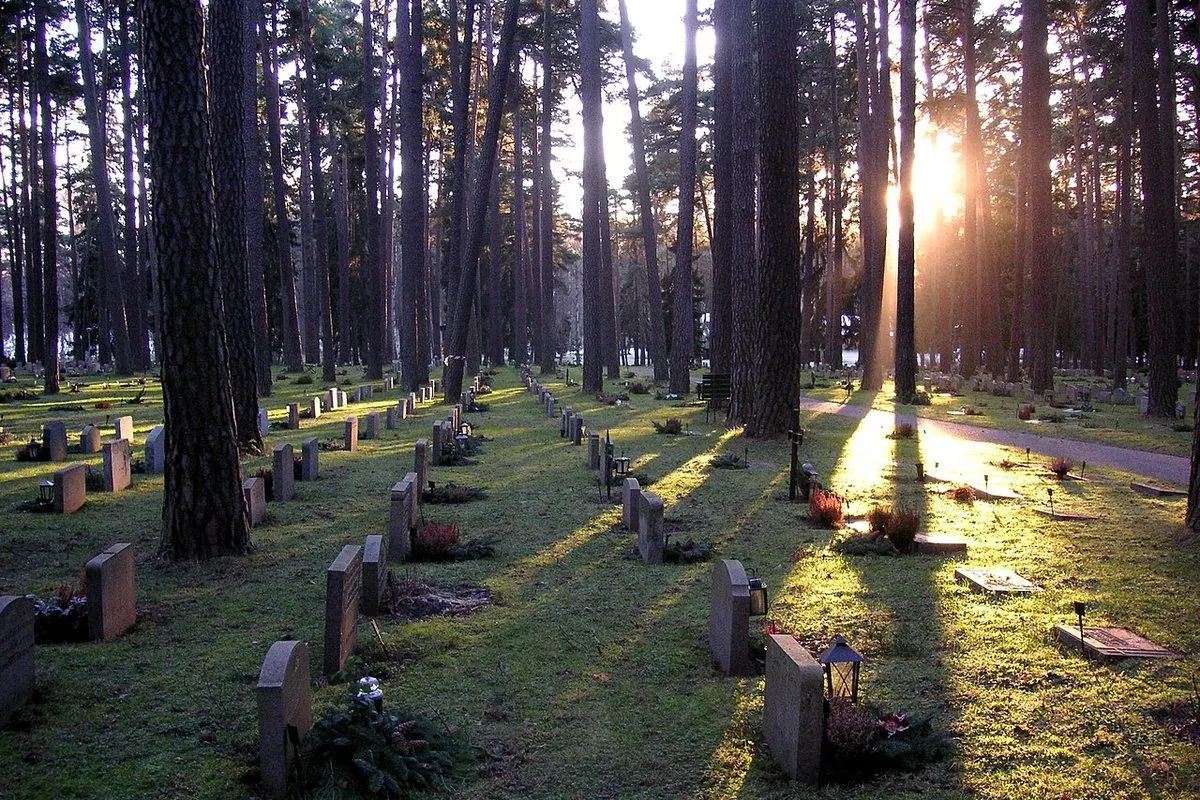
In 1912, Stockholm City Council decided to set aside a wooded area in southern Stockholm for a new cemetery. The area was a pine-covered esker with a few sand pits in the north. In the autumn of 1914, an international architectural competition was announced, and in 1915 first prize went to the proposal "Tallum" by two then 30-year-old architects: Gunnar Asplund and Sigurd Lewerentz. Among the sources of inspiration were the German forest cemeteries in Hamburg and Munich, but also the painting of Caspar David Friedrich.
The architects took the landscape as their starting point. Lewerentz was primarily responsible for the landscape, the main entrance and the classicist Chapel of the Resurrection from 1925; Asplund for the buildings. The first stage was inaugurated in 1920, and the complex was completed in 1940. The architects designed everything, from the landscape to the smallest lamps. In 1994, the Woodland Cemetery became a World Heritage Site – the second 20th-century cultural site on Unesco's list.
What you see when you walk there
The oldest building is the Woodland Chapel, a simple timber chapel with a shingle roof designed by Asplund in 1917–1919. After that came Lewerentz's Chapel of the Resurrection, clearly inspired by antiquity. The crowning achievement is Asplund's Woodland Crematorium, built in 1937–1940, with the Chapels of Faith, Hope and the Holy Cross and the great Monumental Hall – austere, stripped-back and modern. In the waiting room of the Chapel of the Holy Cross, according to Wikipedia, Asplund had the ceiling shaped like an exclamation mark, something said to mark an architect's final great work. Asplund died in 1940, the same year the crematorium was completed.
The large granite cross on the slope was designed by Asplund following an anonymous donation, despite his own reservations about the cross as a symbol. West of the chapels rises Almhöjden, a hill with elm trees also known as the Meditation Grove. With around 100,000 burial plots, the Woodland Cemetery is Sweden's largest burial ground in terms of the number of graves. It is a place of stillness, and visitors should conduct themselves accordingly.
How to visit Asplund's Stockholm
The Public Library is in Vasastan, on Sveavägen, and can be combined with a walk in Observatorielunden and the blocks around Odengatan. See the street in VERA PI's street guide to Sveavägen and the district in VERA PI's guide to Vasastan, and follow our plan for a day in Vasastan.
The easiest way to get to the Woodland Cemetery is by metro to Skogskyrkogården station. During the summer half of the year, the Stockholm City Museum regularly arranges guided tours. Find both places on Metro Mode's Stockholm map, and point your phone at the library's façade with Metro Mode Camera.
At a glance
Asplund's two works in brief
| Fact | Public Library | Woodland Cemetery |
|---|---|---|
| Architect | Gunnar Asplund | Gunnar Asplund and Sigurd Lewerentz |
| Dates | Opened 1928 | 1915–1940 |
| Style | Swedish Grace (Nordic Classicism) | From National Romanticism to modernism |
| Status | Closed for renovation until the end of 2028 | World Heritage Site since 1994 |
Stockholm Public Library
Asplund's cylinder on Sveavägen, 1928
One of the foremost examples of Swedish Grace, with the famous rotunda.
Sveavägen/Odengatan, Stockholm
Insider tipClosed for renovation until the end of 2028.
The Woodland Cemetery
The World Heritage Site in the pine forest
Asplund and Lewerentz's landscape with the Woodland Chapel, the Chapel of the Resurrection and the Woodland Crematorium.
Sockenvägen, Enskede
Insider tipGuided tours during the summer half of the year.