For three centuries it belonged to the Swedish navy. Today Skeppsholmen is a quiet green island of barracks, boathouses and museums a few minutes' walk from the Grand Hôtel – and one of the most rewarding places in Stockholm simply to wander.
In this story · 6 sections
Cross the bridge from Blasieholmen, past the Grand Hôtel and Nationalmuseum, and the city seems to fall away. Skeppsholmen, a small island in Saltsjön at the very centre of Stockholm, is a place of old barracks, sea walls and wooden ships, with views back across the water to the Royal Palace and Strandvägen. From the bridge you can see Skeppsholmen Church, the battlements and tower of the Admiralty House and the full-rigged ship af Chapman moored along the western shore. The island lies within the Royal National City Park and, together with its little neighbour Kastellholmen, forms its own district.
2 places
© OpenStreetMap contributors · OpenFreeMap
Skeppsholmen at a glance- Location
- Saltsjön, central Stockholm, bridges to Blasieholmen and Kastellholmen
- Naval base
- From 1634; military presence until 1968–69
- Oldest buildings
- Nicodemus Tessin the Younger, around 1700
- Newest landmark
- Moderna Museet by Rafael Moneo, 1998
- Managed by
- National Property Board, since 1993
- Kastellholmen
- 3.1 hectares; Kastellet by Fredrik Blom, 1848
From pleasure island to naval base
In the Middle Ages the island was called Wangsö, after an old word for a field, and it was largely bare rock with a little soil on its southern side for crops and grazing. By the late sixteenth century it had become Lustholmen – the pleasure island – where the first Vasa kings came to relax. Gustav Vasa laid out a garden, Eric XIV held frequent parties here, and John III enclosed a garden on the south side and built a pavilion designed and decorated by the architect and artist Willem Boy.
The change came in 1634, when the Admiralty moved out from Blasieholmen and the island became Stockholm's naval base. The navy's shipyard followed, and the island took the name it still bears: Skeppsholmen, the ship islet. Space for the yard was part of the reason, but Wikipedia suggests the main motive was Queen Christina's wish that shores visible from the palace should not look like building sites – and the busy yards on Blasieholmen lay directly in her line of sight.
During the Scanian War of 1675–1679 it was decided that the main fleet should move to the newly founded city of Karlskrona, to guard the provinces recently won from Denmark. Skeppsholmen's days as the navy's headquarters were over, but military life continued here for almost three more centuries. When the old Tre Kronor castle burned on 7 May 1697, papers rescued from the palace were carried to the navy's archive in the Admiralty House.
Three centuries of architecture
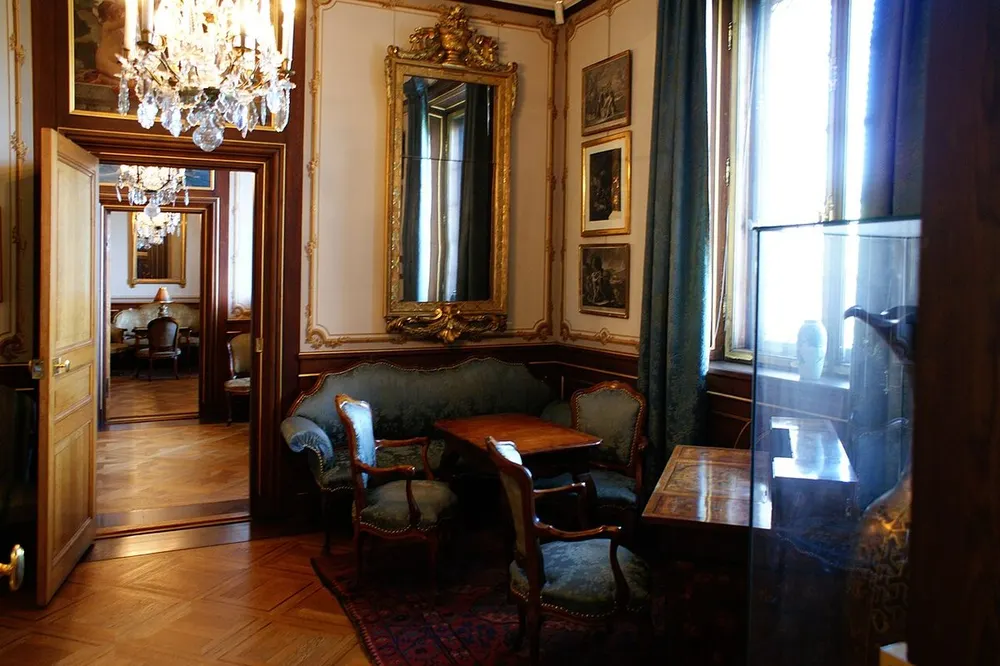
For a small island, Skeppsholmen holds a remarkable collection of buildings, designed over several centuries by some of Sweden's leading architects. The oldest were created by the palace architect Nicodemus Tessin the Younger around 1700: the East and West Officers' Quarters, built in 1699–1702 to house Charles XII's bodyguard, and the navy's arsenal, where the Museum of Far Eastern Antiquities has been based since 1963. The Commissariat Store is unique in Stockholm as the only surviving monumental building by the city architect Johan Eberhard Carlberg, and in the 1750s Carl Hårleman was engaged for a thorough rebuilding of the Sail Loft.
Most of the rest came from the navy's own architects. Fredrik Blom designed the Admiralty House and the Craftsmen's Barracks of 1832, and Victor Ringheim the Boatswains' Barracks, the Hydrographic Office and the East Chancellery. The nineteenth century added the Barracks Commander's Residence of 1849 by Johan Fredrik Åbom, the architect of Berns, as well as the water tower of 1872 and the Old Naval Academy of 1879. The newest major building is the Moderna Museet complex by the Spanish architect Rafael Moneo, opened in 1998.
From barracks to culture
The last military functions left in 1968–1969, when the navy moved to the Muskö base, and the old buildings were handed over to museums, schools and cultural institutions. The Royal Institute of Art had already moved into the Boatswains' Barracks in 1953, remodelled by the functionalist architect Paul Hedqvist. Moderna Museet began exhibiting in the old drill hall in 1956, and today the island is also home to ArkDes, the national centre for architecture and design, the Museum of Far Eastern Antiquities and the rock-cut exhibition hall beneath the church. Svensk Form occupies the former Hydrographic Office, and the old torpedo workshop is a theatre and dance stage. With so many museums, Stockholmers call it the museum island. Since 1993 both islands have been managed by the National Property Board.
Ships along the quays
Skeppsholmen is still an island of boats. The af Chapman has been moored here since 1949 and served as a youth hostel until 2022. Along the timber-decked eastern quay, Östra Brobänken, some thirty to forty older private vessels lie at their moorings, from trawlers to lightships, and the smell of real pine tar hangs in the air. Between 1997 and 2005 the brig Tre Kronor af Stockholm was built here, beside the building known as Norra fundamentet, while Stockholmers watched her slowly take shape and contributed money to the project.
The water around the islands hides more. In June 2017 repairs to the quays at Östra Brobänken uncovered large timbers that, by a first assessment, came from the early seventeenth century, possibly from a warship of up to 30 metres.
Kastellholmen and the naval ensign
A short bridge leads to Kastellholmen, just 3.1 hectares. Its landmark is the Kastellet, the red-brick citadel with a stair tower designed by Fredrik Blom after the earlier fortress exploded in 1845. The Swedish naval ensign has flown here since 1665 as a sign that Sweden is at peace and Stockholm free of foreign rule. When the armed forces decided in 1990 to stop flying it, the captain of the corvette HMS Stockholm raised it again on his own initiative on 2 April 1990 and fired a salute. The decision was reversed, and since 6 June 1990 the flag has again been raised and lowered every day. Look out, too, for the Skating Pavilion and, along the western shore, the Craftsmen's Residence and the Petty Officers' Residence, both visible from far across the water.
According to a survey by the National Property Board in 2007, around thirty shipwrecks lie around Skeppsholmen and Kastellholmen. One, below the Craftsmen's Residence on Kastellholmen's western shore, can be seen with the naked eye when the water is low.
How to spend an afternoon here
Walk over Skeppsholmsbron from Blasieholmen, follow the quays clockwise past the af Chapman and the old ships, cross to Kastellholmen for the views towards Djurgården and Gamla stan, and finish with a museum or a coffee. The island has been home to the Stockholm Jazz Festival, held each July since 1980 according to Wikipedia, on the old shipyard below Moderna Museet.
Read about the bridge in VERA PI's guide to Skeppsholmsbron, walk Långa raden and Slupskjulsvägen, cross Kastellholmsbron, and plan the rest of the day with Metro Mode's Stockholm map. On the quays, point your phone at any façade with Metro Mode Camera.
Skeppsholmen
The former naval island in the heart of Stockholm
Barracks by Tessin and Hårleman, old ships along the quays and several of Stockholm's museums.
Skeppsholmen, Stockholm
Insider tipWalk the quays clockwise from Skeppsholmsbron.
Kastellet
The red-brick citadel on Kastellholmen
Fredrik Blom's citadel of 1848, where the naval ensign flies every day.
Kastellholmen, Stockholm
Insider tipBest seen from the water or from Skeppsholmen's south shore.