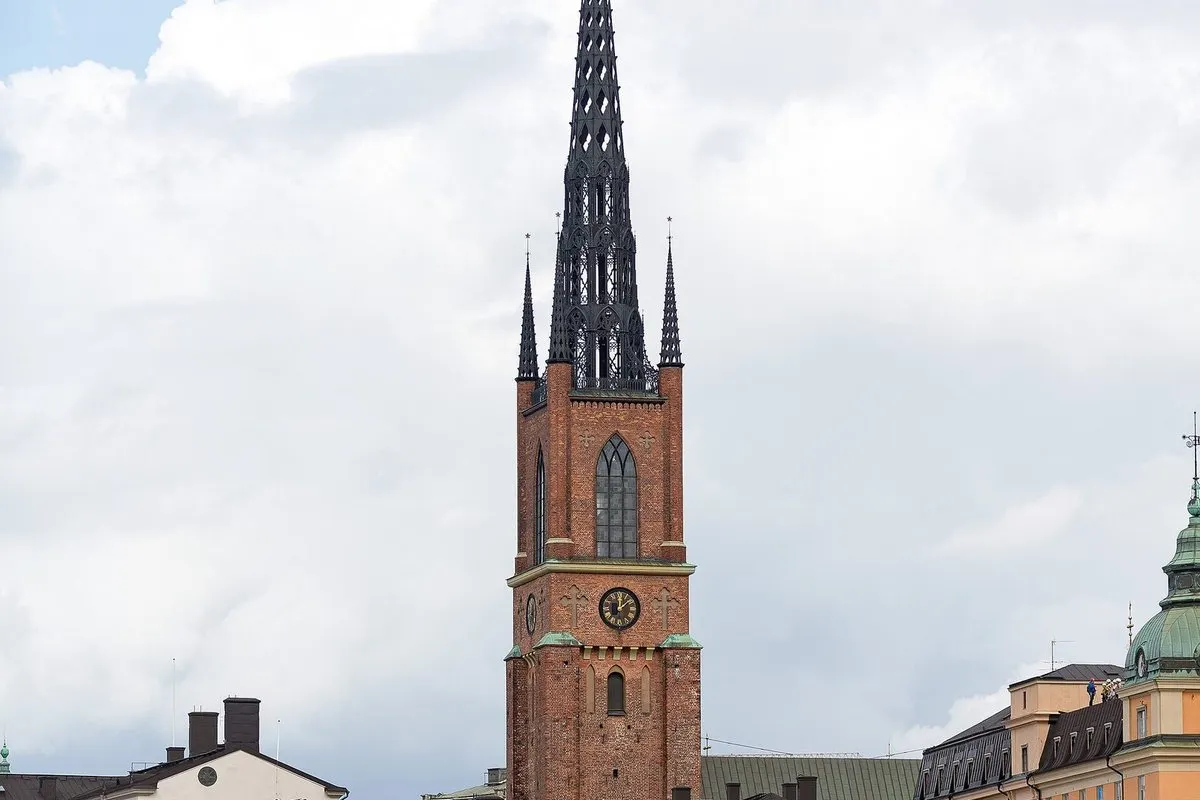
A Franciscan friary church from the 1280s, fifteen monarchs in three burial chapels and an openwork spire of cast iron. Riddarholmen Church is Stockholm's oldest surviving building – and the resting place of Sweden's kings.
In this story · 6 sections
Seen from Riddarfjärden or from the City Hall across the water, the skyline of Riddarholmen is dominated by a single feature: the tall, openwork spire of Riddarholmen Church, rising above the palaces of the little island just west of Gamla stan. The church began life in the 1280s as the church of a Franciscan friary. It is the oldest surviving building in Stockholm, with the oldest brick walls above ground, and the city's only surviving medieval monastery church. For almost four centuries it has also been the place where Sweden buries its kings.
Riddarholmen Church
Church · Riddarholmen
© OpenStreetMap contributors · OpenFreeMap
- Address
- Birger Jarls torg, Stockholm
- Built
- About 1280–1300 as a Franciscan friary church
- Royal burials
- 15 monarchs, Gustav II Adolf to Gustaf V
- Burial chapels
- Gustavian, Caroline and Bernadotte, plus five noble chapels
- Spire
- Cast iron, 1838–1841; under restoration until 2028
- Height
- 90.8 metres to the top of the cross
- Managed by
- Office of the Marshal of the Realm and National Property Board
A thirteenth-century friary church with the burial chapels of fifteen Swedish monarchs.
01A friary church of red brick
The Greyfriars' friary in Stockholm was founded, according to its surviving diary, in 1270, after a donation from King Magnus Ladulås, but work on the church did not begin until about a decade later. By 1292 it was complete enough for the king himself to be buried in its choir, and it was probably finished by the turn of the fourteenth century. It was built as a hall of two aisles, a common plan for the churches of the mendicant orders in Scandinavia and northern Germany, and it had no tower: the Franciscans' rule did not permit one. In the early fifteenth century the friary's southern cloister walk was opened up to become a side aisle.
After Gustav Vasa's Reformation the friary was dissolved and the church became a parish church. John III raised a tall tower with a copper-clad timber spire, probably designed by Willem Boy, and in 1573–1574 he set up the two great tombs before the high altar for the medieval kings Magnus Ladulås and Karl Knutsson, carved by the Netherlander Lucas van der Werdt with recumbent figures in royal robes holding crown, sceptre and orb.
02The kings' chapels
The tradition of royal burial here was revived with Gustav II Adolf, who was buried in 1634. Every Swedish monarch from Gustav II Adolf to Gustaf V, with the exception of Queen Christina, rests in the church – fifteen in all. They lie in three burial chapels built against the church: the Gustavian, the Caroline and the Bernadotte. Queens, princes and princesses lie here too, and five further chapels were built by noble families in the seventeenth century.
Insider tipOpen as a museum in summer – check dates.
The first, the Gustavian chapel on the south side of the choir, was built in 1633–1634 for Gustav II Adolf, probably to a design by the sculptor and stonemason Jost Henne in the Dutch Renaissance style. The Caroline chapel was begun in 1675 to designs by Nicodemus Tessin the Elder, but only the burial vault was finished at first; the chapel above was not completed until the mid-eighteenth century, to updated designs by Carl Hårleman. With its Rococo roof it is the most striking of all, and the Renaissance chapels around the nave contrast sharply with the plain brick Gothic of the medieval church.
A grave opening in 2011 revealed that the remains in the grave long believed to be that of Magnus Ladulås were too young to be his or his family's.
03Fire, and a spire of iron
On 28 July 1835 lightning struck the tower. The fire burned for three days; the spire collapsed, the upper part of the church was gutted and the bells fell from their frames, but the interior was saved. When the church was rebuilt in 1838–1841 the original plan was to restore its old appearance, but on the king's decision it was given instead the cast-iron spire that defines it today, made at the Åker cannon foundry. Its neo-Gothic form was drawn by the sculptor Erik Gustaf Göthe and completed by the architect Carl Gustaf Blom Carlsson. Its forerunner was the cast-iron spire of Rouen Cathedral; both were made possible by the growing power of the iron industry. From the lowest ground level at the high choir to the top of the cross, the church measures 90.8 metres. The present bell, the Seraphim Bell, was cast in 1839 using bronze from the bells destroyed in the fire.
In 2025 the National Property Board announced that the 42-metre spire would be taken down in late summer 2026, in around 2,000 pieces, to be restored because of PCB and asbestos, with the work expected to be finished in 2028. Visitors in the meantime should expect to see the church without its familiar silhouette.
04Inside
The interior is dominated by funerary monuments, and medieval wall paintings survive in the vaults. This is also the church of the Order of the Seraphim. The altarpiece was made from 1678 onwards by the sculptor Peter Schultz to designs from the Tessin circle, while the altar slab itself is medieval and still bears consecration crosses. Above the two medieval tombs in the choir hangs a great silver chandelier made in Augsburg by Andreas Wickert the Elder, a gift from Queen Hedvig Eleonora in memory of Charles X Gustav. The organ of 1920 stands behind an Empire façade designed by Fredrik Blom.
05A church of memory
The parish of Riddarholmen was dissolved in 1807, and since then the church has served as a burial and memorial church, managed by the Office of the Marshal of the Realm and the National Property Board. It is open as a museum in the summer months and for concerts, Seraphim bell-ringings and special occasions. The only regular services are a Christmas morning service arranged by the Stockholm scouts since 1937 and a Catholic Mass on 7 June, marking the death of Queen Josephine in 1876.
06Visiting Riddarholmen
The church stands on Birger Jarls torg, a short walk over the bridge from Riddarhustorget in Gamla stan. Check the summer opening dates before you go. Read about the square in VERA PI's guide to Birger Jarls torg and Riddarhustorget, follow our plan for a day in Gamla stan, and explore Gamla stan with VERA PI. Point your phone at the church with Metro Mode Camera to learn more as you go.