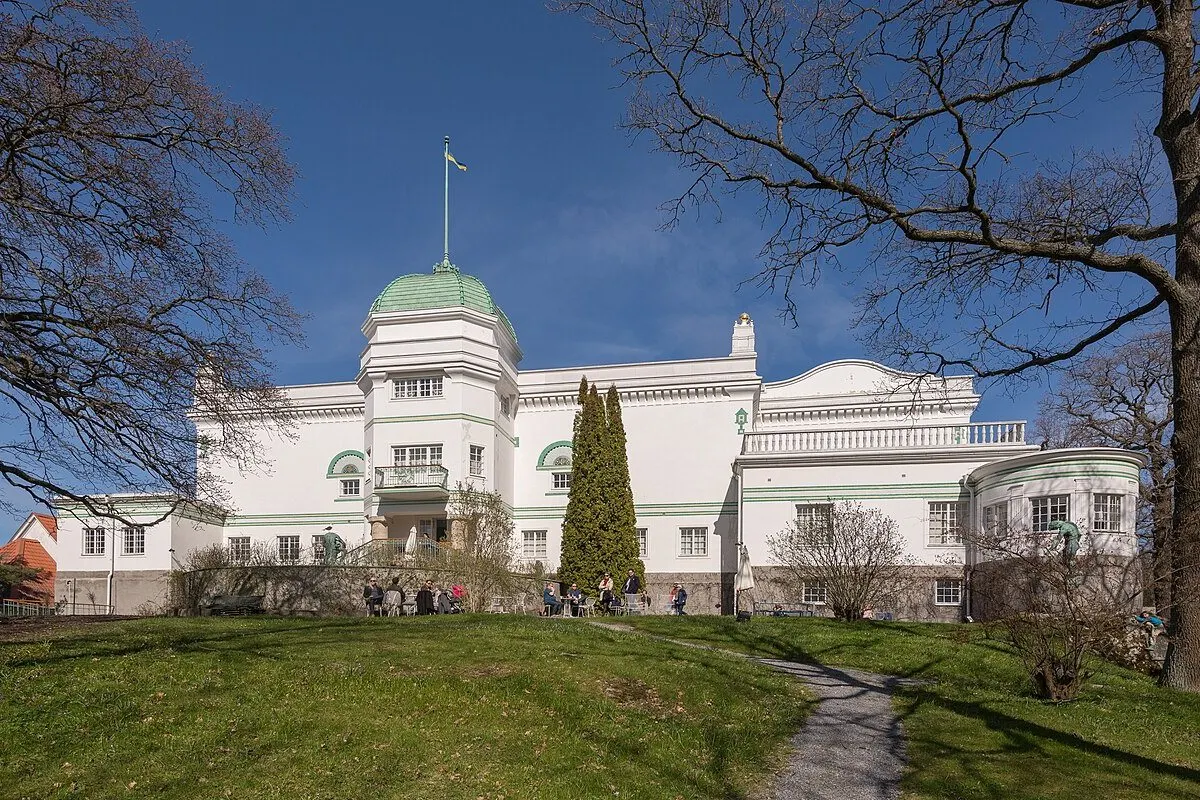
A white Jugendstil villa on the tip of Djurgården, built for a financier who wanted "pictures on every wall". The Thiel Gallery holds one of the great collections of Nordic art from around 1900 – and one of the largest Munch collections outside Norway.
In this story · 5 sections
At the far eastern tip of southern Djurgården, on Blockhusudden, a white villa with a green dome stands on the highest point of the headland. This is the Thiel Gallery, the former home of the financier and collector Ernest Thiel, and inside it hangs one of Sweden's most important private collections of art from around 1900: Bruno Liljefors, Ernst Josephson, Eugène Jansson, Carl Larsson, August Strindberg and Anders Zorn, alongside Edvard Munch, Paul Gauguin and Henri de Toulouse-Lautrec. Its holding of Munch is among the largest anywhere outside Norway. The house stands within the Royal National City Park, and the setting is as much a part of the experience as the pictures.
Thiel Gallery
Museum · Djurgården
© OpenStreetMap contributors · OpenFreeMap
- Address
- Sjötullsbacken, Stockholm
- Location
- Sjötullsbacken, Blockhusudden, southern Djurgården
- Building
- Villa Eolskulle, Ferdinand Boberg, 1905–1907
- Collection
- Just over 300 paintings plus sketches, drawings and sculpture
- Highlights
- Munch, Liljefors, Jansson, Carl Larsson, Zorn, Toulouse-Lautrec
- Opened as a museum
- 7 January 1925
- Listed building
- Since 1958
Boberg's white Jugendstil villa with works by Munch, Liljefors, Jansson, Larsson and Zorn.
01"I want to live there"
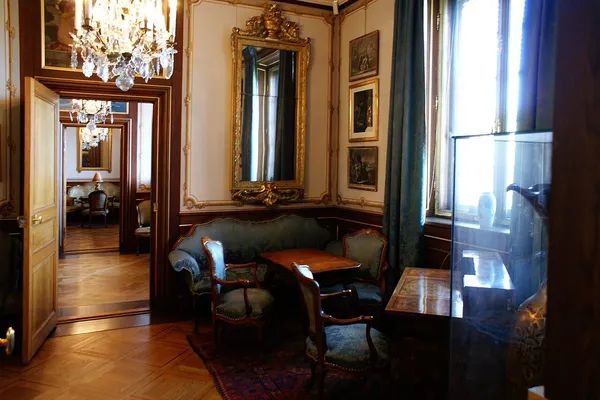
Thiel began collecting seriously after moving into a nine-room apartment on Strandvägen. In 1896 he bought his first large painting, Bruno Liljefors's "Morning Mood by the Sea", an oil measuring 119 by 209 centimetres, for 2,000 kronor. Before long the apartment could not hold the pictures and sculpture he was buying, and he needed a new home. To his architect, Ferdinand Boberg, he wrote: "I want a home decorated with pictures on all the walls; it must be comfortable; I want to live there."
His collecting rested largely on friendship. Thiel bought from artists he knew and supported them financially in the process, and three in particular were close to him: Eugène Jansson, Carl Larsson and Bruno Liljefors. Members of the Artists' Association, the artists' group of the turn of the century, are richly represented.
02Boberg's villa on the headland
Boberg designed Villa Eolskulle, named after the hill on which it stands, in Jugendstil with white façades. The first stage was finished in 1905 – Boberg had just completed Prince Eugen's palace at Waldemarsudde along the same shore. Even as the family moved in, the house proved too small for the growing collection, and Boberg was immediately commissioned to add an eastern wing with more rooms for the family and servants and a grand hall known today as the Munch Room. It was inaugurated in March 1907.
Insider tipCombine with a walk along the Djurgården shore.
The house has been altered several times since. In the 1960s the façades were rendered in grey concrete and lost much of their original lustre; a renovation in 1999 aimed to restore the building as far as possible to its first appearance, and the National Property Board renovated the interiors in 2004–2005. The villa has been a listed building since 1958.
03The collection
The museum's 2010 catalogue lists just over 300 paintings, with roughly as many sketches and drawings and a small number of sculptures. Beyond the Munch works, the names run through Nordic art of the period: J. A. G. Acke, Ivar Arosenius, Gustaf Fjæstad, Karl Nordström, Nils Kreuger, Richard Bergh, Carl Fredrik Hill, Olof Sager-Nelson and the Dane Vilhelm Hammershøi. One of the most important paintings is Toulouse-Lautrec's "Ballet Scene", which Thiel bought in 1916 for 27,000 francs.
Look out, too, for the monumental Fjæstad suite of 1907–1908 by Gustaf Fjæstad, its sofa carved from a single piece of wood, shipped to Stockholm in parts, assembled and upholstered by the furniture workshop of NK, and later joined by four matching armchairs. Thiel admired Friedrich Nietzsche, and a copy of the philosopher's death mask is part of the collection. Outside, the sculpture park holds Johan Tobias Sergel's "Faun", Auguste Rodin's "L'Ombre" and works by Gustav Vigeland.
04From private passion to public museum
In the early 1920s Thiel's finances collapsed. A sale became unavoidable, and the threat that the collection might be broken up drew wide attention. At the Gothenburg Exhibition of 1923, 93 works from the collection were shown and seen by 50,000 people, and some went on to the Royal Academy of Arts in London. When no private buyer could be found, Thiel offered the collection to the state. The trade minister Rickard Sandler was a driving force, and on 19 December 1924 the government decided to buy the collection, the villa and some of its furnishings for 1.5 million kronor – financed not by taxes but by a special lottery. Ownership passed to a foundation chaired by Prince Eugen.
The Thiel Gallery opened to the public on 7 January 1925. Admission was free at first; in the autumn of 1926 a fee of 25 öre was introduced. Since 1 November 2021 the villa has again been owned by the foundation, after a private donation allowed it to buy the building back from the state.
05Visiting
The gallery is at Sjötullsbacken on Blockhusudden. Combine it with a walk along the shore of Djurgården, and check opening hours and exhibitions before you go. Read about the street in VERA PI's guide to Sjötullsbacken, explore Djurgården with VERA PI, see where Thiel once lived on Strandvägen, and follow our plan for a day on Djurgården. On the headland, point your phone at the villa with Metro Mode Camera.