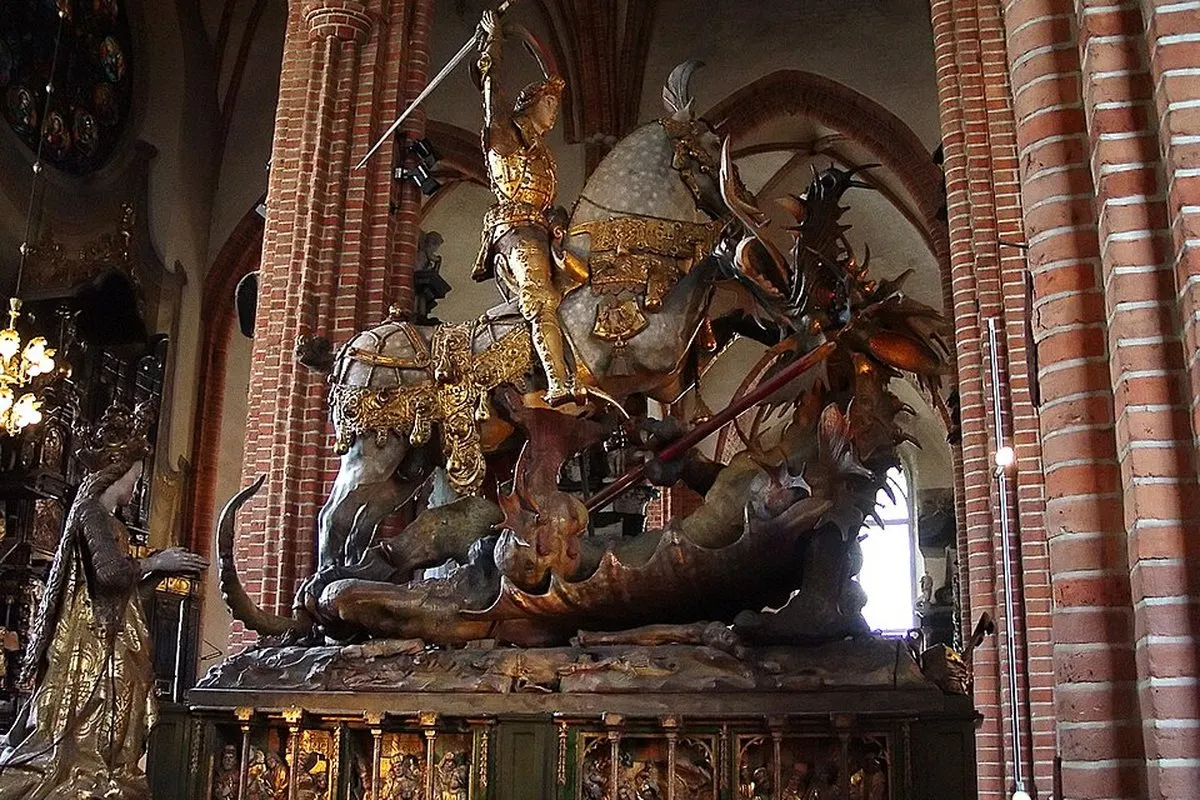
Stockholm's oldest church, where kings were crowned and royal couples married, hides a medieval masterpiece of St George and the dragon and one of the oldest pictures of the city. Storkyrkan sits between the Royal Palace and Stortorget – and is easy to walk past.
In this story · 6 sections
From Slottsbacken, Storkyrkan looks almost like part of the Royal Palace: a sober Baroque façade in ochre with a tall tower crowned by a lantern. Step inside and the illusion falls away. Behind the eighteenth-century front stands a five-aisled Gothic hall church of red brick, its interior little changed since the late Middle Ages. Storkyrkan – officially the Church of St Nicholas – is Stockholm's cathedral, the seat of its bishop and the setting for some of the most important ceremonies in Swedish history.
Storkyrkan
Church · Gamla stan
© OpenStreetMap contributors · OpenFreeMap
- Address
- Trångsund, Stockholm
- Location
- Between the Royal Palace and Stortorget, Gamla stan
- First church
- By tradition 1264
- Form
- Five-aisled Gothic hall church; Baroque exterior 1736–1742
- St George and the Dragon
- Bernt Notke, consecrated 1489
- Last coronation
- Oscar II and Queen Sophia, 12 May 1873
- Cathedral
- Since the diocese of Stockholm was founded in 1942
A Gothic hall church with Notke's St George and the Dragon and the Vädersolstavlan painting.
01The village church that became a cathedral
By tradition the first church was built in 1264 with gifts from Birger Jarl. For centuries it was simply the "village church", the only parish church in the city, standing on the highest point of Stadsholmen. In 1279 a knight's will already mentioned "Stockholm's great church". When it was consecrated in 1306 it was dedicated to St Nicholas, patron of seafarers – a fitting choice for a Hanseatic port – as well as St Olof and St Erik.
The church grew in stages. A three-aisled building was consecrated in 1306; around 1340 a square Lady Chapel was added to the south; and in the early fifteenth century the church was extended five bays to the east with eight side chapels. Towards the end of that century the walls between many of the chapels were removed, the church was raised and given larger windows, and it took the five-aisled hall form it has kept ever since. The diocese of Stockholm was founded on 1 July 1942, and Storkyrkan became the bishop's church.
02St George and the Dragon
The great treasure of the church is Bernt Notke's sculpture of St George and the Dragon, made at the end of the fifteenth century. The saint on horseback raises his sword over a writhing dragon, and the group is also a reliquary: at its consecration in 1489 a papal nuncio, Antonius Masth, handed over relics of St George, St Blaise, St Germanus, St Leo, St Martin, St Donatus and St Cyriacus, which were placed in a four-part reliquary inside the saint's chest.
Insider tipCheck opening hours – services take precedence.
03The sun-dog painting
On the wall hangs Vädersolstavlan, the sun-dog painting, an oil on panel measuring 163 by 110 centimetres and one of the oldest known pictures of Stockholm. It shows the halo phenomenon of parhelia – "sun dogs" – in the sky above the city, and its inscription dates the event to 20 April 1535. Investigation in 1999 showed that the panel itself was made in or shortly before 1636 by Jacob Heinrich Elbfas, who "renovated" – in effect copied – an earlier original that has since disappeared. Tradition links the original to the reformer Olaus Petri, but some historians date it instead to the time of John III.
04Coronations, reformers and royal weddings
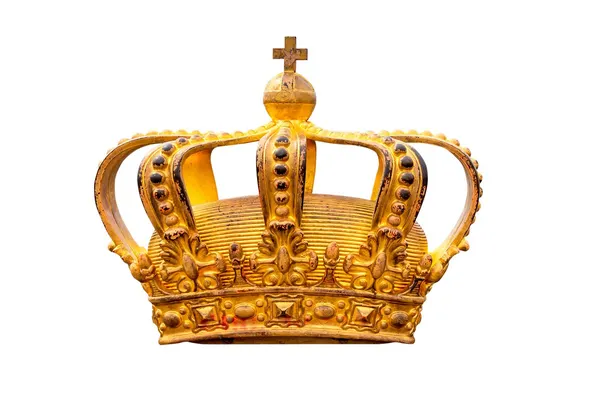
Storkyrkan has been used since the fourteenth century for coronations and state ceremonies. Magnus Eriksson and Blanche of Namur were the first to be crowned here, in 1336; Christian II followed in 1520, and Queen Christina and Charles XII were crowned here too. With one exception, every king from Frederick I onwards was crowned in the church until 1907, when Gustaf V chose not to be crowned. The last coronation took place on 12 May 1873, when Oscar II and Queen Sophia were crowned.
It was during Olaus Petri's time as priest here that the Reformation began in Sweden, and here that Mass was first celebrated in Swedish; his statue stands outside the east wall facing Slottsbacken. In 1736–1742 the city architect Johan Eberhard Carlberg gave the exterior its Baroque dress to harmonise with the palace. Inside, the pulpit and two royal pews of the 1680s were carved by Burchard Precht to Nicodemus Tessin the Younger's instructions, and the Eel Pillar has a relief by Adam van Düren of two lions fighting over an eel.
The church has also seen royal weddings: King Carl XVI Gustaf and Silvia Sommerlath were married here on 19 June 1976, and Crown Princess Victoria and Daniel Westling on 19 June 2010. Each year the opening of the Riksdag begins with a service here, attended by members of parliament and the royal family.
05The bells and the clock
The great bell, cast by Jurgen Putensen in 1638, weighs 5.2 tonnes. The smallest, the Priests' Bell from the fifteenth century, is the oldest church bell in Stockholm. Until 1909 the bells were rung by prisoners detailed to the task. The tower clock, made in 1888 at Linderoth's clock factory, still keeps time behind dials of black-painted copper with gilded Roman numerals.
06Visiting
Storkyrkan stands between the Royal Palace and Stortorget, at the top of Storkyrkobrinken. Check opening hours before you visit, as services and ceremonies take precedence. Read about the streets around it in VERA PI's guide to Storkyrkobrinken, Trångsund and Slottsbacken, and follow our plan for a day in Gamla stan. Outside, point your phone at the façade with Metro Mode Camera.