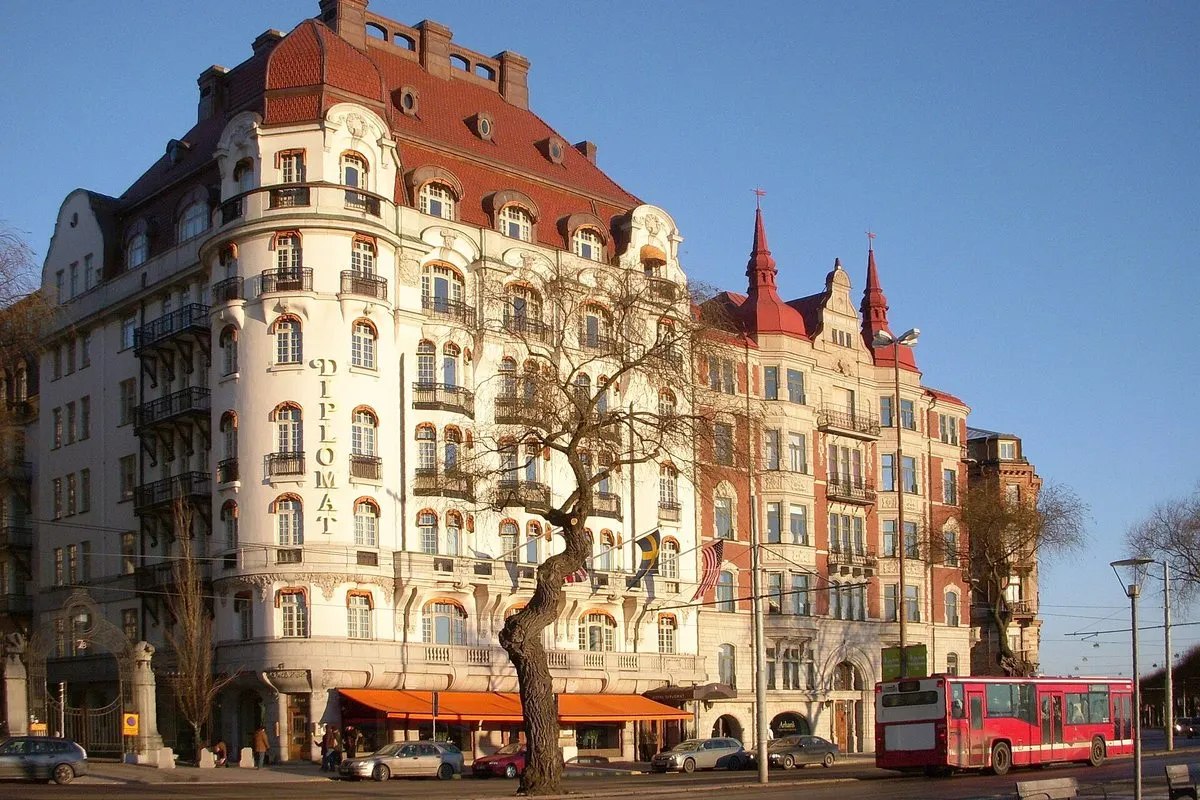
Grand flats of 550 square metres, embassies and a family in its fifth generation: Hotel Diplomat on Strandvägen 7C is Stockholm's most private large hotel. This is what it's like to stay there today.
In this story · 6 sections
Strandvägen 7 in Stockholm is a U-shaped Art Nouveau palace with two wings facing the street, and many consider it the most beautiful building on the whole of Strandvägen. In the eastern wing, 7C, is Hotel Diplomat. From the rooms facing the street you look out over Nybroviken, where the boats leave for Djurgården and the archipelago, and from the pavement below you can see the curved balconies and the soft forms typical of the early 20th-century style.
Hotel Diplomat is still owned by the family that founded it, today in its fourth and fifth generations. It shows in the details.
Hotel Diplomat
Hotel · Östermalm
© OpenStreetMap contributors · OpenFreeMap
- Address
- Strandvägen 7C, Stockholm
- Building completed
- 1911
- Architects
- Hagström & Ekman
- Hotel since
- 1966 (guesthouse from the early 1940s)
- Rooms and suites
- 130
- Largest suite
- Dagmar Master Suite, 69 m²
130 rooms and suites at Strandvägen 7C with views over Nybroviken, a restaurant, afternoon tea and a hammam.
01The house: grand flats and embassies
Strandvägen was originally the king's idea. According to the hotel's own history, it was Oscar II who wanted Stockholm to have a boulevard when the districts were expanded, partly so that the royal family's traditional spring procession to Djurgården – around the first of May – would no longer have to jolt along the uneven Storgatan. Around 1870 the city began acquiring the plots, and the first buildings were completed in 1882–1883. Oscar II died in 1907 and never saw the boulevard finished.
The Klippan block, Strandvägen 7A, B and C, was the last plot along the grand avenue to be built on. The building was designed by the architects Hagström & Ekman – Georg Hagström and Frithiof Ekman, who together designed more than 200 buildings in Stockholm – and the hotel dates its history from 1911. According to the hotel, 7C was planned with six storeys, one more than the city plan actually allowed, and each floor held two grand flats of 550 and 350 square metres, with fine parquet floors and moulded ceilings.
In 1917, 7C was bought by the family – Karl and Dagmar Bergsten – who lived in the house themselves for a few years. When the Depression emptied many of the city's large flats, the house let its floors in the 1930s, 40s and 50s to foreign embassies, among them the Italian, Chilean, Persian and Canadian. A couple of rooms the family had kept began to be let to travellers in the early 1940s under the name Strandvägspensionatet.
02From guesthouse to Hotel Diplomat
In 1962, the floor occupied by the Romanian embassy was converted into fifteen hotel rooms. Four years later, Sune Malmström bought out his siblings and rebuilt the whole building as a modern hotel. The name – Hotel Diplomat – was chosen as a reminder of the building's years with the embassies. The interior architect Gunborg Ström and the furniture designer David Rosén of NK Inredning were given the commission, and together with Malmström they chose a light, neutral Scandinavian look instead of the dark teak and mahogany of the 1960s.
Insider tipAsk for a room facing Nybroviken – or facing the courtyard if you want to sleep completely undisturbed.
The light style has endured. Today the architect Per Öberg is responsible for the hotel's design vision, and Anna Cappelen, who took over the business from her father in 2011, handles the interiors together with her daughter Pauline. The family company also runs the sister hotels Villa Dagmar on Nybrogatan and Villa Dahlia.
03Rooms: ask for Nybroviken
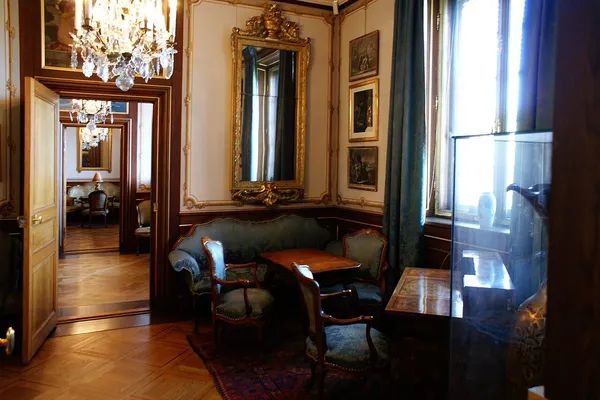
Hotel Diplomat has 130 rooms and suites, and the original details of the grand apartments remain, according to the hotel. The rooms face either the boulevard and the water or the quiet courtyard, and many have a balcony.
The hotel's largest suite, the Dagmar Master Suite, is 69 square metres with views over Nybroviken, a king-size bed, a large seating area and its own steam bath – and can be connected to three adjoining rooms for a large family. The junior suites facing Nybroviken each have their own touch of the building's Art Nouveau architecture, and the Deluxe rooms facing the water have been newly renovated. Those who prefer to sleep in quiet can choose a suite facing the courtyard, with a balcony and Scandinavian interiors.
04Afternoon tea since the 1960s
The restaurant is on the ground floor overlooking the water and serves breakfast, lunch and dinner with seasonal Nordic cooking that, according to the hotel, draws inspiration from all over the world. But the ritual to take home with you is afternoon tea, which the hotel has served since the late 1960s. On weekdays there is a weekly-changing lunch, and the hotel's shop, Butiken, sells smoothies, salads and lighter dishes from local suppliers.
05Hammam, gym and an art collection
The hotel's Retreat has a hammam, sauna, shower and relaxation chairs, and hotel guests can book it privately. Treatments are given by Mia Hjalmarsson, and the hotel recommends booking at least a week in advance. The gym is free for all guests, and the building also has a hair salon run by the hairdresser Bo Göran Guldbrand.
In the corridors hangs the family's collection of Swedish contemporary art and photography, with works by Denise Grünstein, Maria Friberg, Annèe Olofsson, Carl Fredrik Reuterswärd and Helene Schmitz, among others. New art is selected by the art adviser and co-owner Lovisa Malmström.
06Strandvägen outside the door
Strandvägen is Stockholm's grand avenue, and it deserves a walk of its own. Read our walk Strandvägen, house by house, see facts and sunlight in VERA PI's street guide to Strandvägen, or explore the rest of Östermalm. If you want to know who designed the building opposite, point your phone at the façade with Metro Mode Camera.