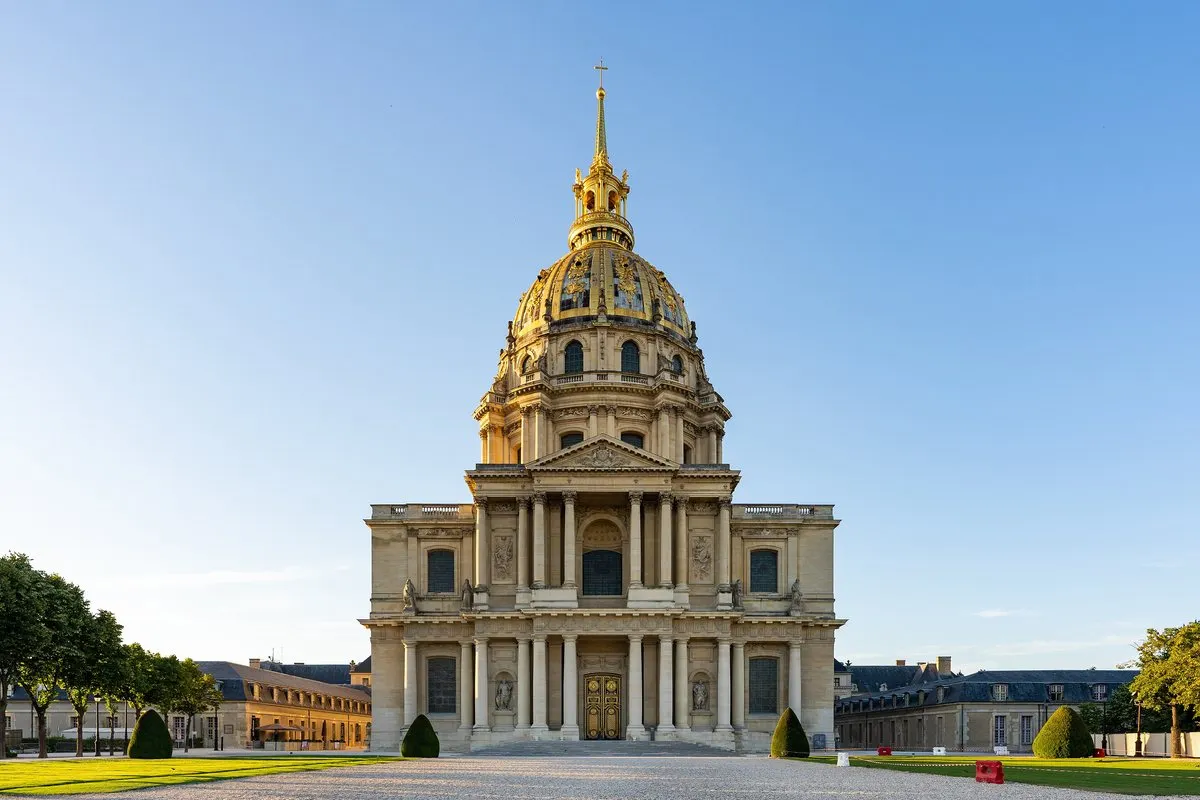
Louis XIV built it for his old soldiers; Napoleon lies beneath its dome. Les Invalides combines one of the great Baroque churches of Paris with an outstanding military museum, and it still houses veterans today.
In this story · 4 sections
Of all the domes on the Paris skyline, the gilded one above Les Invalides catches the light best. It crowns a complex in the 7th arrondissement that Louis XIV founded for soldiers too old or wounded to serve, and which still fulfils that purpose: alongside the museums and monuments, Les Invalides houses a hospital and a home for veterans. For visitors it offers a rare combination of Baroque architecture, French history and one of the world's great military collections.
Hôtel des Invalides
Museum and monument · 7th arrondissement
© OpenStreetMap contributors · OpenFreeMap
- Address
- 129 rue de Grenelle, 75007 Paris
- Founded
- 1670, by Louis XIV
- Architects
- Libéral Bruant; Jules Hardouin-Mansart (Dôme)
- Dôme
- Finished 1706; 107 metres high
- Inside
- Napoleon's tomb, Musée de l'Armée, Plans-Reliefs
- Area
- 7th arrondissement
Louis XIV's soldiers' hospital, with the Dôme des Invalides, Napoleon's tomb and the Musée de l'Armée.
01A Sun King's hospital
Louis XIV ordered the project on 24 November 1670. The first architect, Libéral Bruant, designed the long north façade and the arcaded courtyards that give the complex its calm, almost monastic order. The soldiers worshipped in the church of Saint-Louis-des-Invalides, still the cathedral of the French armed forces, its nave hung with flags captured in battle.
Shortly after the soldiers' church was begun, the king commissioned Jules Hardouin-Mansart, later the architect of the Hall of Mirrors, to build a separate royal chapel behind it. That chapel, the Dôme des Invalides, was finished in 1706. Rising to 107 metres, it is the tallest church building in Paris, and its gilded dome remains the most striking element of the whole composition.
02Napoleon's tomb
Napoleon died in exile on Saint Helena in 1821. In 1840 his remains were brought back to France and entombed beneath the Dôme with a grand ceremony, and the monumental tomb created for him was completed in 1861. From the circular balustrade you look down into an open crypt where the massive sarcophagus stands on a pedestal, surrounded by sculpted figures representing his victories. The effect is theatrical and somewhat chilling, exactly as intended.
Insider tipOne ticket covers the Dôme and the museum collections.
Around the crypt, the chapels of the Dôme hold the tombs of other French military figures, among them Napoleon's brothers and the marshals who served him, as well as later commanders. Look up before leaving: the painted cupola is one of the finest of its period in France.
03The Musée de l'Armée
The Army Museum occupies the wings around the main courtyard and covers French military history from the Middle Ages to the twentieth century. Its armour galleries are among the richest in the world, with suits made for kings and princes, and the Napoleonic rooms display uniforms, weapons and personal objects of the emperor. The galleries on the two World Wars are thorough and sober, and they deserve time if you have it.
The complex also contains the Musée des Plans-Reliefs, an extraordinary collection of scale models of fortified towns made for French kings, which is often overlooked and rarely crowded.
04Around Les Invalides
The great lawn of the Esplanade des Invalides runs north to the Seine and the Pont Alexandre III, one of the most elegant approaches in the city. To the south, place Vauban frames the view of the dome, and avenue de Tourville leads west towards the École Militaire and the Eiffel Tower. The Musée Rodin is next door on boulevard des Invalides. More in our 7th arrondissement guide.