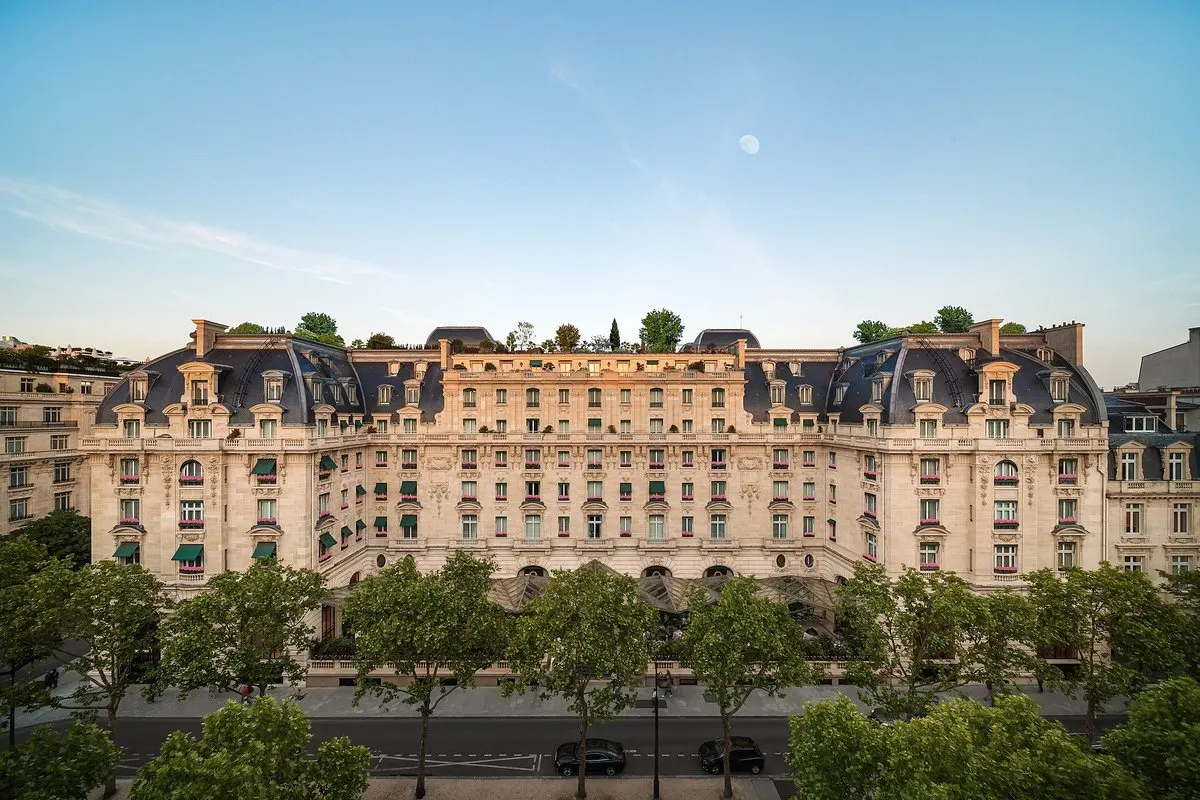
On avenue Kléber, a hotel of 1908 that became a military headquarters, UNESCO's first home and the room where the Vietnam peace was signed, before returning to hospitality in 2014.
In this story · 6 sections
In January 1973, in a salon on avenue Kléber, the agreement that ended the Vietnam War was signed. The same room is now Le Bar Kléber, and the building around it is The Peninsula Paris – a hotel that opened in 1908 as the Hôtel Majestic, spent most of the twentieth century in the service of states and institutions, and returned to its first vocation in August 2014.
It stands a short walk from the Arc de Triomphe in the 16th arrondissement and has held France's Palace distinction since 2016.
The Peninsula Paris
- Address
- 19 avenue Kléber, 75116 Paris
- Built
- 1905–1908 as Hôtel Majestic
- Architect
- Armand Sibien
- Restoration
- Richard Martinet (architecture), Henry Leung (interiors); reopened August 2014
- Distinction
- Palace (since 2016)
- Rooms
- 200, including 34 suites
- Restaurants
- L'Oiseau Blanc (two Michelin stars), LiLi, Le Lobby
- Bar
- Bar Kléber, Terrasse Kléber
01From Palais de Castille to Hôtel Majestic
The site has a royal prologue. In 1864 Alexander Basilewsky built a palace here, and in 1868 the exiled Queen Isabella II of Spain bought it and renamed it Palais de Castille; she formally abdicated there on 20 June 1870. After Basilewsky's death the property passed to the hotelier Leonard Tauber, who between 1905 and 1908 raised the Hôtel Majestic to designs by the architect Armand Sibien.
The Majestic soon found its place in the cultural life of the city. In 1922 it hosted a dinner, often remembered as the dinner of giants, at which Marcel Proust, Pablo Picasso, Igor Stravinsky and James Joyce sat at the same table. In 1928 George Gershwin stayed here while composing An American in Paris.
02A century in the service of history
During the First World War the hotel served as a hospital for wounded officers, and in 1919 it housed sessions of the inter-Allied peace talks. In 1936 the French state acquired the building for the Ministry of Defence. Between 1940 and 1944 it was occupied by the German military high command, and in August 1944 the Liberation of Paris was fought around its walls.
From 1946 to 1958 the former Majestic was the headquarters of UNESCO. It went on to serve as an international conference centre: the Paris Peace Accords were signed here in 1973, and in 1991 the treaty that ended the Cambodian civil war.
03Four years of restoration
When the state decided to sell, the building was restored over roughly four years at a reported cost of 338 million euros. The architectural restoration was led by Richard Martinet of Affine, the interiors by Henry Leung of Chhada Siembieda & Associates. French craftsmen recreated the Saint-Leu limestone façades and the monumental glass canopy over the entrance, using traditional techniques.
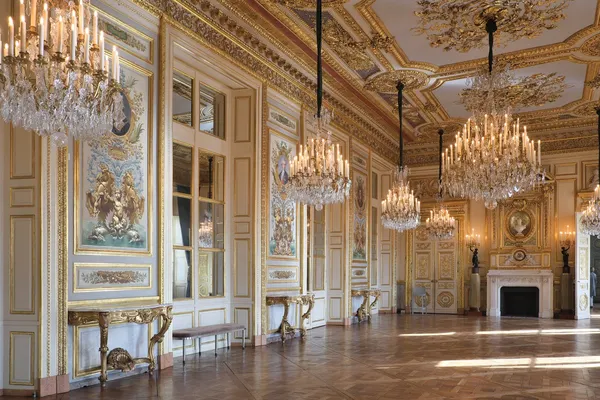
The lobby is crowned by a cascading chandelier of glass leaves, inspired by the plane trees of avenue Kléber, and there are installations by Ben Jakober and Xavier Corberó. The hotel has 200 rooms, 34 of them suites; five suites have private rooftop gardens. The Suite Historique keeps its herringbone parquet, mouldings and period fireplaces.
04L'Oiseau Blanc on the roof
On the sixth floor, beneath a glass roof, L'Oiseau Blanc takes its name from the biplane in which Charles Nungesser and François Coli attempted the first non-stop crossing of the North Atlantic in 1927. A full-size replica with an eleven-metre wingspan hangs in the dining room, its nose turned towards the Eiffel Tower. The terrace looks out from the tower to Sacré-Cœur.
The chef is David Bizet, the pastry chef Anne Coruble, and the restaurant holds two stars in the Michelin Guide, which describes its cooking as contemporary French gastronomy. The hotel also has LiLi, a Cantonese restaurant, Le Lobby for breakfast, lunch and dinner, and Bar Kléber with its terrace.
05The spa and the neighbourhood
The spa, fitness room and indoor pool occupy levels excavated beneath the building. Above ground, the Étoile is minutes away. The whole city, arrondissement by arrondissement, is in VERA PI's guide to Paris, and more of the world's great hotels are collected on metromode.co.
06Making the most of a stay
Order a drink in Le Bar Kléber, the room in which the 1973 accords were signed. Book L'Oiseau Blanc when you book the room. For the full sense of the restoration, ask about the Suite Historique or one of the suites with a rooftop garden.