Built for the Exposition Universelle of 1900, the two palaces off the Champs-Élysées face each other across a single avenue. One has just emerged from a four-year renovation; the other hides a free museum and a garden café. How to see both in a day.
In this story · 5 sections
Between the Champs-Élysées and the Seine in Paris, two palaces of stone, iron and glass face one another across avenue Winston-Churchill. They were built together, between 1897 and 1900, for the Exposition Universelle that also gave the city the Pont Alexandre III, and they remain the most exuberant statement of Belle Époque confidence in the capital. Seeing them together, on foot, makes for one of the most rewarding half-days in the 8th arrondissement.
Petit Palais
Museum · 8th arrondissement
© OpenStreetMap contributors · OpenFreeMap
- Address
- Avenue Winston-Churchill, 75008 Paris
- Built
- 1897–1900, for the Exposition Universelle
- Grand Palais
- Exhibitions and fairs; reopened June 2025
- Petit Palais
- City of Paris Museum of Fine Arts, by Charles Girault
- Admission
- Petit Palais permanent collection free
- Area
- 8th arrondissement
The City of Paris Museum of Fine Arts, in a palace built for 1900, with a free permanent collection and a garden courtyard.
01The Grand Palais: a nave of glass
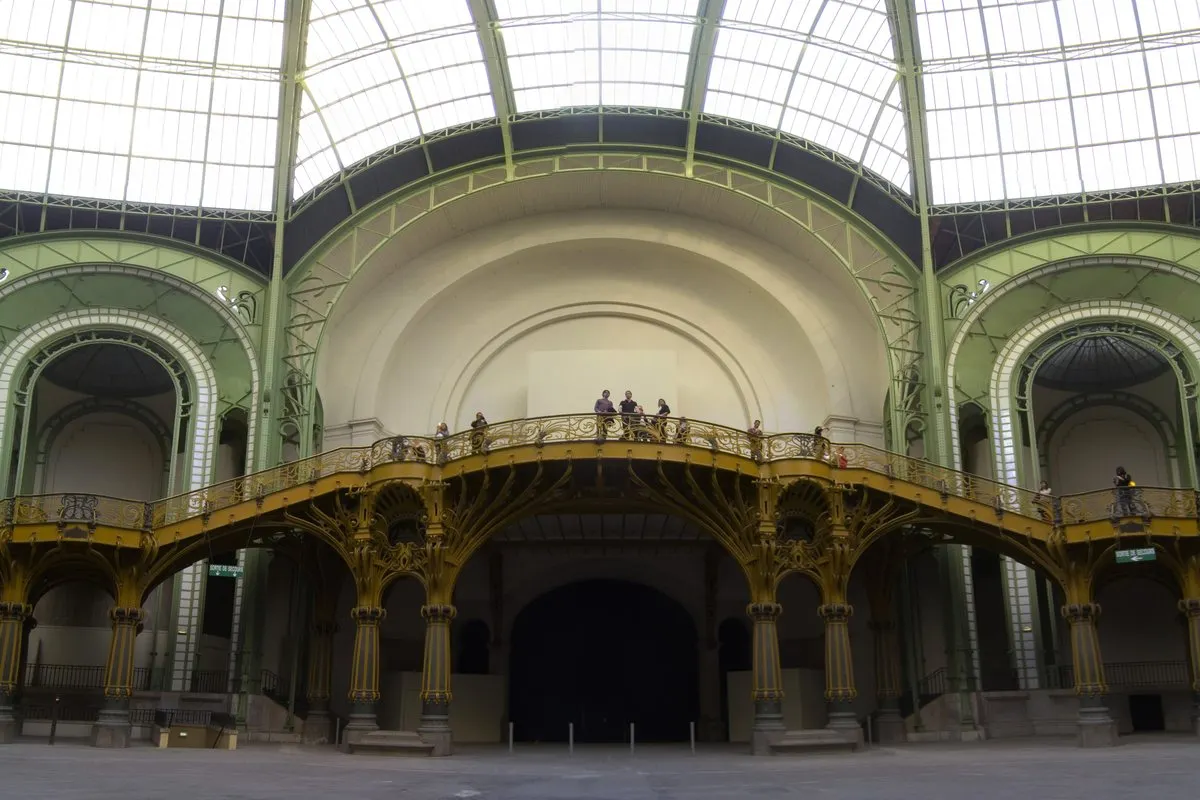
The Grand Palais replaced the Palais de l'Industrie of 1855 and was designed as a vast venue for official artistic events. Its Beaux-Arts façades of carved stone conceal a structure of iron and light steel, with reinforced concrete, the technical novelties of the age. An inscription on the building describes it as a monument dedicated by the Republic to the glory of French art.
The heart of the building is the nave, a great hall under a glass roof that floods the space with daylight. It has hosted horse shows, motor shows, aviation salons and art fairs, and the building has had a turbulent history: when a glass panel fell from the roof in 1993 the nave closed for restoration and did not fully reopen until 2007.
02Renovated for a new century
The most recent transformation began in 2021. The nave was readied in time for the Paris 2024 Olympic Games, when it hosted the fencing and taekwondo, and in June 2025 the Grand Palais reopened in full after a four-year overhaul costing around €466 million. Circulation has been rethought, previously closed spaces opened up and the galleries connected, so that the building now works as a single cultural complex rather than a set of separate halls.
Insider tipClosed on Mondays. Temporary exhibitions are ticketed.
In practice, what you see depends on the programme. The Grand Palais is the stage for major exhibitions and for some of the city's most important fairs, including Art Basel's Paris edition in the autumn. Check what is on before you go; even on a day without a show you can admire the building from the outside, and the views of the roof from the Pont Alexandre III and the riverbank are part of the pleasure.
03The Petit Palais: a free museum of fine arts
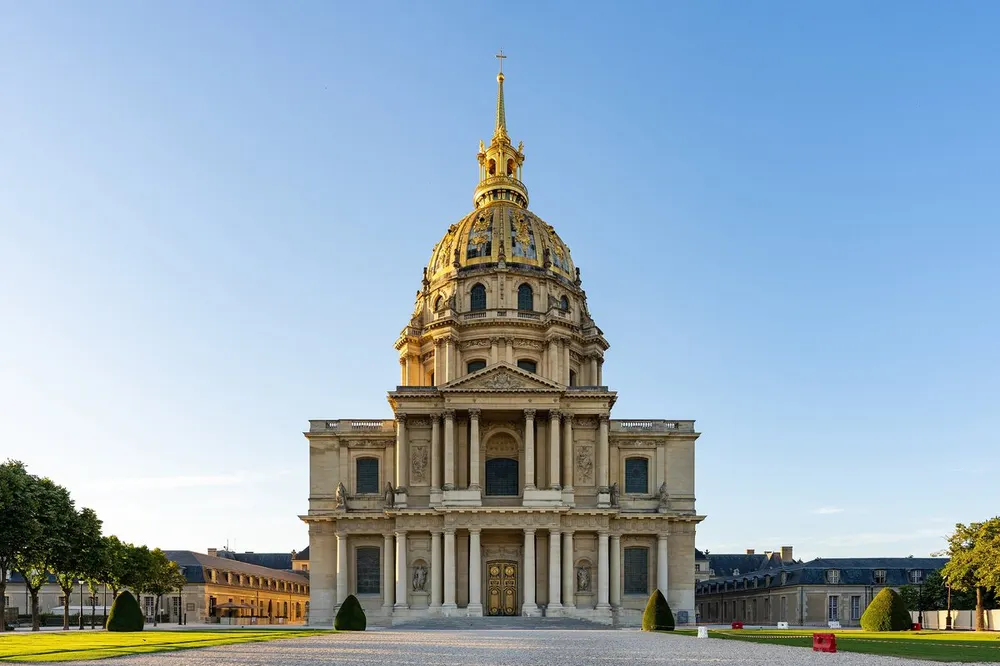
Across the avenue, the Petit Palais is smaller only by comparison. Designed by Charles Girault, who won the competition for the exhibition site, it was built from October 1897 to April 1900 and now houses the City of Paris Museum of Fine Arts. Its gilded entrance gate, its painted cupolas and its mosaic floors would be reason enough to visit.
The permanent collection spans antiquity to 1900, with Greek vases, medieval objects, Renaissance pieces, French painting of the eighteenth and nineteenth centuries and a fine group of Art Nouveau decorative arts. Look out for works by Courbet, Delacroix and Monet, and for the painted ceilings by Albert Besnard and others in the galleries. As with the other City of Paris museums, the permanent collection is free to visit; paid temporary exhibitions are held alongside.
04The garden café
The Petit Palais's best-kept secret is its semicircular inner garden, surrounded by a curved colonnade with mosaic floors and painted vaults. A café serves from its terrace, and on a fine day there are few calmer places for a coffee within sight of the Champs-Élysées. Go in the late morning before the lunch rush.
05A route through the quarter
Start at the Petit Palais on avenue Winston-Churchill, cross to the Grand Palais for its current exhibition, then walk down to the Pont Alexandre III for the view back towards both. The riverside Cours la Reine leads west towards avenue Montaigne, and the avenue des Champs-Élysées is a few minutes north. More addresses in our 8th arrondissement guide.