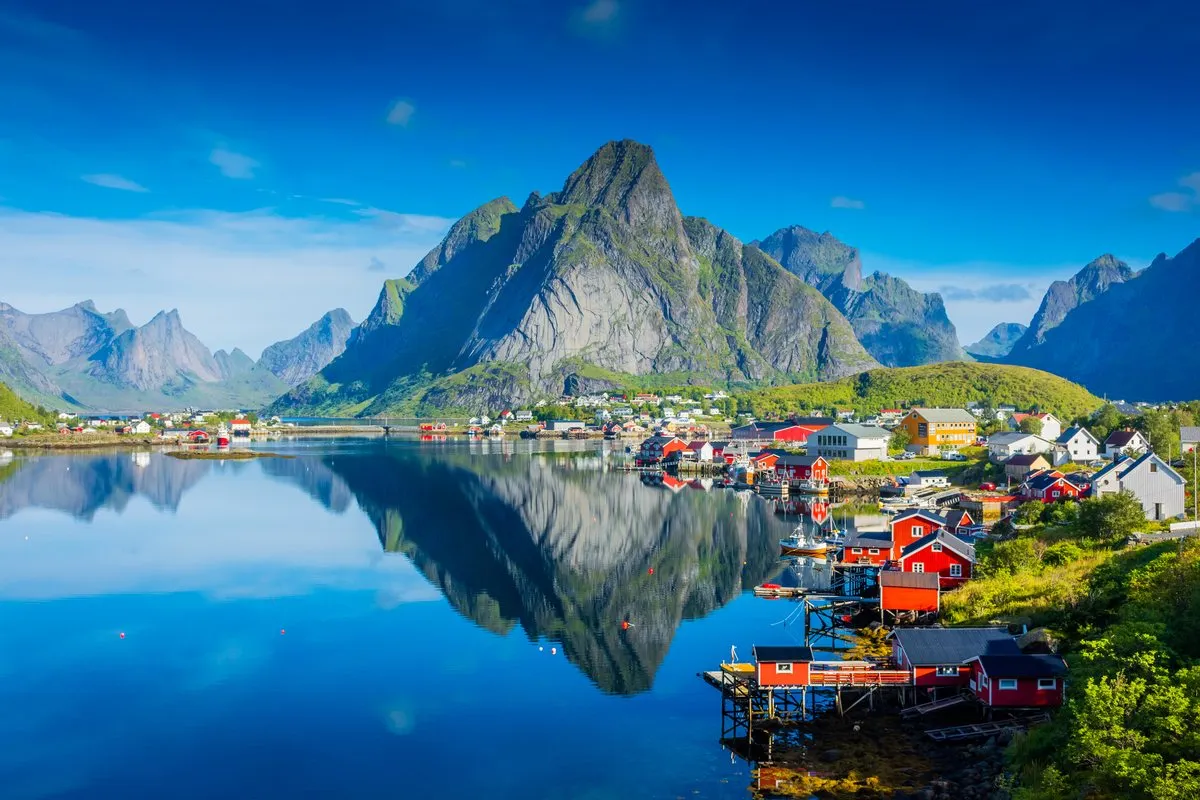
Lofoten is a chain of islands north of the Arctic Circle, where the mountains plunge straight into the sea and cod has built fortunes for a thousand years. Since 2007 the road has run all the way out from the mainland. Our route follows the E10 west, from Svolvær to the village of Å, where the road ends.
In this story · 7 sections
Lofoten is an archipelago and traditional district in Nordland county, Norway, with steep mountains and peaks, open sea, sheltered bays and beaches. The islands lie north of the Arctic Circle but have unusually mild winters for their latitude – possibly the greatest positive temperature anomaly in the world relative to latitude. By 2017 Lofoten had around a million visitors a year, and winter tourism is growing: more and more people come for the northern lights and the polar night. The origin of the name is disputed; one theory is the Old Norse word for a lynx's foot, which the island of Vestvågøya is said to resemble.
Since the Lofoten Mainland Connection, Lofast, opened on 1 December 2007, you can drive all the way from the mainland without taking a ferry; the larger islands were already linked by bridges and undersea tunnels. The route below follows the E10 from Svolvær in the north-east to Å in the south-west.
01Cod – the reason Lofoten exists
The waters around Lofoten are a spawning ground for North Atlantic cod, and when spawning begins in winter the Lofoten fishery gets under way – the seasonal fishery that has shaped the islands' history. The climate is ideal for stockfish, unsalted cod dried in the cold air and wind on wooden racks called hjell. Stockfish is Norway's oldest export still traded today: Egil's Saga tells how the chieftain Torolf Kveldulfsson shipped stockfish from Helgeland to England as early as 875, and it accounted for most of Norway's trade income from the Viking Age right through the Middle Ages.
02Svolvær and Kabelvåg – Northern Norway's first town
Svolvær, on the island of Austvågøya, is Lofoten's largest town, with 4,736 inhabitants in 2023, and its coat of arms shows a swimming cod. Just west of the town, by the narrow natural harbour near Kabelvåg, lay Vågar – the first known town in Northern Norway, mentioned in the Heimskringla and in existence from around 1000 to 1400. King Øystein Magnusson built a church and fishermen's cabins here in the 12th century.
In Kabelvåg stands Vågan Church, known as the Lofoten Cathedral: a yellow cruciform wooden church from 1898 with around 1,200 seats, the largest wooden building in Northern Norway. The village is also home to the Lofoten Museum, the Lofoten Aquarium and Galleri Espolin.
03Henningsvær – the fishing village on the islets
Turn off south towards Henningsvær, a fishing village on a string of small islands off the south coast of Austvågøya, linked to the rest of the municipality by the Henningsvær bridges. The village had 507 inhabitants in 2023 and draws visitors with its traditional fishing-village buildings, climbing and diving. The name is first recorded in 1567. The football pitch on one of the islets, surrounded by sea and mountains, has become world-famous through drone footage.
04Borg – the Viking chieftain's hall
On Vestvågøya, in the village of Borg, archaeologists found the remains of a chieftain's house in 1983 that probably stood as early as around 500 and was extended in the 8th century. It proved to be the largest Viking Age building found in Norway. The Lofotr Viking Museum, opened in 1995, has reconstructed the 83-metre-long house just north of the excavation site, with a smithy, a boathouse and two replicas of the Gokstad ship. Two exhibition halls show the finds from Borg.
05Nusfjord – one of Norway's best-preserved fishing villages
On the south side of Flakstadøya lies Nusfjord, one of Norway's oldest and best-preserved fishing villages, where people have fished since the mid-19th century. It is not on Unesco's World Heritage List, as is sometimes claimed, but during European Architectural Heritage Year in 1975 it was chosen as one of three Norwegian pilot projects for preserving wooden buildings. Here the sun sets for the last time before the polar night on 8 December and returns on 4 January.
06Reine and Hamnøy – the postcard view
On Moskenesøya lies Reine, the municipality's administrative centre, with 297 inhabitants and a trading post since 1743. In December 1941 the Germans burned part of the village in reprisal for a British raid on the islands. In the late 1970s the weekly magazine Allers named Reine Norway's most beautiful village, and the view from the mountain Reinebringen graces countless tourist brochures. Between 2016 and 2019 a stone staircase was built to the summit, making the once steep and muddy climb easy. Just north-east of Reine is Hamnøy, once reached by ferry and now linked by bridges on the E10.
07Å – where the road ends
Furthest out lies Å, where the E10 – here called Kong Olavs veg – comes to an end. The name comes from the Old Norse á, a small river, and was spelt Aa until the spelling reform of 1917. Until the 1990s Å was a small fishing village specialising in stockfish; today tourism matters most, with the Lofoten Stockfish Museum and the Norwegian Fishing Village Museum as the main sights. It is a fitting end point: a village that tells the whole story of Lofoten in a single letter.
More Nordic destinations can be found among Metro Mode's destinations. Also read our perfect day in Helsinki, take the Stockholm archipelago by boat and discover how Copenhagen became one of the world's great food cities.