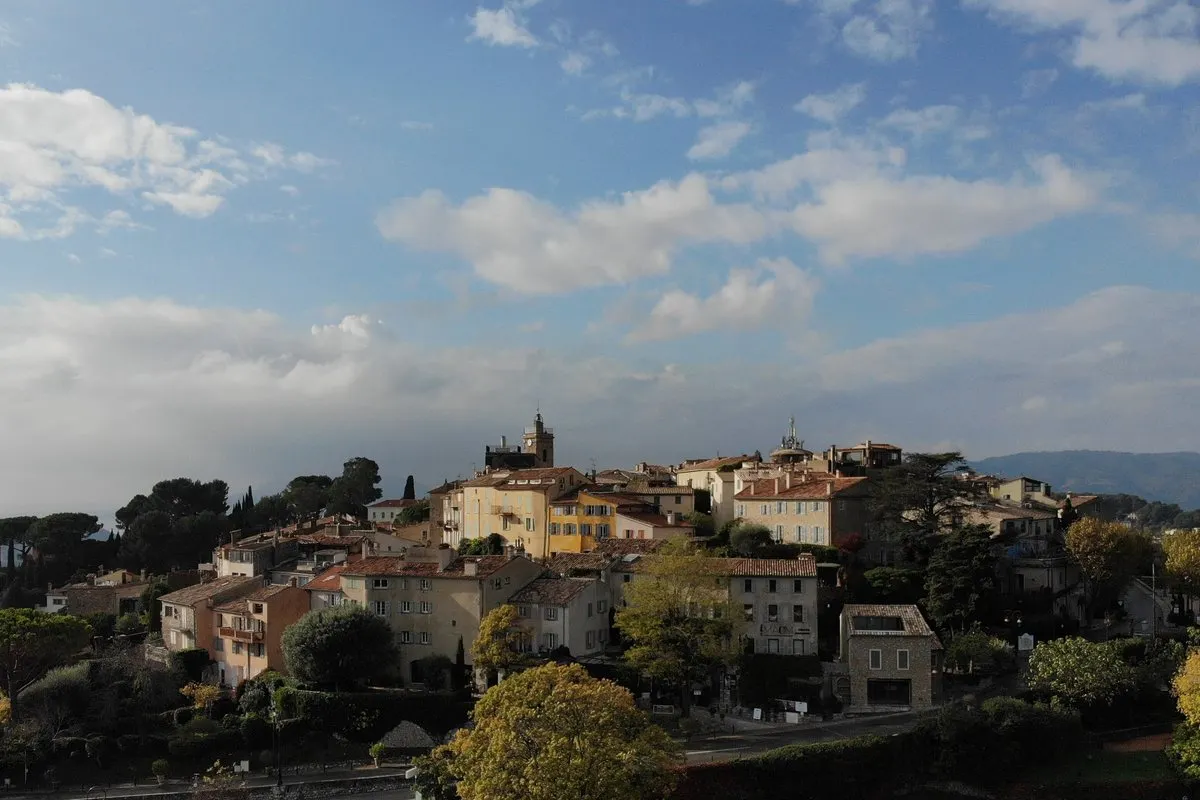
Above Cannes lies a village built in a spiral around its own hill. This is where Picabia, Léger, Cocteau and finally Picasso moved – and after the artists came the chefs. A guide to Mougins, the Riviera's village of fine dining.
In this story · 4 sections
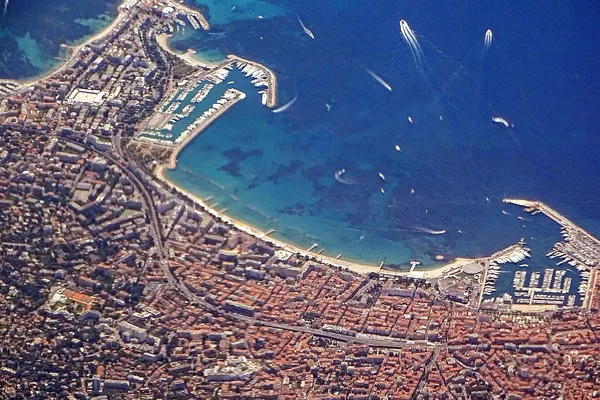
From the air, Mougins' old village looks like a shell. The houses lie in rings around the top of the hill, 260 metres above sea level, and the lanes follow the circle of the old town wall even where the wall was demolished long ago. All around spread pine forests, olive groves and cypresses, and a quarter of an hour's drive to the south lies Cannes. It is one of the Riviera's smallest villages – and one of its most influential, first for artists and then for chefs.
The municipality was for a long time a farming area that lived on jasmine picking. Today it is one of the more exclusive addresses in the Côte d’Azur’s hinterland, but the village itself has retained its form and its scale. Facts about the municipality can be found on VERA PI’s page about Mougins.
5 places
© OpenStreetMap contributors · OpenFreeMap
- 01FAMM – Femmes Artistes du Musée de MouginsMuseum · Old village
- 02Musée de la Photographie André VillersMuseum · Old village
- 03Place du Commandant LamySquare · Old village
- 04Le LavoirSight · Old village
- 05Chapelle Notre-Dame-de-VieChapel · Notre-Dame-de-Vie
- 1924
- Francis Picabia builds a house in Mougins
- 1937
- Picasso, Éluard, Cocteau, Léger and Man Ray at Hôtel Vaste Horizon
- 1961–1973
- Picasso's final years at Notre-Dame-de-Vie
- 2024
- FAMM opens with female artists
The monks' village
The hill has been inhabited since pre-Roman times, and during the first century BC the settlement of Muginum grew up on the Via Aurelia between Rome and Arles. In 1056, the Count of Antibes gave the hill to the monks of Saint-Honorat, the island off Cannes, and until the French Revolution the village's history followed that of the monastery. The monks' old courtroom, a vaulted chamber known as the Salle des Moines, still stands today on the first floor of the building where the restaurant L'Amandier is located.
During the Middle Ages, the village was fortified with walls and three gates. Only one of them remains, the Porte Sarrazine. During the War of the Austrian Succession in the 1700s, the village was plundered and burnt by Austro-Sardinian troops, after which parts of the wall were demolished. At the heart of the village today lies Place du Commandant Lamy, with a shaded spot, a large fountain from the late 1800s, and the old wash house close by.
The artists arrive
It was the surrealist Francis Picabia who, in 1924, built his house in Mougins. His friends followed: Fernand Léger, Paul Éluard, Robert Desnos, Jean Cocteau, Isadora Duncan and Man Ray. From 1937, Picasso, Éluard, Cocteau, Léger and Man Ray lived at Hôtel Vaste Horizon. Christian Dior had a residence right in the centre of the village.
Picasso came back for good. His last twelve years, 1961–1973, he lived in a mas near Notre-Dame-de-Vie, a small hill right next to the old village, and that is where he died. His studio was in the village, in the house that today is the tourist office. Winston Churchill used to sit out in nature in front of the Notre-Dame-de-Vie chapel to write, close to his neighbour Picasso. The chapel, dating from the 16th century, stands on the site of a Roman temple, and the walk there from the village is one of the most beautiful in the area.
Museums in the village
The Musée de la Photographie André Villers is built around Picasso's friend and house photographer André Villers. Here, portraits of the artist taken by Villers and other photographers, among them Denise Colomb, are displayed, together with a collection of old cameras and temporary exhibitions of contemporary photography.
In a medieval house in the village, the British collector Christian Levett opened a museum for ancient art in 2011. In June 2024, it was transformed into FAMM, Femmes Artistes du Musée de Mougins, a museum devoted solely to female artists. The collection comprises over a hundred works by around 80 artists from 1870 to the present day: Impressionists such as Berthe Morisot, Mary Cassatt and Eva Gonzalès, and Surrealists such as Frida Kahlo, Leonor Fini and Leonora Carrington.
The village at the table
After the artists came the chefs. Roger Vergé, one of the great names of twentieth-century French cuisine, created the Moulin de Mougins and helped launch the village's international gastronomy festival. The festival is held every September, when the village's lanes fill with chefs, demonstrations and tastings.
For the rest of the year, it is the restaurants that keep the village alive. Around Place du Commandant Lamy and along the alleys lie table after table beneath the awnings, and after nightfall, when the day-trippers have left, Mougins is at its most beautiful. The village also has around twenty galleries and studios.
If you'd like to continue inland, Valbonne is a short drive away, and towards the coast awaits Antibes. You'll find more destinations on metromode.co and in our guide to Monaco.
FAMM – Femmes Artistes du Musée de Mougins
Museum of women artists
Christian Levett's 2024 museum featuring works by, among others, Morisot, Cassatt and Kahlo.
Rue du Commandeur, Mougins
Musée de la Photographie André Villers
Picasso through the camera
Portraits of Picasso, a camera collection and temporary photography exhibitions.
Rue des Remparts, Mougins
Place du Commandant Lamy
Village square
Shady square with a fountain from the late 19th century, surrounded by restaurants.
Le Lavoir
The old wash house
The village's old wash house just next to the square.
Chapelle Notre-Dame-de-Vie
The chapel at Picasso's mas
Chapel from the 1500s on the site of a Roman temple, near the house where Picasso spent his final years.