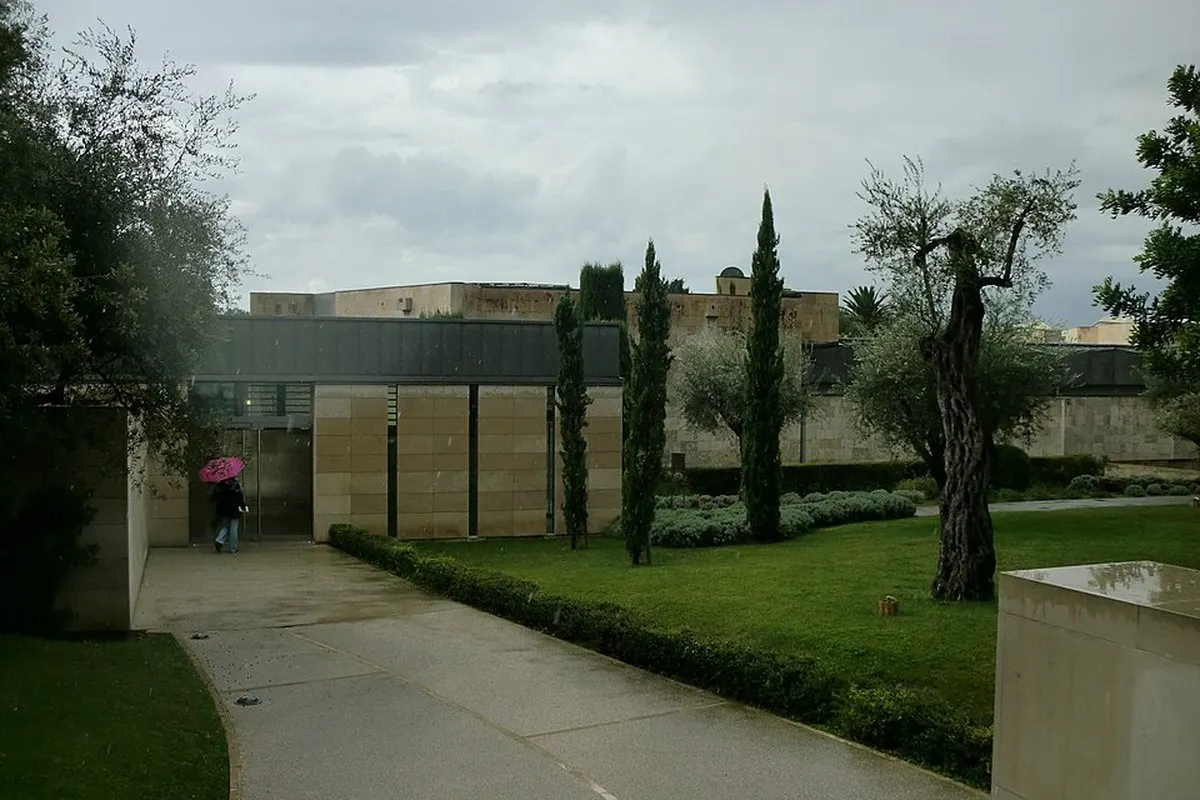
Marc Chagall was nearly 80 when he began giving the French state the works that would become the museum in Cimiez. Since 1973, his Message biblique has hung in rooms built for it, with his own stained-glass windows in the concert hall and a garden in cool tones.
In this story · 5 sections
On the corner of boulevard de Cimiez and avenue du Docteur Ménard in Nice stands a low building of pale stone behind olive trees and cypresses. The Musée national Marc Chagall was built while the artist was alive, for the works he himself had given to the state, and he was present when it was inaugurated.
Musée national Marc Chagall
Museum · Cimiez, Nice
© OpenStreetMap contributors · OpenFreeMap
- Address
- 36 avenue du Docteur Ménard, 06000 Nice
- 2 May–31 October
- 10am–1pm and 2.30pm–6pm
- 1 November 2026 – 30 April 2027
- 10am–1pm and 2.30pm–5pm (in March until 4.30pm)
- Entrance without temporary exhibition
- 10 euros, reduced 8 euros
- Entrance with temporary exhibition
- 12 euros, reduced 10 euros
- First Sunday of the month
- Free
André Hermant's 1973 museum featuring Chagall's twelve paintings Message biblique and stained-glass windows in the concert hall.
01Chagall's gift and Malraux's decision
According to the French Ministry of Culture, Marc Chagall, then nearly 80, donated a large number of works to the French state in 1966 and 1972, with the support of the Minister of Culture André Malraux. In 1969, Malraux decided that a museum should be built to preserve the Message biblique, and in 1970 construction began on land donated by the city of Nice. According to the region's tourist board, the founding collection, which Chagall himself put together, comprised more than 250 works.
The museum was inaugurated in 1973 in the presence of Chagall, Malraux and the Minister of Culture Maurice Druon. After Chagall's death in 1985, further works were added in 1987 through a so-called "dation", whereby the heirs paid inheritance tax with art. In 2008, the museum was given its current name.
02André Hermant's building and Henri Fisch's garden
The architect André Hermant (1908–1978) designed the building between 1966 and 1973. It is single-storey, with an austere façade in stone from La Turbie. The light was originally meant to come from above but was changed to side light so that the paintings would be better seen. In 2000, the building received the Architecture contemporaine remarquable label. Major works were carried out in 2007 and 2018, with a new entrance and improved accessibility.
Insider tipClosed on Tuesdays.
The landscape architect Henri Fisch planned the garden from the very beginning. Chagall wanted Mediterranean plants in cool tones, and several ponds provide coolness.
03Message biblique – twelve paintings, one wall each
In the great hall hang twelve paintings illustrating the Book of Genesis and the Book of Exodus, with one wall for each work. This is the core of the museum and the reason it was built. A mosaic that Chagall made together with Lino Melano also features in the museum.
04Concert hall and stained glass
Chagall asked for a concert hall among the museum's rooms, and for it he created stained-glass windows together with the glassmaker Charles Marcq. The museum has since run a concert programme that Chagall himself set in motion. Visitor numbers have gone from 30,000 in the first year to more than 178,000 in 2019.
Source: Provence-Alpes-Côte d'Azur Tourisme. Ticket sales end 30 minutes before closing. Closed 1 January, 1 May and 25 December.
05Cimiez – Chagall and Matisse on the same hill
From the Chagall Museum, the road leads up boulevard de Cimiez to the Musée Matisse in the olive grove, and the two museums work well on the same day. More destinations can be found among our Riviera guides on metromode.co.