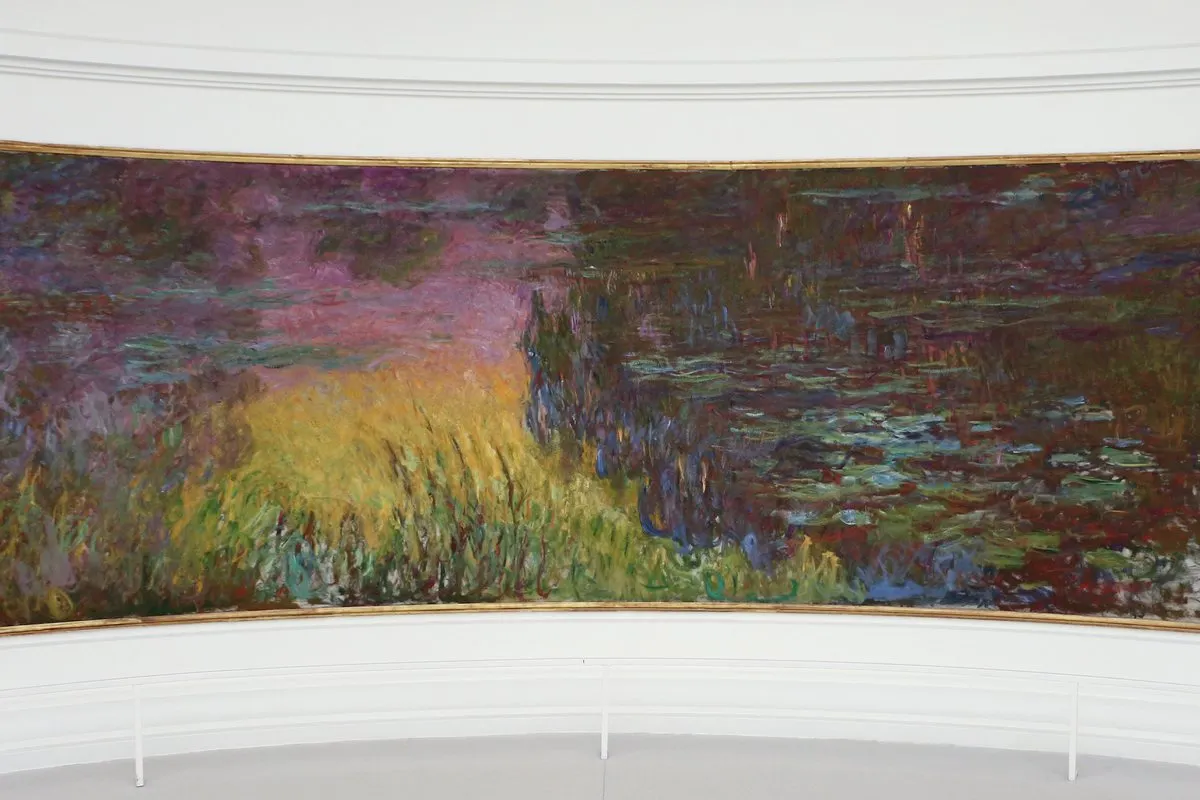
Eight paintings, 91 metres of water lilies and daylight from the ceiling. Monet helped design the rooms at the Musée de l'Orangerie in Paris – here's the story behind the halls and how best to view them.
In this story · 5 sections
In the western corner of the Tuileries Garden, by the Place de la Concorde in Paris, stands a long, low building that once sheltered orange trees from the winter cold. Today, the Musée de l'Orangerie is the permanent home of Claude Monet's eight large Water Lilies – paintings that the artist himself helped to place. The rooms are one of Paris's great art experiences, and they can be seen in an hour.
Musée de l'Orangerie
Museum · 1st arrondissement
© OpenStreetMap contributors · OpenFreeMap
- Address
- Jardin des Tuileries, Place de la Concorde, 75001 Paris
- Address
- Jardin des Tuileries, Place de la Concorde, 75001 Paris
- Orangery built
- 1852
- Museum opened
- May 1927
- Water Lilies
- 8 panels, 2 m high, 91 m in total
- Walter-Guillaume collection
- Acquired in 1959 and 1963
- Most recent renovation
- 2000–2006
Napoleon III's orangery with Monet's rooms and the Walter-Guillaume collection.
01A greenhouse for the Tuileries' citrus trees
Napoleon III had the orangery built in 1852 to designs by the architect Firmin Bourgeois. The south side facing the Seine is made of glass to let light in to the trees, whilst the north side is almost entirely without windows to protect against cold winds. Before this, the trees had been kept in the Louvre's Grande Galerie. After the fall of the empire in 1870 and the fire at the Tuileries Palace in 1871, the state took over the building, which was used until 1922 both for the trees and for concerts, exhibitions and dog shows.
02Monet, Clemenceau and the gift to the nation
Monet painted the water lilies in his garden at Giverny during the last 31 years of his life, in a series of around 250 works. With encouragement from his friend Georges Clemenceau, he began in 1914 on a series of large decorative panels, and in 1918 he initiated the gift to France. Many of the paintings were made whilst he was suffering from cataracts – the diagnosis came in July 1912. The panels were initially intended for the Musée Rodin, but Clemenceau wanted them at the Orangerie, and the gift was finalised in 1922.
Insider tipMetro: Concorde (lines 1, 8 and 12).
Monet himself worked with the architect Camille Lefèvre on the rooms: eight panels, two metres high and totalling 91 metres long, in two oval halls that together form an infinity symbol. He demanded skylights so that the paintings would be seen in daylight. The building runs in an east–west direction, the same axis that goes from the Arc de Triomphe to the Louvre, so that the rooms follow the path of the sun. The museum was inaugurated in May 1927, a few months after Monet's death.
03Cézanne, Matisse and Modigliani
One floor down is the Jean Walter and Paul Guillaume collection, which the state acquired in 1959 and 1963. Paul Guillaume was an art dealer and dreamt of a museum for French modern art. Here hang works by Paul Cézanne, Henri Matisse, Amedeo Modigliani, Pablo Picasso, Pierre-Auguste Renoir, Henri Rousseau, Alfred Sisley, Chaïm Soutine and Maurice Utrillo. After the stillness of the Water Lilies, it is a dense and colourful collection in more intimate rooms.
04The renovation that brought back the light
In the 1960s, an extra floor was built above the rooms, and the Water Lilies lost their daylight. During the renovation from 2000 to 2006, led by the architect Olivier Brochet, the floor was demolished and the light returned. The Walter-Guillaume collection was moved to new rooms on the lower ground floor, and during the works, remains of a wall from 1566 that had protected the Tuileries Palace were found. The museum reopened on 17 May 2006.
05How best to see the Water Lilies
As the rooms have daylight, the paintings change with the weather – on an overcast day the light is softer and blue, on a sunny day warmer. Sit down on the benches in the middle and let your eye wander along the walls. Combine the visit with a walk through the Tuileries and a cup of hot chocolate at Angelina on rue de Rivoli, or cross Place de la Concorde to the Hôtel de Crillon. The neighbourhood can be found on VERA PI's page about the 1st arrondissement, and the museum is included in our 48 hours in Paris.