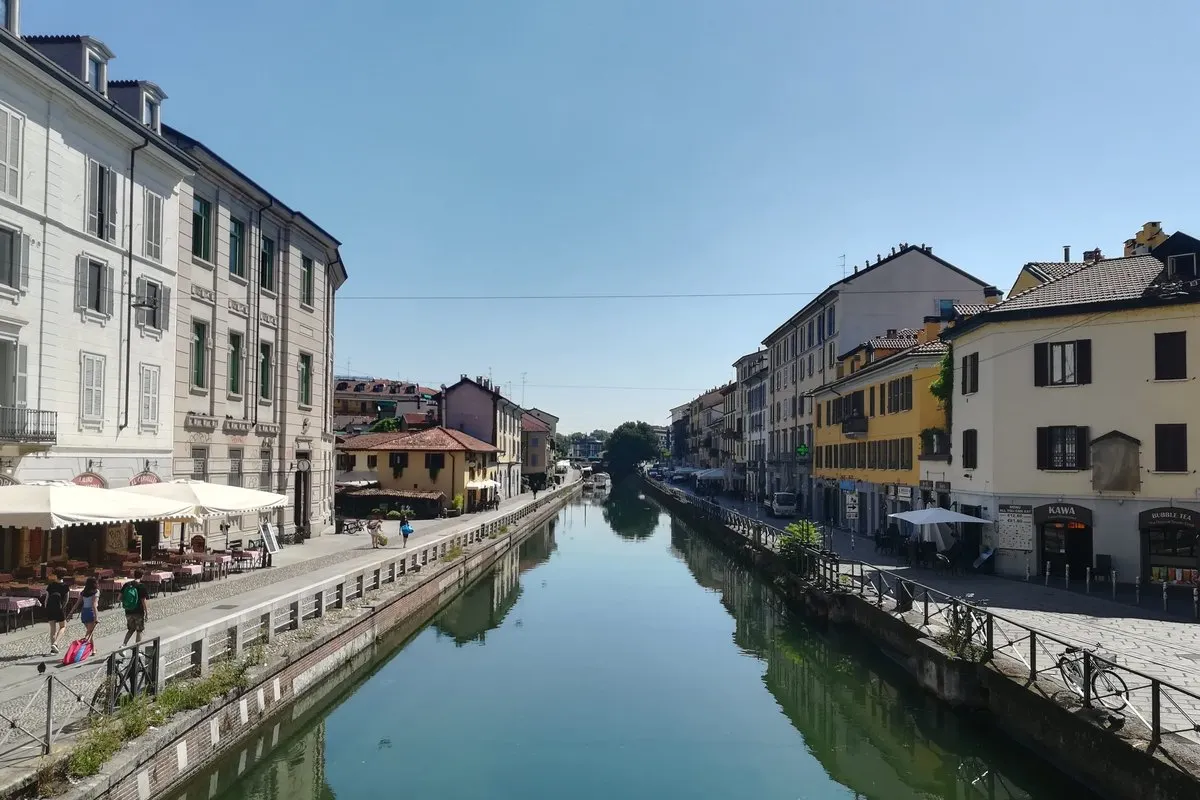
Milan was once a city of canals, and the marble for its cathedral arrived by water. Two canals and the old harbour survive in the south-west, lined with bars, studios and a monthly antiques market. Their history, and how to spend an afternoon and an evening there.
In this story · 4 sections
It is easy to forget that Milan, far from the sea and from any great river, was built around water. For seven centuries a network of canals, the navigli, carried salt, grain, timber and stone into the city, irrigated the plain around it and ringed its centre. Most of that network has been covered over. What remains in the south-west – the Naviglio Grande, the Naviglio Pavese and the harbour basin where they meet, the Darsena – has become one of the city's liveliest quarters.
Come in the afternoon for the towpaths and the courtyards, stay for the evening when the bars fill along the water, and if you can, time your visit for the last Sunday of the month.
Naviglio Grande and the Darsena
Canal quarter · Navigli, Milan
© OpenStreetMap contributors · OpenFreeMap
- Address
- Alzaia Naviglio Grande, 20144 Milano
- Naviglio Grande
- 49.9 km from the Ticino; navigable into Milan from 1272
- Naviglio Pavese
- 33 km to Pavia; begun 1564, completed 1819
- Darsena
- Built 1603; about 750 × 25 metres
- Last cargo
- 30 March 1979, a load of sand
- Inner ring
- Filled in around 1930
The Naviglio Grande, the canal that brought the Duomo's marble into Milan, meets the Naviglio Pavese at the Darsena; towpaths with the Vicolo dei Lavandai, bars and the monthly antiques market.
01A city of canals
The system had five canals: the Naviglio Grande, the Naviglio Pavese, the Martesana, the Naviglio di Paderno and the Naviglio di Bereguardo. The first three were joined inside Milan by an inner ring of water, the Cerchia dei Navigli, that circled the old centre. Around 1930 the ring and the urban stretch of the Martesana were filled in and paved over; commercial traffic continued on the Naviglio Grande, and declined after the war as road transport took over.
02Marble for the Duomo
The Naviglio Grande is the oldest and was the most important. Work began near the Ticino in 1177, the canal reached Milan in 1258, and from 1272, deepened and widened, it was navigable all the way to the bridge of Sant'Eustorgio. It runs 49.9 kilometres from the river near Tornavento and drops 34 metres on the way. When the cathedral was begun in 1386, this was how its marble arrived: from the Candoglia quarry by Lake Maggiore, down the Ticino, along the Naviglio Grande and through locks into the inner ring, to a small landing basin beside the building site.
Insider tipCome on the last Sunday of the month for the market, or at dusk for aperitivo on the water.
Boats carrying stone for the cathedral were marked AUF, ad usum fabricae, for the use of the Fabbrica, and paid no duty. A stone at one end of the Conca di Viarenna, the lock that took them into the city, still carries a ducal decree of 1497 confirming the exemption.
03The Darsena
The harbour basin at Porta Ticinese was built in 1603 by the Spanish governor, the Count of Fuentes, who turned an older pool beside Sant'Eustorgio into a real port, following the line of the Spanish city walls – hence its long, curved shape, about 750 metres by 25. The Naviglio Grande flows in and the Naviglio Pavese flows out. In 1953 the Darsena ranked thirteenth among Italian ports for goods received; the last barge of sand was unloaded here on 30 March 1979. It was restored for Expo 2015, when the remains of a medieval bridge were uncovered; you can see them from Piazza XXIV Maggio.
The Naviglio Pavese, 33 kilometres to Pavia, had a harder birth. Work started in 1564 and stopped twenty years later just outside Milan because of technical problems – the lock there is still called the Conca Fallata, the failed lock – and the canal was only completed in 1819.
04Along the Naviglio Grande today
At Alzaia Naviglio Grande 14, turn into the Vicolo dei Lavandai, where the public washhouse under its long roof is still largely intact. It was used from the nineteenth century until the 1950s. The washing was originally done by men, organised since the eighteenth century in a confraternity of washermen whose patron, St Anthony of Padua, has an altar in the nearby church of Santa Maria delle Grazie al Naviglio; they knelt on wooden boards and scrubbed linen on the stone slabs that are still there.
On the last Sunday of most months the Mercatone dell'Antiquariato stretches along the Alzaia Naviglio Grande from Viale Gorizia to the bridge at Via Valenza, from about 8.30 to 18.30, with antiques, vintage and second-hand pieces. In the evening the towpaths become one long terrace for aperitivo, and the bridges are the best places to watch the light go off the water.
Fact file
Antiques market, remaining 2026 dates
- Sunday 29 November 2026
- Last Sunday of the month
- Sunday 20 December 2026
- Brought forward before Christmas