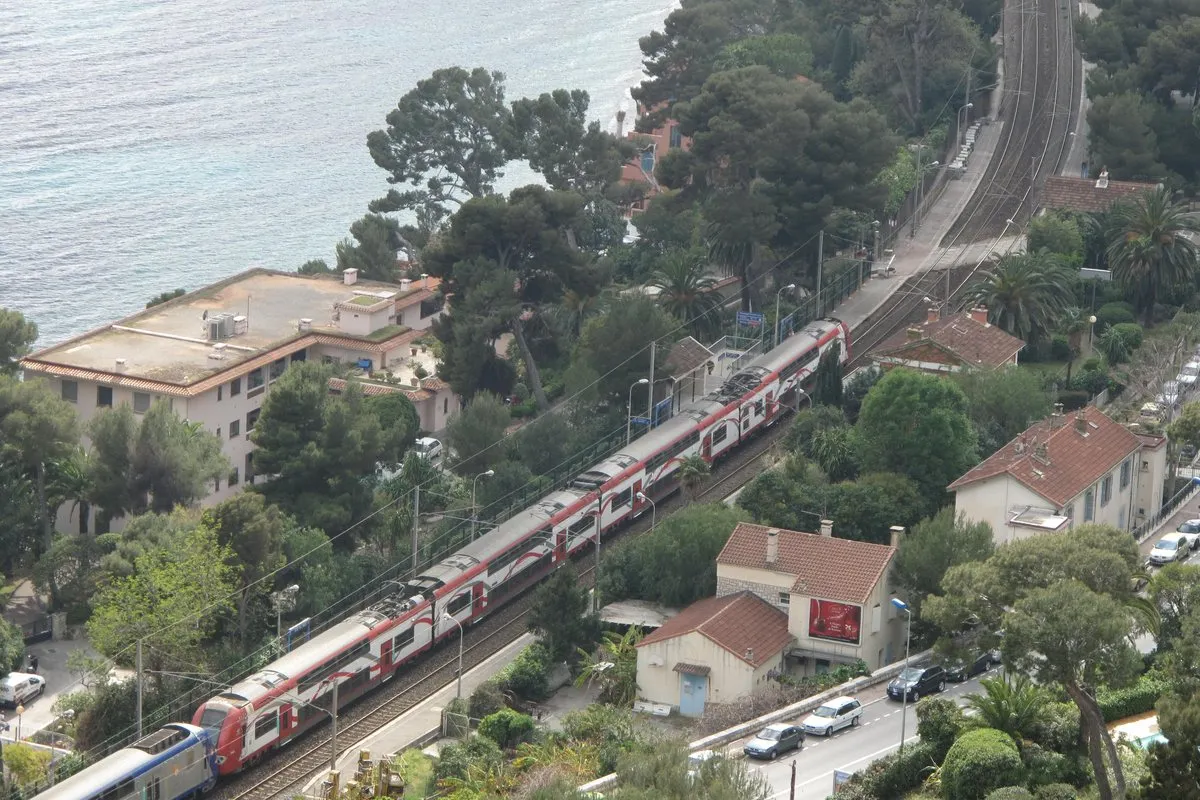
The regional train between Nice and Menton runs a few metres from the sea, through rock and under a principality. Here is how to use it as a day out: where to get off, and what to do when you do.
In this story · 8 sections
There are three roads east from Nice to Menton, and in summer all of them are slow. The railway is the quiet alternative. Laid along the shore in the 1860s, it follows the same coves and capes as the coast road and lets you step off in a different village at almost every stop. Buy a ticket, sit on the right-hand side heading east, and the Riviera arrives one bay at a time.
4 places
© OpenStreetMap contributors · OpenFreeMap
- 01Gare de Nice-VilleStation · Nice
- 02Chemin de NietzscheWalk · Èze
- 03Gare de Monaco–Monte-CarloStation · Monaco
- 04Cap ModerneArchitecture · Roquebrune-Cap-Martin
- Nice-Ville
- The start: Louis-Jules Bouchot's station of 1864–67
- Villefranche-sur-Mer
- The bay and the old town
- Beaulieu-sur-Mer
- Belle Époque villas and the seafront
- Èze (bord de mer)
- The Chemin de Nietzsche up to Èze village
- Cap-d'Ail
- Plage Mala
- Monaco–Monte-Carlo
- The principality
- Cap-Martin–Roquebrune
- Cap Moderne: E-1027 and Le Corbusier's Cabanon
- Carnolès
- The coastal path round Cap Martin
- Menton
- The old town, gardens and Cocteau
The line
This is the eastern end of the Marseille–Ventimiglia railway, 259 kilometres in all. The rails reached Nice in 1864, Monaco in 1868 and Menton in 1869; the final stretch to Ventimiglia opened in 1872. Today most trains are regional TER services operated by SNCF, and the stopping trains between Nice and Ventimiglia call at each of the stations below. Check the TER timetable before you set out: not every train stops everywhere.
Nice-Ville: a station of stone and steel
Nice's main station, on Avenue Thiers, opened in 1864 and was completed in 1867 for the PLM railway company. Louis-Jules Bouchot designed it in a Louis XIII style; it keeps its carved Arles stone and forged-steel roof, and the passenger hall still has its balconies and great clock, though the chandeliers have gone. The Gare Thiers stop on tram line 1 is outside.
Villefranche and Beaulieu: two bays
The first stop worth the name is Villefranche-sur-Mer, whose narrow old streets lead down to the water and the Marinières beach; the local tourist office recommends the train precisely because it brings you close to the centre without a car. Beaulieu-sur-Mer, the next stop, is the Riviera at its most composed: Belle Époque villas and a sheltered seafront between Cap-Ferrat and the mountains.
Èze: Nietzsche's path
The small station of Èze-sur-Mer sits by the sea, some 400 metres below the medieval village of Èze. Between them climbs the Chemin de Nietzsche: walk 200 metres east along the Basse Corniche to find the trailhead, then allow about an hour for 2.1 kilometres and 400 metres of ascent, according to the regional tourist board. Friedrich Nietzsche first wintered on the Riviera from December 1883 to April 1884, and composed the third part of Thus Spoke Zarathustra while walking this path. He returned every year until 1888. Walk up, have lunch in the village, and take the train onward from the same station.
Cap-d'Ail: the last stop in France
Cap-d'Ail has had a station since 1881 and is the last stop before Monaco. Its draw is Plage Mala, one of the best-known beaches on this stretch of coast. See our guide to Cap-d'Ail for addresses.
Monaco: a station inside the mountain
The railway reached Monaco in 1868, with a first station in La Condamine; a second, Monte Carlo, opened the following year and closed in 1965. Since 7 December 1999 the principality has been served by a single underground station in the Ravin de Sainte-Dévote, part of which lies in Beausoleil, France. It is a curved tunnel 466 metres long, 22 metres wide and 13 metres high, and the whole line through Monaco now runs underground. For what to do once you surface, see our Monaco guide.
Cap Martin: modernism by the sea
Cap-Martin–Roquebrune is the stop for Cap Moderne, the site that includes Eileen Gray's villa E-1027 and Le Corbusier's Cabanon. Tours start from the reception and ticket office in a converted warehouse on the station esplanade, Avenue Le Corbusier, and booking is compulsory; the site itself recommends coming by stopping train. Above, the medieval village of Roquebrune-Cap-Martin climbs to its tenth-century château.
The railway also makes a fine walk possible. The Sentier littoral du Cap Martin runs 4.7 kilometres from Carnolès station round the cape to Cap-Martin–Roquebrune station, with only about 50 metres of climbing. It passes the point, with views across the Bay of Menton towards Bordighera, the pergola of Villa Cypris, a footbridge under the railway to Cap Moderne and a bust of Le Corbusier. Take the train to Carnolès, walk west, and catch the train home from the other end.
Menton: the end of the line
Menton station opened on 6 December 1869 and handled more than 2.7 million passengers in 2024. From here the old town of Menton, its gardens and the Cocteau museums are within reach. One stop further, Menton-Garavan is the last station before the Italian border; the line continues to Ventimiglia. For more of the coast, browse our Riviera guides.
Gare de Nice-Ville
Start of the journey
Nice's main station, completed in 1867 to designs by Louis-Jules Bouchot.
Avenue Thiers, 06008 Nice
Chemin de Nietzsche
From the sea to Èze village
2.1 km and 400 m of ascent from Èze-sur-Mer station to the medieval village.
Insider tipAbout an hour uphill.
Gare de Monaco–Monte-Carlo
Underground since 1999
A curved tunnel station, 466 metres long, in the Ravin de Sainte-Dévote.
Cap Moderne
E-1027 and the Cabanon
Guided tours of Eileen Gray's villa and Le Corbusier's Cabanon.
Esplanade de la gare, Avenue Le Corbusier, 06190 Roquebrune-Cap-Martin
Insider tipBooking compulsory.