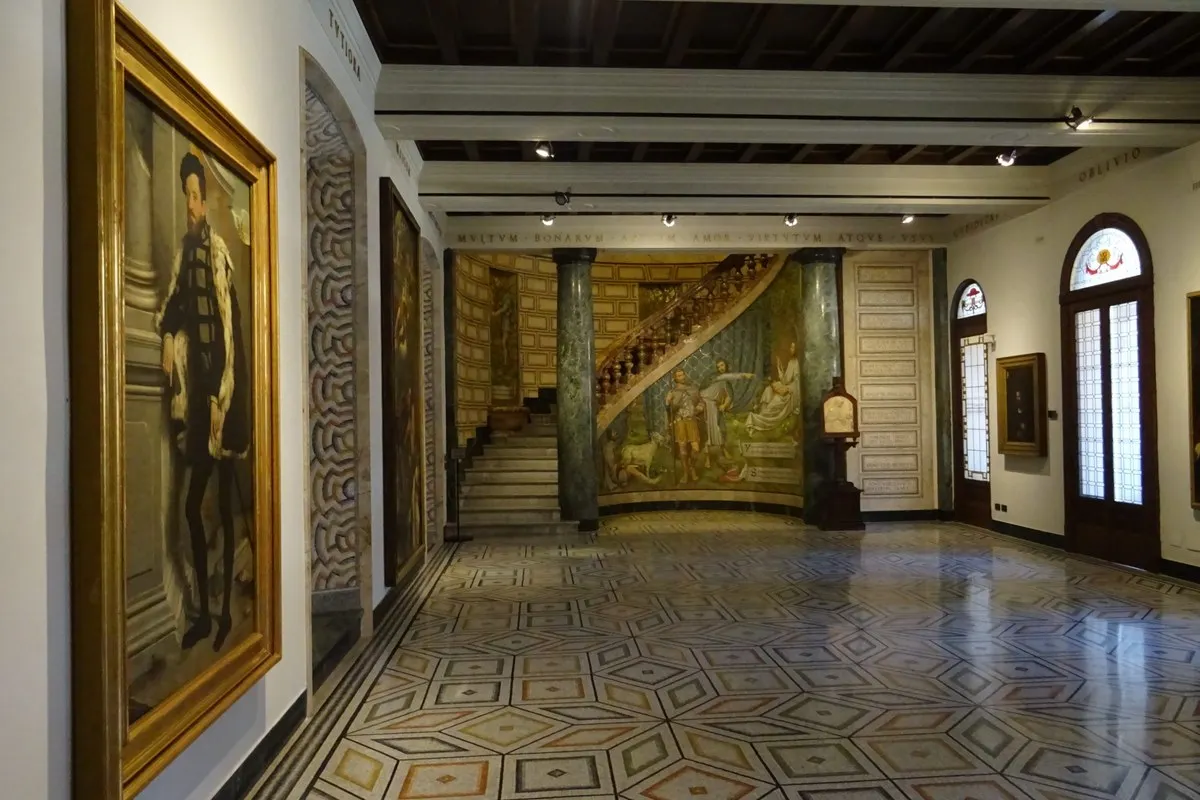
Founded by Cardinal Federico Borromeo in 1609, the Ambrosiana was one of Europe's first public libraries and remains one of Milan's richest galleries: Leonardo's Musician and Codex Atlanticus, Caravaggio's Basket of Fruit and Raphael's cartoon for The School of Athens, five minutes from the Duomo.
In this story · 4 sections
Most visitors to Milan see one Leonardo, The Last Supper, and leave. A few streets west of the Duomo, behind a modest front on Piazza Pio XI, the Ambrosiana holds more of him than anywhere else in the city, alongside one of the most celebrated still lifes ever painted and the full-size drawing Raphael made for a fresco in the Vatican.
It is also a library, and that is where its story begins.
Pinacoteca Ambrosiana
Museum · Duomo, Milan
© OpenStreetMap contributors · OpenFreeMap
- Address
- Piazza Pio XI 2, 20123 Milano
- Founded
- 1609, by Cardinal Federico Borromeo
- First reading room
- Sala Federiciana, opened 8 December 1609
- Pinacoteca building
- 1611–1618
- Academy
- Opened 1625
- Codex Atlanticus
- Acquired 1637; 1,119 leaves in 12 volumes, 1478–1519
- Manuscripts
- About 30,000
- Highlights
- Leonardo, Portrait of a Musician; Caravaggio, Basket of Fruit; Raphael, cartoon for The School of Athens; Bramantino, Adoration of the Christ Child
- Address
- Piazza Pio XI 2, Milan
Leonardo's Portrait of a Musician and Codex Atlanticus, Caravaggio's Basket of Fruit and Raphael's cartoon for The School of Athens.
01A cardinal's library
Federico Borromeo, cardinal and archbishop of Milan, conceived the library during his years in Rome as a place open to scholars and a bulwark of Catholic learning in the age of the Counter-Reformation. He named it after Ambrose, the city's patron saint, and his agents scoured Western Europe and travelled as far as Greece and Syria for books and manuscripts. When its first reading room, the Sala Federiciana, opened to the public on 8 December 1609, it became one of the earliest public libraries in Europe.
Its holdings now include some 30,000 manuscripts, in languages from Greek and Latin to Hebrew, Syriac, Arabic, Ethiopic, Turkish and Persian. Among them are the Muratorian fragment, the earliest known list of the books of the New Testament, and an original copy of Luca Pacioli's De divina proportione, illustrated by Leonardo.
02The Pinacoteca
Borromeo also wanted an academy for artists, which opened in 1625, and a gallery: between 1611 and 1618 a new building went up to house his own paintings and drawings, and they remain the core of the Pinacoteca. Its rooms, some lined with mosaics and inlaid marble, hold Leonardo's Portrait of a Musician, the only portrait on panel by him in Milan; Caravaggio's Basket of Fruit, a wicker basket on a ledge painted with startling realism; Bramantino's Adoration of the Christ Child; and Raphael's cartoon for The School of Athens, the vast preparatory drawing for his fresco in the Vatican.
Insider tipSee it the same day as The Last Supper for the full picture of Leonardo in Milan.
03The Codex Atlanticus
In 1637, six years after the cardinal's death, the library acquired twelve of Leonardo's manuscripts from the Marquis Galeazzo Arconati, among them the Codex Atlanticus. It is the largest single collection of his drawings and writings: 1,119 leaves, or 2,238 pages, bound in twelve volumes and dating from 1478 to 1519, the whole of his working life in Florence, Milan, Rome and Amboise. The subjects range from flight and weaponry to musical instruments, mathematics and botany.
The codex was put together in the late sixteenth century by the sculptor Pompeo Leoni, who cut up some of Leonardo's notebooks to make it; its name comes from the large sheets, of the kind used for atlases, on which the pages were mounted. Being paper, it can only be shown a selection at a time.
04How to visit
The Ambrosiana is on Piazza Pio XI, between Cordusio and the Duomo. The Pinacoteca is visited together with the crypt of the neighbouring church of San Sepolcro, while the library's reading room is for scholars. Allow at least two hours, and check the Ambrosiana's own website for current hours, tickets and which sheets of the Codex Atlanticus are on show.