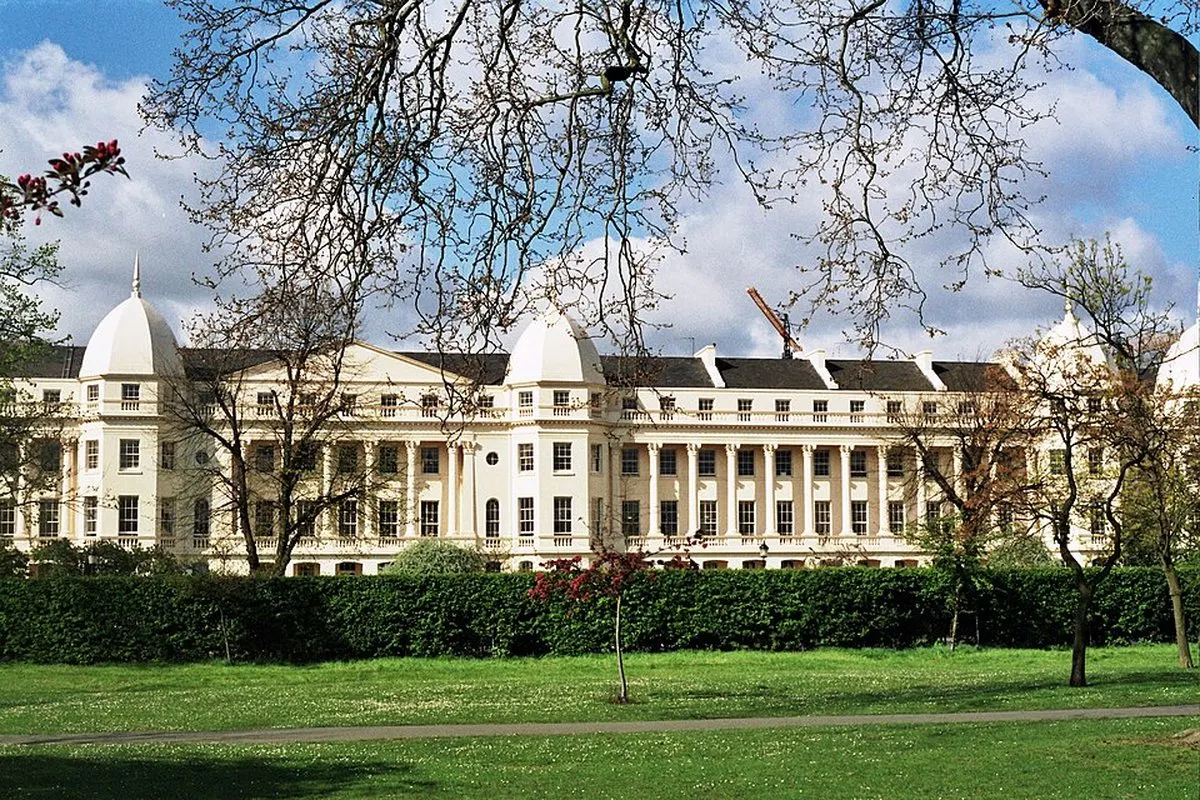
Regent's Park was the Prince Regent's idea and John Nash's masterpiece: 410 acres of parkland ringed by white stucco terraces. Just to the north, Primrose Hill rises to 64 metres and looks out over the whole of central London. Here is the guide to both.
In this story · 5 sections
Regent's Park is one of the Royal Parks of London, covering 410 acres (166 hectares) in north-west inner London between the City of Westminster and Camden. Its south, east and most of its west sides are lined with white stucco terraces by John Nash and Decimus Burton; inside are a boating lake, rose gardens, an open-air theatre and, on the north side, London Zoo. Across the Regent's Canal, Primrose Hill offers one of the finest views of the capital.
2 places
© OpenStreetMap contributors · OpenFreeMap
From Henry VIII's hunting chase to the Prince Regent's park
In the Middle Ages the land belonged to Barking Abbey. Henry VIII took it at the Dissolution of the Monasteries in the 1530s and used it as a hunting park, Marylebone Park; after 1649 it was let as smallholdings for hay and dairy. In the 1810s the Prince Regent proposed turning it into a pleasure garden. John Nash designed the park with James and Decimus Burton, and when the Crown Estate withdrew its pledge to pay, the developer James Burton financed the building himself, buying many of the terrace leases in 1816. The park is Grade I listed on the Register of Historic Parks and Gardens, and the Crown Estate still owns the freehold.
The Nash terraces and the Outer Circle
An outer ring road, the Outer Circle, runs for 4.45 kilometres around the park, and the elegant stucco terraces face inwards across it – the aristocratic townhouses and expensive terrace dwellings that paid for the scheme. Inside, the park is almost entirely reserved for pedestrians. Winfield House, the residence of the United States Ambassador, stands in private grounds in the western part, near the capital's first large mosque, and the Regent's Canal runs along the northern edge.
Queen Mary's Gardens and the Open Air Theatre
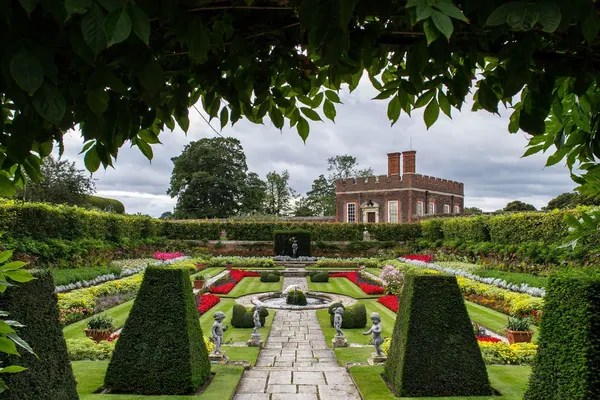
The Inner Circle, a one-kilometre ring, surrounds the most carefully tended part of the park, Queen Mary's Gardens, where the Open Air Theatre stands. In the south-east corner are the formal Italian Gardens and the informal English Gardens, and there are further gardens around St John's Lodge and the Queen Elizabeth II Garden. The lake has a heronry, waterfowl and boats for hire. London Zoo and the headquarters of the Zoological Society of London occupy the north side.
Primrose Hill – the view over London
Primrose Hill, a Grade II listed park opened to the public in 1842, lies immediately north of Regent's Park. Its 64-metre summit, one of the highest points in Camden, has a clear view of central London to the south-east and of Hampstead and Belsize Park to the north, and is engraved with a quotation from William Blake. The name has been in use since the 15th century. In 1678 the hill was the scene of the mysterious murder of Sir Edmund Berry Godfrey, and in 1792 it hosted the first meeting of the Gorsedd of the Bards, organised by Iolo Morganwg. The district around it is also called Primrose Hill.
How to walk Regent's Park and Primrose Hill
Start at the south of the park, walk through the Italian Gardens and on to Queen Mary's Gardens, cross the park past the lake to the zoo and the canal, and climb Primrose Hill for the view – best in the late afternoon. Explore the streets in VERA PI's street file for Chalcot Crescent in Primrose Hill, see all of Camden and Westminster, or start with VERA PI's London guide.
Regent's Park
John Nash's Royal Park
410 acres with Queen Mary's Gardens, the Open Air Theatre, the lake and London Zoo.
- Size
- 410 acres (166 ha)
- Managed by
- The Royal Parks
Regent's Park, London NW1
Primrose Hill
The view over central London
64-metre summit with a William Blake inscription.
- Opened
- 1842
Primrose Hill, London NW1
At a glance
The two parks at a glance
| Regent's Park | Primrose Hill | |
|---|---|---|
| Laid out / opened | 1810s–1820s | 1842 |
| Protection | Grade I | Grade II |
| Highlight | Queen Mary's Gardens | The 64-metre summit |