In this story · 5 sections
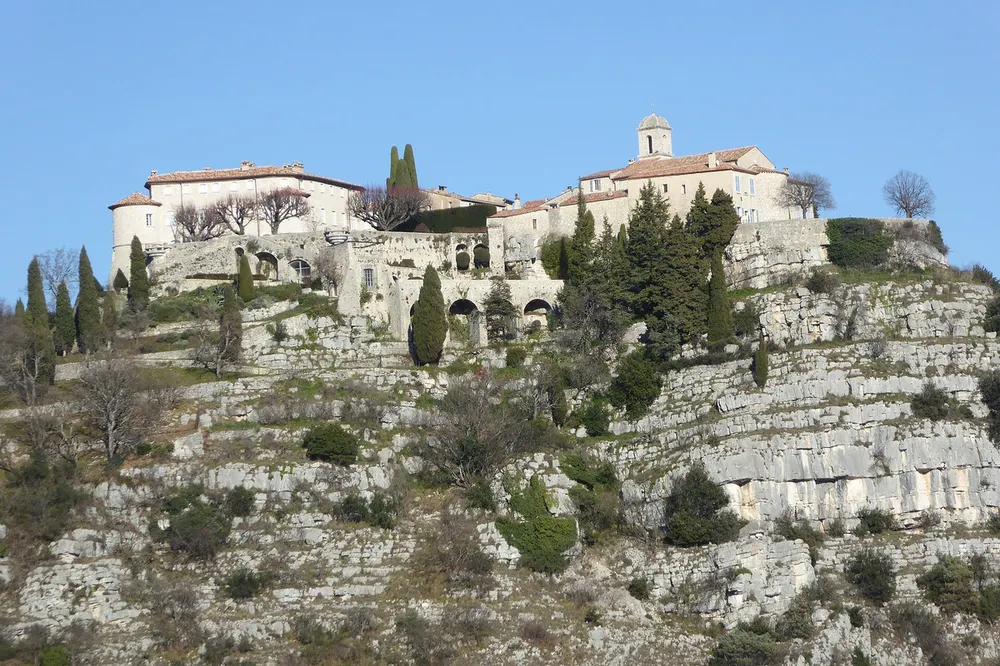
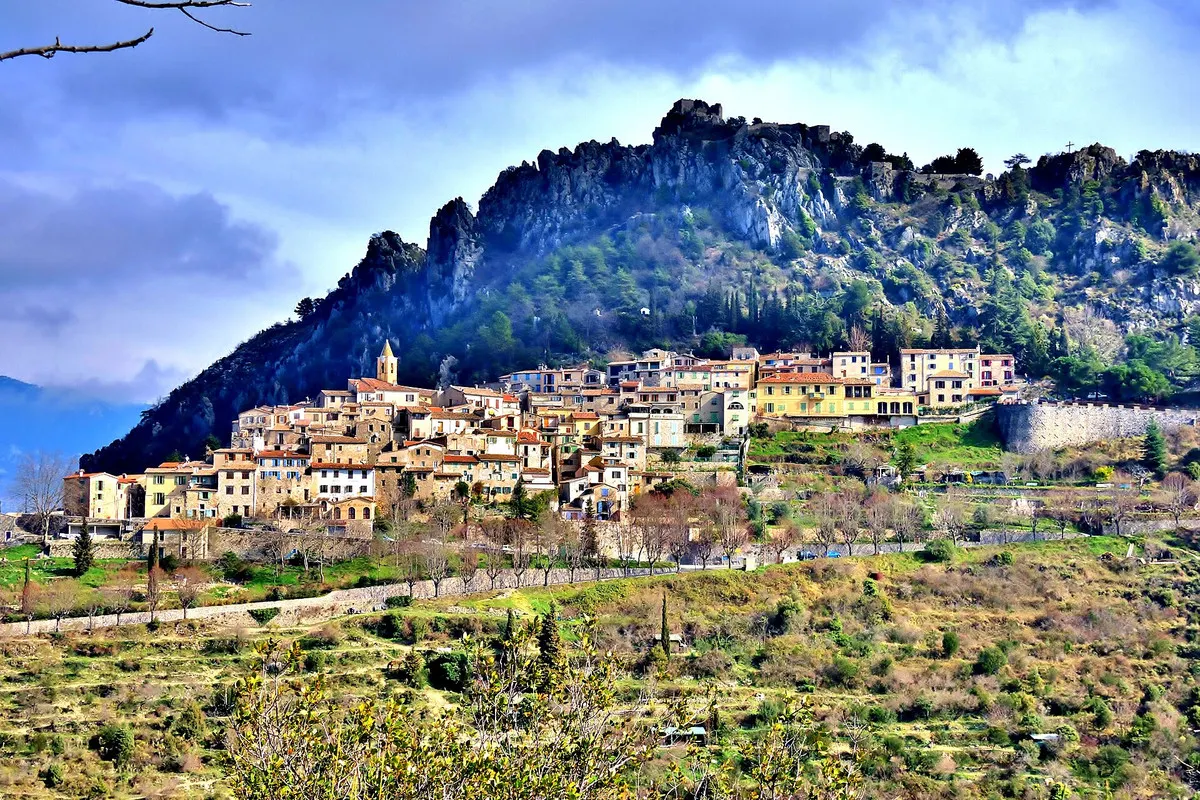
From the seafront at Menton, the D22 follows the valley of the Borrigo up into the mountains. At the top, clinging to a ledge beneath a rocky crest, is Sainte-Agnès, which describes itself as the highest coastal village in Europe and is counted among the most beautiful medieval villages in France. A short way west, across the ridge, lies Gorbio, smaller, quieter and arranged around a square shaded by a very old tree.
Together they make a perfect half-day away from the coast: thin mountain air, views straight down to the sea and the dialect of the Mentonnais still in the place names.
4 places
© OpenStreetMap contributors · OpenFreeMap
Sainte-Agnès: a princess, a castle and the sea below
Legend says the village is named after Agnès, an Italian princess who sheltered from a violent storm in one of its caves; a grotto and the chapel of Anna still recall the story. The castle on the rocky peak above may date from 1180, and excavations in 1993 showed that the foundations of its tower go back to the late tenth or early eleventh century. It stood at 800 metres and was coveted in turn by the counts of Ventimiglia, the counts of Provence, the House of Savoy and even the Grimaldis.
In 1691, after the villagers had encouraged neighbouring Peille to resist the troops of Louis XIV, the king's governor had the castle destroyed, as he did every fortress in the County of Nice. Sainte-Agnès belonged to Piedmont-Sardinia until it became French in 1860. Today the ruins frame a medieval garden laid out by a local artists' association, the Peintres du Soleil, with a panorama over the Mediterranean.
A fort inside the mountain
Beneath the village lies a very different monument. Between 1932 and 1936 the army dug the Ouvrage de Sainte-Agnès deep into the cliff above the bay of Menton, the last link of the Maginot Line. It covers 2,000 square metres and could house 300 to 400 soldiers for three months, completely self-sufficient. Its artillery stopped the advance of Italian troops.
Walking the village
Sainte-Agnès is a single ridge of lanes, and it is best taken slowly. Look for the arcade of the Rue des Sarrasins, the church of Notre-Dame-des-Neiges with its glazed scale-pattern tiles, and the Chapelle Saint-Charles, now a small museum of paintings by the Peintres du Soleil, old tools and pottery from the excavations. The village had 1,380 residents in 2023, and its people are called Agnésois.
Gorbio: Templars, Lascaris and an elm of 1713
Gorbio moved to its present site as the Templar commandery of Agerbol, built by Count Ottone II of Ventimiglia. It was a fief of the counts of Ventimiglia in the 12th and 13th centuries, belonged to the counts of Provence between 1257 and 1285, then returned to Ventimiglia and its heirs, the Lascaris family. Later lords included the Alziari de Malaussène, whose château, built between the 15th and 17th centuries, still stands.
The village square is the place to start. Its elm was planted in 1713, and close by are the church of Saint-Barthélemy, built in 1683 and renovated in 2010, the White Penitents' chapel of the Holy Cross confraternity, built in 1445, and the Lascaris tower of the 12th and 13th centuries. Gorbio had 1,609 residents in 2023. Its people are the Gorbarins, the only village of the Mentonnais whose name for its inhabitants ends in "-in".
At a glance
| Sainte-Agnès | Gorbio | |
|---|---|---|
| Residents (2023) | 1,380 | 1,609 |
| Don't miss | Castle ruins and medieval garden | The 1713 elm and the 1445 chapel |
| History | Castle razed in 1691; Maginot fort 1932–36 | Templar commandery; Lascaris lordship |
| Residents are called | Agnésois | Gorbarins |
How to do both in a day
Start early in Sainte-Agnès, while the light is clear over the sea, and climb to the castle garden before the day warms up. Visit the fort if it is open, then drive down and across to Gorbio for a late lunch in the shade of the square. Finish back in Menton, or continue west to Roquebrune-Cap-Martin for an evening walk.
Château de Sainte-Agnès
Castle ruins and medieval garden at 800 m
The ruined castle razed in 1691, now framing a medieval garden with sea views.
Montée du Souvenir, 06500 Sainte-Agnès
Insider tipGo early for the clearest view of the coast.
Fort de Sainte-Agnès
The last link of the Maginot Line
Dug into the cliff between 1932 and 1936 for up to 400 men.
Avenue du Château, 06500 Sainte-Agnès
Insider tipCheck visiting days before you go.
Église Notre-Dame-des-Neiges
The village church with glazed scale tiles
Recognisable by the glazed scale-pattern tiles of its roof.
Rue du Four, 06500 Sainte-Agnès
Insider tipOn the main lane through the village.
Place de la République, Gorbio
The square of the 1713 elm
Gorbio's shaded square, beside the church of Saint-Barthélemy.
Place de la République, 06500 Gorbio
Insider tipThe natural spot for lunch.
Neighbourhood and property data for Sainte-Agnès and Gorbio is on VERA PI.