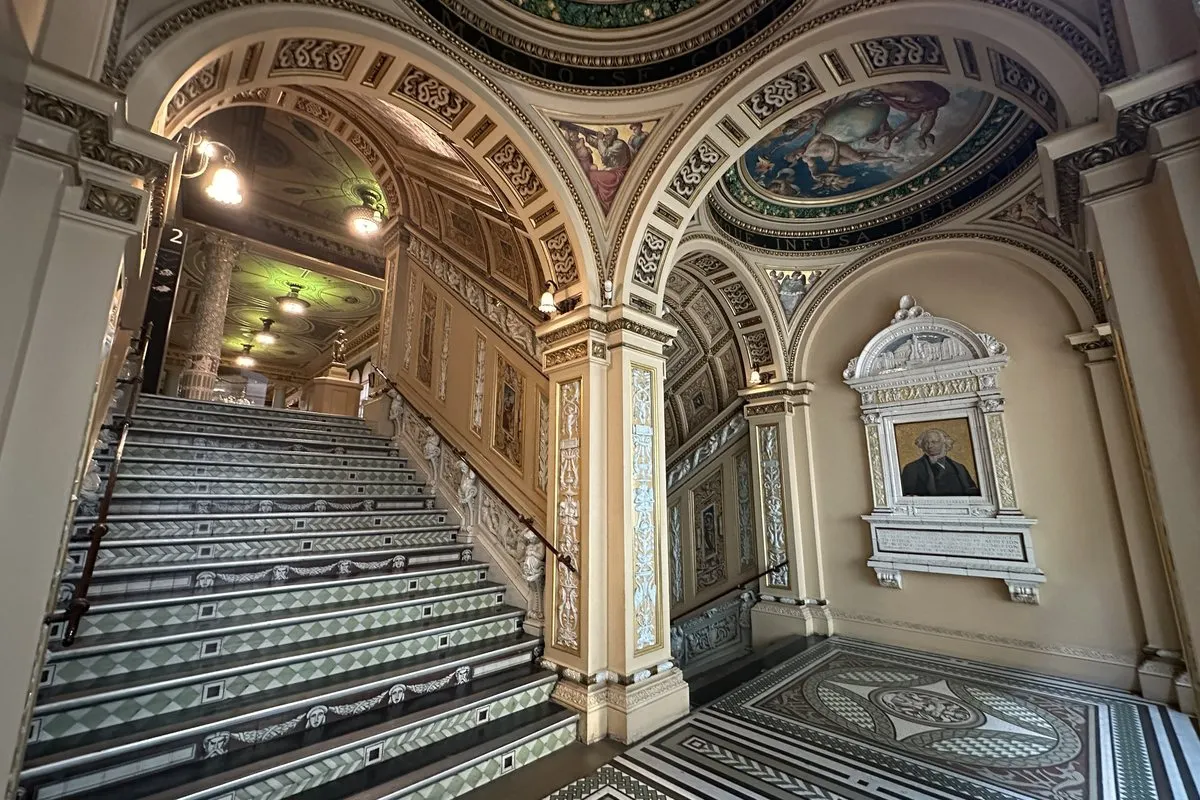
The profits of the Great Exhibition of 1851 paid for a district of museums, colleges and a concert hall in South Kensington. Victorians nicknamed it Albertopolis after Prince Albert. Here is how the V&A, the Natural History Museum, the Science Museum and the Royal Albert Hall came to stand side by side.
In this story · 5 sections
South Kensington in London has one of the densest clusters of museums in the world. Along Exhibition Road and Cromwell Road stand the Victoria and Albert Museum, the Natural History Museum and the Science Museum, and to the north the Royal Albert Hall faces the Albert Memorial in Kensington Gardens. Since the 1850s the district has been known as Albertopolis, after the prince who dreamt it up.
3 places
© OpenStreetMap contributors · OpenFreeMap
- 01Victoria and Albert MuseumMuseum · South Kensington
- 02Natural History MuseumMuseum · South Kensington
- 03Royal Albert HallConcert hall · South Kensington
- Victoria and Albert Museum
- More than 2.8 million objects
- Natural History Museum
- Around 80 million specimens
- Royal Albert Hall
- Opened 1871, 5,272 seats
- South Kensington Subway
- Opened 1885, Grade II listed
How the Great Exhibition built Albertopolis
In 1851 the Great Exhibition, organised by Prince Albert, was held in Hyde Park. On his advice, the Royal Commission for the Exhibition of 1851 used the profits to buy land in the former village of Brompton, now South Kensington, for permanent institutions of learning and culture. The main north–south street on the estate was named Exhibition Road. According to Wikipedia, the name Albertopolis seems to have been coined in the 1850s, partly to celebrate and partly to satirise Albert's role in Victorian cultural life. It fell out of use after his death and was revived by architectural historians in the 1960s, when Imperial College's expansion threatened the area's Victorian buildings.
There is a hidden axis running from the Albert Memorial in the north to the central portal of the Natural History Museum in the south. The Royal Albert Hall, the Royal College of Music and the Queen's Tower of Imperial College all line up on it, though it can only really be seen from above.
The V&A – the world's largest museum of decorative arts
The Victoria and Albert Museum is the world's largest museum of applied arts, decorative arts and design, with a permanent collection of more than 2.8 million objects. The South Kensington site covers 5.1 hectares and has more than 145 galleries. The collection spans 5,000 years and includes one of the largest Islamic collections in the Western world and the largest collection of Italian Renaissance sculpture outside Italy, alongside ceramics, glass, textiles, fashion, jewellery, furniture and photography. The museum traces its origins to the Government School of Design, established in 1832.
The Natural History Museum – a cathedral of nature
The Natural History Museum, with its main frontage on Cromwell Road, holds some 80 million specimens in botany, entomology, mineralogy, palaeontology and zoology, including specimens collected by Charles Darwin. Alfred Waterhouse's building opened by 1881, and its ornate architecture has been called a cathedral of nature. The Diplodocus cast that long dominated the central hall was replaced in 2017 by the skeleton of a blue whale hanging from the ceiling. Like the other national museums, it charges no admission fee.
The Royal Albert Hall and the Albert Memorial
The Royal Albert Hall seats 5,272 and was opened by Queen Victoria in 1871. It was to have been called the Central Hall of Arts and Sciences, but when she laid the foundation stone in 1867 the Queen renamed it in memory of Prince Albert, who had died six years earlier. The hall is the practical part of a memorial to the Prince Consort; the decorative part is the Albert Memorial directly to the north. The BBC Proms have been held here every summer since 1941, and the hall hosts more than 390 shows a year in the main auditorium.
How to spend a day in Albertopolis
Arrive at South Kensington Underground station and take the tiled pedestrian subway, opened in 1885 and now Grade II listed, towards the museums. Choose one museum for the morning – the V&A or the Natural History Museum – then walk up Exhibition Road to the Royal Albert Hall and the Albert Memorial, and end in Kensington Gardens. Explore the streets in VERA PI's street files for Exhibition Road and Cromwell Road, see all of Kensington and Chelsea, or start with VERA PI's London guide.
Victoria and Albert Museum
Decorative arts and design
More than 2.8 million objects in over 145 galleries.
Cromwell Road, London SW7
Natural History Museum
Alfred Waterhouse's cathedral of nature
Around 80 million specimens and a blue whale in the central hall.
- Admission
- Free
Cromwell Road, London SW7
Royal Albert Hall
Concert hall since 1871
5,272 seats and the BBC Proms every summer.
Kensington Gore, London SW7