In this story · 7 sections
The Belle Époque was named in retrospect. It ran from the end of the Franco-Prussian War in 1871 to the outbreak of the First World War in 1914, and only after the catastrophe that followed did Europeans look back on it as a golden age of peace, prosperity and invention. Among its most lasting monuments are its hotels. In four decades, a new class of traveller and new technologies such as electric light and the telephone produced the grand hotel as we know it: a palace open to anyone who could pay.
The hotels below span the era, from its prologue in Monaco to its last summer in Nice. All still receive guests.
6 places
© OpenStreetMap contributors · OpenFreeMap
- 01Hôtel de Paris Monte-CarloGrand hotel · Monte-Carlo, Monaco
- 02Grand HôtelGrand hotel · Stockholm, Sweden
- 03Ritz ParisGrand hotel · Place Vendôme, Paris
- 04Hôtel Hermitage Monte-CarloGrand hotel · Monte-Carlo, Monaco
- 05Carlton CannesGrand hotel · La Croisette, Cannes
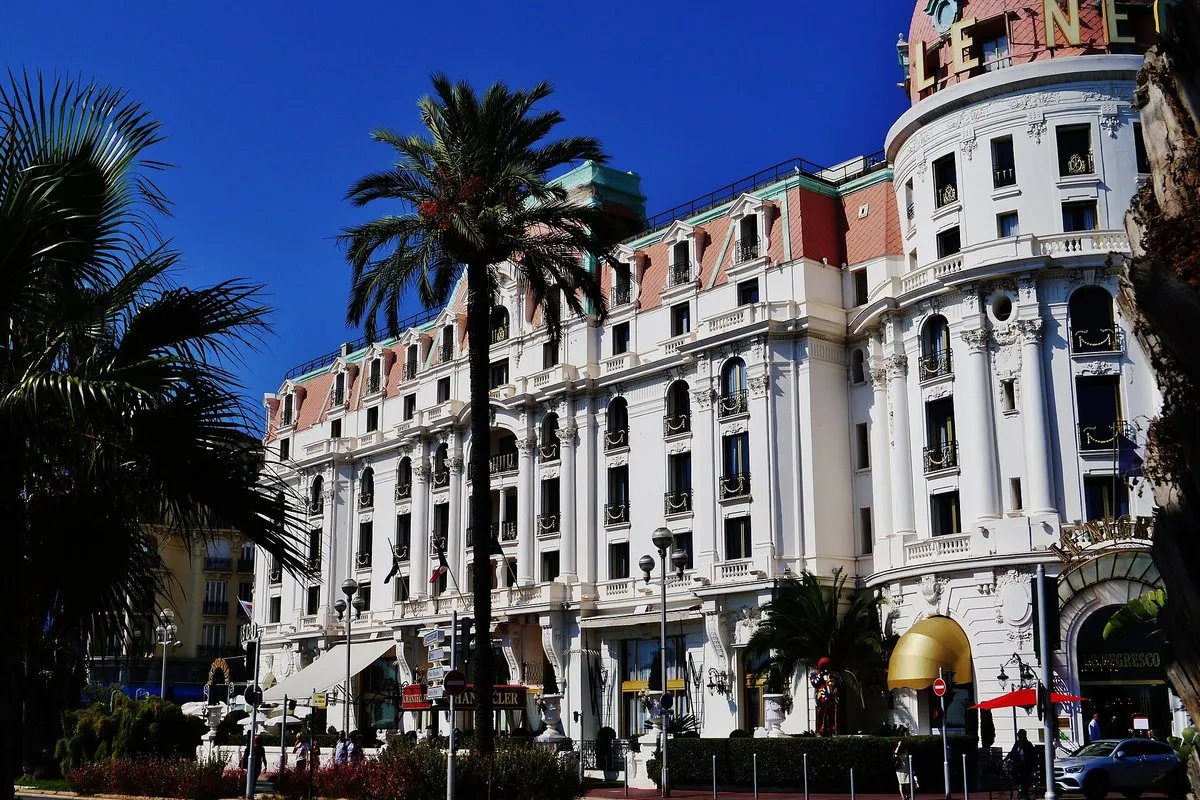
- 06Hôtel NegrescoGrand hotel · Promenade des Anglais, Nice
The prologue: Hôtel de Paris, Monte-Carlo (1864)
Monaco's Hôtel de Paris predates the Belle Époque proper, but it set a pattern. It opened in 1864 on the Place du Casino as part of the Société des Bains de Mer's development of the principality. Its modern history includes a renovation of more than four years, completed in March 2019, and a restaurant, Le Louis XV, with three Michelin stars. For Monaco today, see vpios.com/monaco.
The north: Grand Hôtel, Stockholm (1874)
The idea travelled. In Stockholm, a Frenchman, Jean-François Régis Cadier, founded the Grand Hôtel in 1872 and opened its doors on 14 June 1874, opposite the Royal Palace and Gamla stan. Since 1901 it has traditionally hosted the Nobel laureates and their families. It is a reminder that the grand hotel of the era was a European phenomenon, not merely a French one.
The masterpiece of service: the Ritz, Paris (1898)
If one hotel defines the era, it is the Ritz. The Swiss hotelier César Ritz founded it in 1898 with the chef Auguste Escoffier, building it behind the eighteenth-century facade of a townhouse on the Place Vendôme. It was among the first hotels in Europe to give every room an en suite bathroom, electricity and a telephone. It quickly drew royalty, politicians and writers, and later film stars; suites are named after guests such as Coco Chanel, and the Bar Hemingway honours the writer. It appears in Fitzgerald's Tender Is the Night and Hemingway's The Sun Also Rises. Its Suite Impériale is listed as a national monument.
Iron and glass: Hôtel Hermitage, Monte-Carlo (1896)
The Hermitage was built between 1890 and 1896 by the architect Jean Marquet in full Belle Époque style, with the participation of Gustave Eiffel, whose signature is the cupola of the Jardin d'Hiver, the winter garden. The hotel overlooks the harbour, belongs to the Société des Bains de Mer and is classified as a monument.
The Croisette: Carlton, Cannes (1911)
The Carlton was built between 1909 and 1910 by the Swiss hotelier Henry Ruhl to designs by Charles Dalmas and Marcellin Mayère, with financing from Grand Duke Michael Mikhailovich of Russia. It opened on 30 January 1911 and was so successful that a new wing, built in 1912 and 1913, doubled its size. Today it is the Carlton Cannes, a Regent Hotel, reopened on 13 March 2023 after major renovation, and famous for hosting film stars during the Cannes Film Festival.
The last summer: Hôtel Negresco, Nice (1912)
Henri Negresco, born Alexandru Negrescu in Romania, had trained as a confectioner in Bucharest and become director of Nice's Municipal Casino before he built the hotel that bears his name. He commissioned Édouard-Jean Niermans, the architect of café society, who gave it its pink dome. The Baccarat chandelier in the Royal Lounge, with 16,309 crystals, had been commissioned by Tsar Nicholas II, who never took delivery. Following the conventions of the time, the main entrance faced away from the sea. The hotel opened on the Promenade des Anglais in 1912. When war broke out in 1914 it became a hospital, and after the war wealthy visitors were so few that the hotel fell into severe financial difficulty.
What the era left behind
The Belle Époque hotel gave us much of what we still expect from luxury travel: a private bathroom, electric light, a famous chef, a bar with a story, a lobby where one goes to be seen. It also gave the Riviera its domes and cupolas. To stay in one of these hotels is to step into the era's confidence – and its fragility. More hotel stories in our travel section, on metromode.co and in our Riviera guides at verapi.fr.
Hôtel de Paris Monte-Carlo
Opened in 1864 on the Place du Casino.
Insider tipLe Louis XV holds three Michelin stars.
Grand Hôtel
Opened on 14 June 1874, opposite the Royal Palace.
Insider tipHost to Nobel laureates since 1901.
Ritz Paris
César Ritz and Auguste Escoffier's hotel of 1898.
Insider tipBar Hemingway; the Suite Impériale is a listed monument.
Hôtel Hermitage Monte-Carlo
Belle Époque hotel of 1890–1896 with Gustave Eiffel's winter-garden cupola.
Insider tipClassified as a monument.
Carlton Cannes
Opened on 30 January 1911 at 58 La Croisette.
Insider tipReopened on 13 March 2023 after renovation.
Hôtel Negresco
Henri Negresco's pink-domed palace of 1912.
Insider tipThe Royal Lounge chandelier has 16,309 Baccarat crystals.