Cannes became a resort because a British former Lord Chancellor could not reach Nice in 1834. West of the old port, on the slopes of La Croix-des-Gardes, his countrymen built their villas – and Baroness Betty de Rothschild's, now a library with a free garden, is the one you can walk into.
In this story · 2 sections
Every guide to Cannes tells the story, and it is true. In December 1834 Henry Brougham, the Scottish statesman who had been Lord Chancellor until that year, was travelling to Italy to care for his daughter Éléonore-Louise, who had tuberculosis. The border of the County of Nice was closed because of cholera, and he turned back towards Grasse. On the way he stopped at a coaching inn on the rue du Port in Cannes, then a fishing village, was warmly received, stayed a few days and fell for the place.
He bought land on the slopes of La Croix-des-Gardes, west of the port, and built a large house named after his daughter, the Villa Éléonore-Louise. Then he invited his friends from the English aristocracy. Cannes was launched. Brougham spent much of the rest of his life here, died in Cannes on 7 May 1868 and is buried in the Grand Jas cemetery; his statue stands on the seafront opposite the Palais des Festivals.
Villa Rothschild
Villa and garden · La Croix-des-Gardes, Cannes
© OpenStreetMap contributors · OpenFreeMap
- Address
- 1 avenue Jean-de-Noailles, 06400 Cannes
- 1834
- Lord Brougham stops in Cannes and decides to stay
- 1852–1853
- Villa Victoria built for Sir Thomas Robinson Woolfield
- 1868
- Brougham dies in Cannes
- 1874
- First tennis court on the Côte d'Azur, at the Villa Victoria
- 1880
- Baroness Betty de Rothschild winters at the Villa Victoria
- 1881
- Villa Rothschild begun, to designs by Charles Baron
- 1947
- The town buys the Villa Rothschild for its library
- 1991
- Villa and park classified as historic monuments
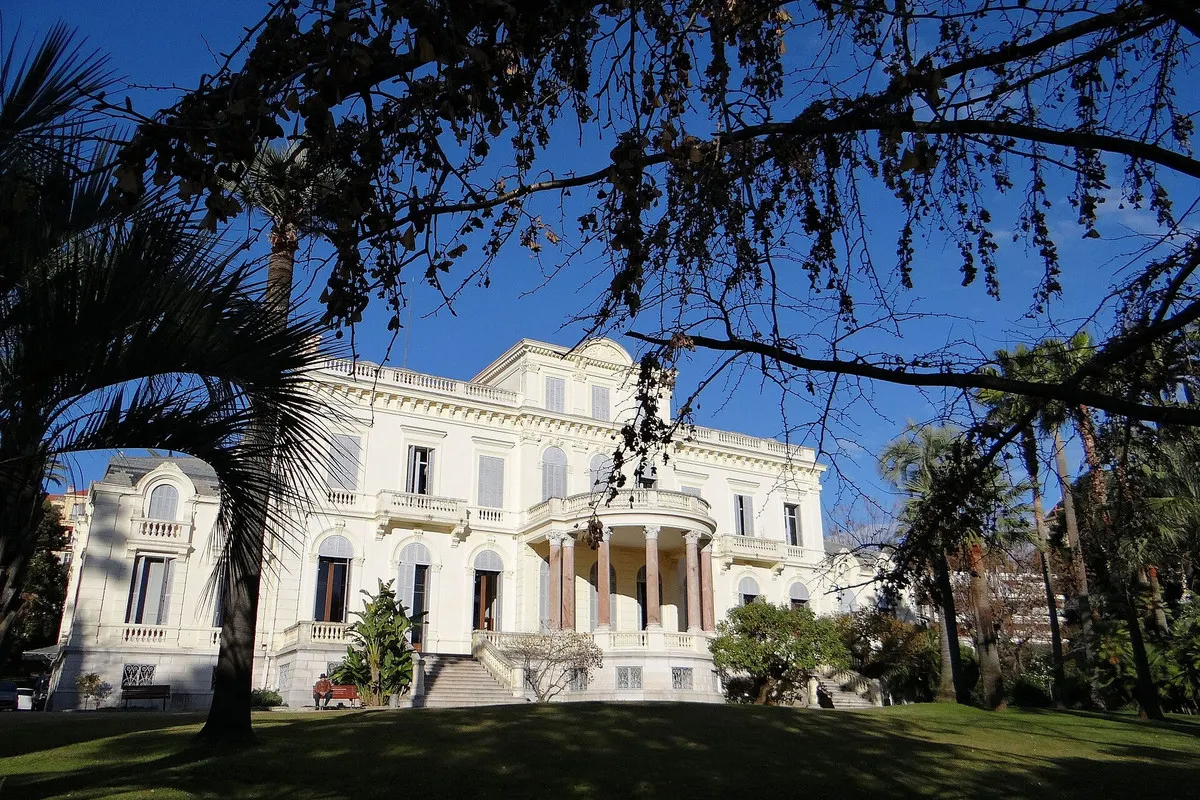
Neoclassical villa by Charles Baron with a rotunda on pink marble columns, home of the Médiathèque Noailles since 1947, in a free public park of cedars, ginkgo, magnolias and palms.
01The English quarter
Where Brougham led, the British gentry followed, and they settled on the same western slopes. While La Californie, on the far side of town, became “little Russia”, La Croix-des-Gardes became the English quarter: villas in gardens planted by English residents and laid out in the English manner, adapted to the small, uneven plots of the Riviera.
One of the most influential arrivals was Sir Thomas Robinson Woolfield, who in 1852 and 1853 built the Villa Victoria in a fifteenth-century English rustic style, designed by the English architect Thomas Smith, in a two-hectare park laid out by the gardener John Taylor. Its exotic trees earned it an article in the Journal of Horticulture and Cottage Gardener. In 1874 Woolfield installed the first tennis court on the Côte d'Azur here, so that the British of Cannes could try a game invented only the year before. The villa, at 7 avenue du Docteur-Raymond-Picaud, has been divided into apartments since 1952.
02Baroness Betty's villa
In the winter of 1880 the Villa Victoria had a famous tenant: Baroness Betty de Rothschild, widow of James de Rothschild of the Paris bank. She liked Cannes so much that in 1881 she bought more than three hectares running down to the sea, kept two of the five villas already standing there for her household, demolished the rest and asked the Marseille-born architect Charles Baron to build her a house for entertaining. It went up within a year.
Insider tipFind the araucaria the baroness had hauled from Golfe-Juan by 32 horses.
The Villa Rothschild is neoclassical: a central block of two and three storeys between two wings, forty rooms including twenty-eight bedrooms, a semicircular winter garden to the east and, on the south side, a rotunda terrace on eight pink marble columns, with twin staircases down to the park. The Rothschild arms crown the pediment above the carriage porch. The barons Alphonse, Édouard, Maurice and Philippe de Rothschild lived here after her; during the Second World War German troops made it their Kommandantur. In 1947 the town bought it, and it has housed the municipal library ever since – today the Médiathèque Noailles.
The park, planted with blue cedar, ginkgo, magnolia and palms, once kept four gardeners busy. In 1884 the baroness ordered a 12-metre araucaria, which had to be brought from Golfe-Juan on a special carriage drawn by 32 horses. Villa and park have been classified as historic monuments since 22 July 1991, and the garden is open to everyone, free of charge.