In this story · 5 sections
The Esterel is the moment the Riviera changes colour. West of Cannes the white limestone gives way to rock the shade of terracotta, and the hills of this low volcanic massif tumble straight into the sea between Saint-Raphaël and Mandelieu-la-Napoule. It covers some 32,000 hectares of south-eastern Var and spills over into the Alpes-Maritimes, and its highest point, Mont Vinaigre, reaches just 614 metres.
Low it may be, but it is wild. Most of the massif is protected, much of it is state forest, and the only way to know it is on foot, by bike, or along the coast road that its builders called the Corniche d'Or, the golden corniche.
4 places
© OpenStreetMap contributors · OpenFreeMap
- 01Cap Dramontsee · Saint-Raphaël
- 02Viaduc d'Anthéorsee · Anthéor
- 03Calanque de Mauboissee · Le Trayas
- 04Mont Vinaigresee · Fréjus
- Cap Dramont
- Coastal path, semaphore and the 1944 landing beach
- Agay
- The deep bay where the Corniche d'Or begins
- Viaduc d'Anthéor
- Arched railway viaduct above a tiny cove
- Le Trayas
- Red coves such as the Calanque de Maubois
- Théoule-sur-Mer
- The last village before Mandelieu
Why the rocks are red
The base of the Esterel dates from the Hercynian mountain building, but almost all of its volcanic rock appeared at the end of the Palaeozoic, around 250 million years ago, during 30 million years of intense eruptions. Basalts came first, then the red rhyolites that give the massif its colour, threaded here and there with blue estérellite. Later, in the Miocene, Corsica and Sardinia broke away and rotated, which is why the same porphyry is found in the calanques of Piana in Corsica. Erosion has long since erased the shape of the original volcanoes.
Hermits, brigands and cork
Celto-Ligurian tribes left hill forts across the massif, and the Romans ran their road to Forum Julii, modern Fréjus, past it. In the fourth century the hermit Honorat, who would found the monastery on the Lérins islands, lived in a cave in the hills, still known as the Sainte-Baume of Saint-Honorat.
For centuries the Esterel was bandit country. Gaspard de Besse robbed travellers and tax collectors here in the 18th century, "crossing the Esterel" became a byword for danger, and a forester's house is still called Malpey, the bad mountain. In the 19th century the forest was worked for cork oak and juniper oil; today beekeepers come for the thyme, heather and strawberry trees.
The Corniche d'Or
From Roman times until the end of the 19th century, the only way from Fréjus to Cannes was through the hills. The coast road was built on the initiative of the Touring Club de France, with support from the PLM railway company, and inaugurated on 11 April 1903; the club's president, Abel Ballif, built his own house beside it. It became part of the N7 in 1904 and is today the D559 in the Var and the D6098 in the Alpes-Maritimes.
Film-makers have loved it ever since. It appears in Le Corniaud, Le Clan des Siciliens and L'Arnacœur, among others. Drive it east to west in the late afternoon, when the rock glows and the sea turns deep blue.
Anthéor and the 1944 landings
On 15 August 1944, part of the Allied landings in Provence came ashore on the beach at Le Dramont, after a commando had seized the viaduct of Anthéor further east. The viaduct's arches still stride across the little cove beneath it, one of the most photographed sights on the road.
Walking, diving and the fire season
Inland, forest roads waymarked by the Office national des forêts lead to summits such as Mont Vinaigre and the Pic de l'Ours. Divers head for the Île d'Or, the Lion de Mer and the Cap-Roux reserve. The Esterel has suffered terrible fires, in 1964, 1986, 2003 and 2007, and in 1964 almost the entire forest burned. Between 21 June and 30 September access to the massif is regulated, and roads close on days of mistral. In the Alpes-Maritimes part, a departmental park of 772 hectares shelters red deer introduced in 1961.
Cap Dramont
Coastal path, semaphore and landing beach
A loop around the cape with views to the Île d'Or.
Sentier littoral du Cap Dramont, 83700 Saint-Raphaël
Insider tipThe 1944 landing beach is at its foot.
Viaduc d'Anthéor
The arched viaduct over the cove
Seized by a commando before the landings of August 1944.
Boulevard des Lucioles, 83530 Saint-Raphaël
Insider tipBest seen from the beach below.
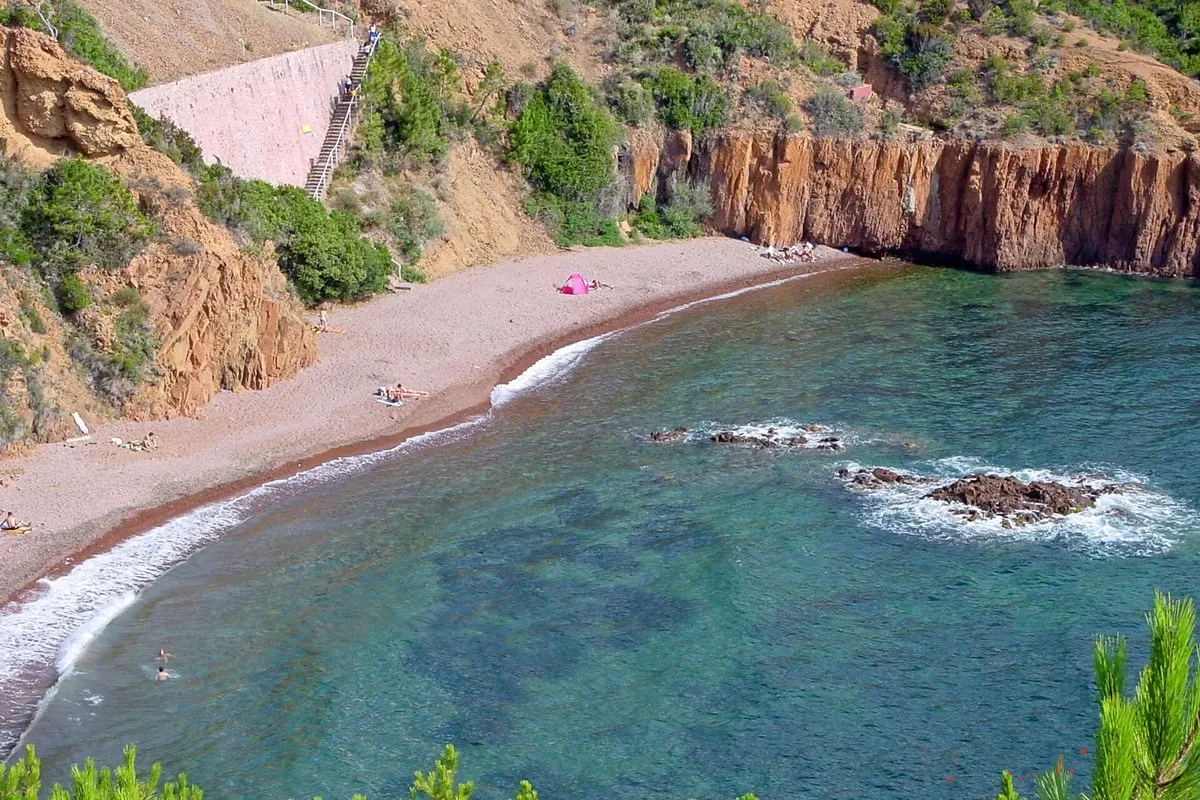
Calanque de Maubois
A red-rock cove at Le Trayas
Pebbles, porphyry cliffs and clear water below the Corniche.
Le Trayas, 83530 Saint-Raphaël
Insider tipSteep paths; wear sturdy shoes.
Mont Vinaigre
The Esterel's highest point, 614 m
The summit of the massif, reached via the forest roads.
Route des Cols, 83600 Fréjus
Insider tipCheck access rules in summer and on mistral days.
Neighbourhood and property data for Théoule-sur-Mer and Mandelieu-la-Napoule is on VERA PI, and more coastal drives are on metromode.co.