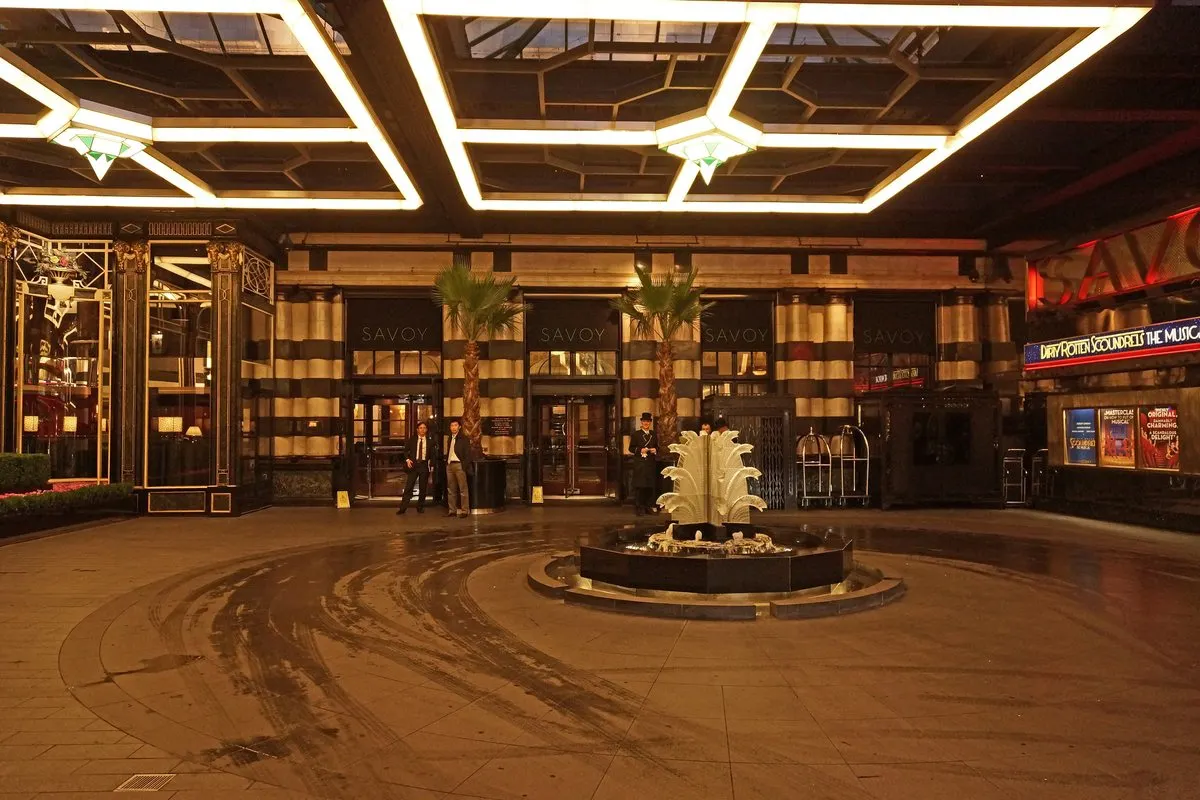
The Savoy on the Strand opened in 1889, built with the profits from Gilbert and Sullivan's operettas. Here, César Ritz and Escoffier reinvented London dining, Monet painted the Thames, and a black cat has made up the numbers as the fourteenth guest since 1926.
In this story · 6 sections
The Savoy stands on the Strand in Westminster, with its façade facing the Thames and its entrance on Savoy Court. The hotel has been called London's most famous, and it is difficult to find any building in the city that has shaped so much of what we mean today by a luxury hotel.
The Savoy
Hotel · Strand
© OpenStreetMap contributors · OpenFreeMap
- Address
- Strand, London WC2R
- Opened
- 6 August 1889
- Architect
- Thomas Edward Collcutt
- Operated by
- Fairmont Hotels and Resorts
- Afternoon tea
- Thames Foyer
- 1889
- The hotel opens on 6 August
- 1893
- Escoffier creates pêche Melba
- 1926
- Kaspar the cat becomes the fourteenth guest
- 1930
- The Savoy Cocktail Book is published
Richard D'Oyly Carte's hotel, designed by Thomas Edward Collcutt. Operated by Fairmont Hotels and Resorts.
01A hotel built on Gilbert and Sullivan
The site has a long history. In the 13th century, Peter of Savoy built a palace here, and later John of Gaunt's Savoy Palace stood on the site until it was burned down during the Peasants' Revolt in 1381. The name lived on, and when the theatre impresario Richard D'Oyly Carte bought the plot in 1880, he first built the Savoy Theatre for Gilbert and Sullivan's operettas.
After travelling in the USA, Carte wanted to build an American-style luxury hotel in London. The architect Thomas Edward Collcutt, who also designed Wigmore Hall, was given the commission, and the building was financed with the profits from the partnership – not least from The Mikado. The hotel opened on 6 August 1889. It was the first in Britain with electric light throughout the building and with electric lifts, and most of the 268 rooms had their own marble bathrooms with hot and cold running water.
02César Ritz and Auguste Escoffier take over the kitchen
The start was sluggish. Within six months, the hotel was losing money, and the board asked Carte to change the management. He hired César Ritz as manager, and Ritz brought along the chef Auguste Escoffier and the maître d'hôtel Louis Echenard. Soon, the Prince of Wales and the aristocracy filled the dining rooms, and upper-class women, who had previously rarely dined in public, now appeared at the Savoy.
Insider tipThe entrance is on Savoy Court, off the Strand. The nearest Underground stations are Charing Cross and Embankment.
Escoffier created several of his most famous dishes here: pêche Melba in 1893, in honour of the opera singer Nellie Melba, and Melba toast in 1897. In 1897, Ritz, Escoffier and Echenard were dismissed after wine and spirits worth over £3,400 went missing. For a long time the official version was that they had resigned; the truth did not become known until 1985, according to Wikipedia.
03Monet at the window and Gershwin on stage
The Savoy has long been the artists' hotel. Whistler stayed here in 1896 and made eight lithographs of the Thames from his room. Claude Monet came in 1899, 1900 and 1901 and painted Charing Cross Bridge and Waterloo Bridge from the window; 26 pastels from the visits survive. In 1925, George Gershwin gave the British premiere of Rhapsody in Blue at the hotel, broadcast simultaneously on BBC radio from the studio at Savoy Hill next door.
During the Second World War, Winston Churchill often brought his cabinet here for lunch, and Charles de Gaulle and Lord Mountbatten were regulars in the Grill Room. The hotel's air-raid shelter was said to be the most elegant in London.
04Kaspar, the fourteenth guest
In 1898, the diamond magnate Woolf Joel held a dinner for fourteen people, but one guest dropped out, leaving thirteen. Joel was the first to leave the table and was shot dead in Johannesburg a few weeks later. After that, the hotel seated a member of staff at tables of thirteen. In 1926, the designer Basil Ionides instead sculpted Kaspar, a black Art Deco cat just under a metre tall, which has since been given a full place setting and served every course. Churchill was so fond of Kaspar that the cat was allowed to join his dinners regardless of how many guests there were.
05The American Bar, the Beaufort Bar and the Thames Foyer
The American Bar was one of the first in Europe to serve American cocktails, and in 1930 the hotel published The Savoy Cocktail Book with 750 recipes compiled by the bartender Harry Craddock. The book has been in print ever since. The bar is decorated in Art Deco style in cream and ochre, and a pianist plays jazz on a grand piano every day.
In December 2007, the hotel closed for a total renovation. It was budgeted at £100 million but ended up costing £220 million, and the hotel reopened in October 2010. The restoration gave the Thames Foyer a winter garden under a glass dome that had been covered since the Second World War – this is where afternoon tea is served, to piano music. The new Beaufort Bar, in black and gold, has cabaret in the evenings. The rooms facing the Thames are decorated in Edwardian style, those facing the Strand in Art Deco.
06The Savoy and the Strand around it
The hotel is operated by Fairmont Hotels and Resorts and is Grade II listed. A small museum by the American Bar displays items from the archive and is open to the public. See the street in VERA PI's street file for Strand, see the whole of Westminster, start at VERA PI's London guide and find more city guides at metromode.co.