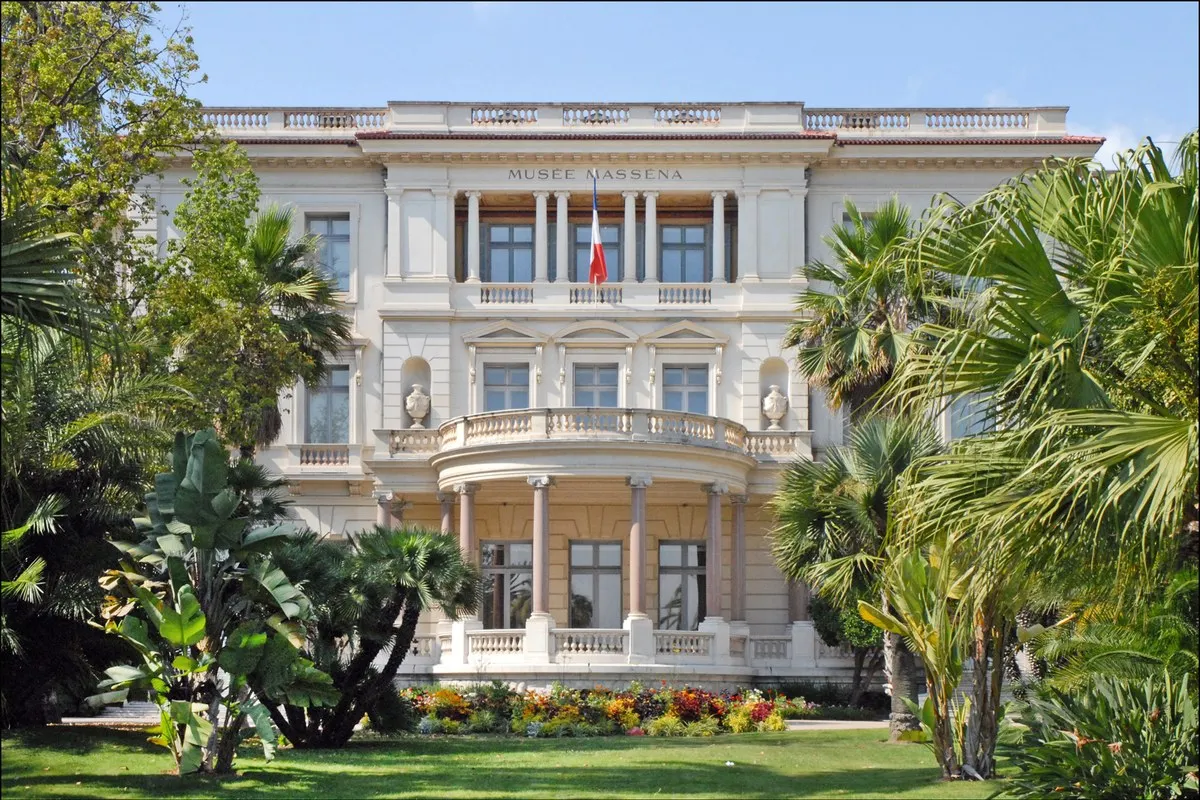
Next door to the Negresco, the seaside villa a prince began in 1898 now tells the story of Nice – from Napoleon's marshal to the winter visitors of the Belle Époque – and its garden is open to anyone walking by.
In this story · 4 sections
Of the private palaces that once lined the Promenade des Anglais, the Villa Masséna is one of the last still standing, and the only one you can simply walk into. It sits behind railings and palms beside the Negresco, white, symmetrical and composed, a reminder of the decades when Nice was the winter capital of Europe's aristocracy.
Since 1921 it has been the city's museum of art and history, and since a long restoration that ended in 2008 it has looked very much as its builders intended. This is a guide to the house, the rooms worth lingering in and the garden that the family insisted should belong to everyone.
Villa Masséna
Museum · Promenade des Anglais, Nice
© OpenStreetMap contributors · OpenFreeMap
- Address
- 65 rue de France, 06000 Nice
- Built
- From 1898
- Commissioned by
- Victor Masséna, Prince of Essling and Duke of Rivoli
- Architects
- Hans-Georg Tersling and Aaron Messiah
- Garden
- Édouard André, restored 2006–2007
- Museum
- Opened 1921, reopened 1 March 2008
- Display
- 1,800 m² on the history of Nice, 1792–1939
- Protected
- Historic monument since 1975, the whole estate since 2023
Belle Époque villa begun in 1898 for Victor Masséna, Prince of Essling, beside the Negresco: Empire reception rooms, the history of Nice from 1792 to 1939 and a public garden by Édouard André.
01A grandson's villa
In 1898 Victor Masséna, Prince of Essling and Duke of Rivoli, decided to build a grand pleasure villa on the Nice seafront. He was the grandson of André Masséna, the Nice-born marshal Napoleon called “the dear child of victory”, and the house was meant to say so.
The family admired the Villa Rothschild in Cannes and held it up as a model to their architects, Hans-Georg Tersling and Aaron Messiah, who were also asked to look to the great neoclassical villas of Italy. They added an Empire accent, an open tribute to Napoleon I, to whom the Massénas owed their titles. The villa was designed for receptions, and its garden was laid out by the landscape architect and botanist Édouard André.
In 1919 the prince's son, André Masséna, sold the property to the city for a sum equal to the inheritance tax he had just paid. He set two conditions: the villa was to become a museum of local history under the name Musée Masséna, and the garden was to be open to the public. Both were honoured, and the museum opened in 1921.
02The reception rooms
The ground floor is the Belle Époque at full volume. A grand gallery runs the length of the house and opens onto the rooms the prince used for entertaining: a dining room that ends in a domed conservatory, a grand salon overlooking the garden with chandeliers and paintings of the marshal's campaigns, a smoking room, the prince's study and a library. Among the panelling is a set of early nineteenth-century boiseries brought from the Château de Govone near Turin, and most of the furniture is Empire.
Insider tipBuy the €15 ticket if you plan another municipal museum – it covers them all for 96 hours.
The restoration, led by the Nice architect Philippe Mialon, reopened the museum on 1 March 2008 and gave it 1,800 square metres of permanent display. Façades and roofs have been listed as historic monuments since 1975, and in 2023 the protection was extended to the whole ensemble: villa, forecourt, garden, belvedere terrace and lodge.
03Nice, 1792 to 1939
The upper floors tell the history of the city from the arrival of the French Revolution's armies to the eve of the Second World War, in chronological and thematic rooms. There are mementos of Napoleon and the Empress Joséphine, including a death mask of the emperor and Antoine-Jean Gros's portrait of Joséphine from 1808. There are tributes to the Russian imperial family and the other royal visitors who wintered in Nice, and old photographs and maps that show the Baie des Anges and the Promenade changing from a rough shore into the boulevard we know.
The top floor holds the Bibliothèque de Cessole, a library of thousands of documents on the County of Nice, Provence, Savoy and northern Italy.
04The garden
André's garden was restored in 2006 and 2007 to its original plan, with palms, lawns and flower beds running down from the south façade to a belvedere terrace above the Promenade. It is the kind of place locals cross on the way to somewhere else, and that is part of its charm.
In the garden stands the memorial to the victims of the attack on the Promenade des Anglais on 14 July 2016. At night the façades are floodlit, like those of the Negresco next door, and the villa reads as clearly from the sea front as it did when the prince's guests arrived by carriage.