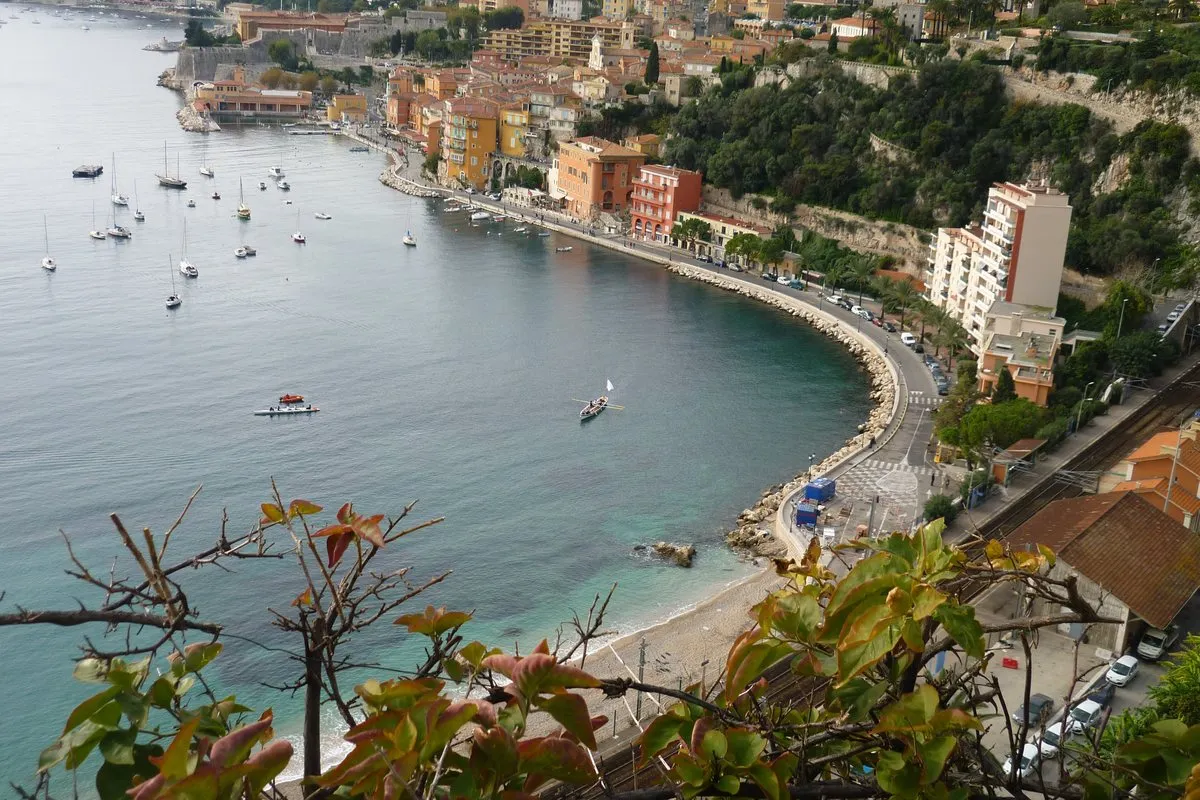
Ochre-coloured façades, a street running beneath the 13th-century houses, and a fishermen's chapel that Jean Cocteau painted from floor to ceiling. Villefranche-sur-Mer is the Riviera's best-preserved harbour town – and best experienced on foot.
In this story · 6 sections
From the train rolling in along the coast from Nice, Villefranche-sur-Mer looks almost too beautiful to be real: a staircase of ochre, terracotta and peach climbing upwards from the water, with the church tower at its centre and a fortress at one edge. Below lies the bay, so deep that cruise ships can anchor right in the middle of it. It is one of the Mediterranean's deepest natural harbours, and it is this that has shaped the town for more than seven hundred years.
The name means "the free town by the sea". In 1295, Charles II of Anjou, Count of Provence, enticed the inhabitants of the hilltop village of Montolivo to move down to the coast and gave the new town free-port status, with tax privileges that lived on well into the 1700s. The old town centre is remarkably intact, and the best way to experience it is to start by the water and let the narrow streets take you upwards. More about the municipality and its houses can be found on VERA PI's page about Villefranche-sur-Mer.
7 places
© OpenStreetMap contributors · OpenFreeMap
- 01Chapelle Saint-PierreArt and chapel · Quai Courbet
- 02Hôtel WelcomeHotel · Quai Courbet
- 03Rue ObscureSight · Old town
- 04Église Saint-MichelChurch · Old town
- 05Citadelle Saint-ElmeSights and museums · La Citadelle
- 06La DarseHarbour · La Darse
- 07Plage des MarinièresBeach · Les Marinières
- 1260
- The covered street, Rue Obscure, is built
- 1295
- The town is founded as a free port by Charles II of Anjou
- 1557
- The Citadelle Saint-Elme is completed
- 1860
- The County of Nice, and with it Villefranche, becomes French
- 1948–1966
- Home port of the American Sixth Fleet
- 1957
- Jean Cocteau paints the Chapelle Saint-Pierre
Quai Courbet and Cocteau's chapel
The walk begins on Quai de l’Amiral Courbet, the quay where the small fishing boats are moored in front of the restaurants' awnings. At the far end, by the harbour entrance, stands a low stone chapel with a painted façade. The Chapelle Saint-Pierre probably dates from the second half of the 16th century and long belonged to the fishermen: in the 19th century and into the 20th it was used as a store for nets and gear, and it was here that the fishermen's guild, the Prud’homie des pêcheurs, settled its disputes.
In 1957, Jean Cocteau covered the entire interior with paintings. It was the first chapel he painted. Five large scenes fill the walls: two depict life by the Mediterranean and three tell the story of the apostle Peter, the fisherman. The candlesticks are shaped like human faces, and the altar is carved from a block of stone from La Turbie. The chapel was consecrated with a mass on 30 June 1957 and still belongs to the fishermen's guild. It is a small, almost intimate place – expect to stay longer than you think.
Cocteau had a long relationship with the town. He came to Villefranche in the 1920s, decided to stay, and checked into the Hôtel Welcome a few steps away on the same quay. The corner room facing the harbour that he chose is today room 22 and is called the Cocteau Room, according to France Today. He painted the chapel roughly thirty years after his first stay.
Rue Obscure – the street beneath the houses
From the quay, you take one of the steep staircases up into the old town. Just above the harbour, you'll find the town's most peculiar spot: Rue Obscure, "the dark street". It's a vaulted, almost underground passage running beneath the houses parallel to the water, with stone arches and small openings where the light falls in. It dates back to 1260 and is one of the best-preserved medieval streets on the coast.
It's cool here even in the middle of summer, and quiet in a way that's unusual on the Riviera. Walk slowly and let your eyes adjust to the half-light before you step back out into the sun.
The Église Saint-Michel and the steep alleyways
Up the alleyways, where the stairs are so narrow that the houses almost meet overhead, lies the Église Saint-Michel. The church was built in Italian Baroque style in the 1750s, on the site of a simpler church from the early 1300s. Inside there is a large painting of the Archangel Michael above the marble altar, a reclining Christ from the 1700s known as the "Galley Slaves' Christ" and a polychrome wooden statue of San Rocco. The organ, built by the Grinda brothers in 1790, is one of the oldest still in use in the old County of Nice.
Citadelle Saint-Elme and the museums
Down towards the west, the citadel awaits. After Franco-Turkish forces plundered the town in 1543, Duke Emmanuel Philibert of Savoy had a fortress built here, and another up on Mont Alban. The Citadelle Saint-Elme was completed in 1557 and has kept its thick walls and moats. Today it houses the town hall, a congress centre, an open-air theatre and museums of sculpture, painting and contemporary art, among them the Musée Volti and the Musée Goetz-Boumeester. Walk around the walls – the view over the bay towards Cap Ferrat is the best in town.
La Darse, the bay and the film history
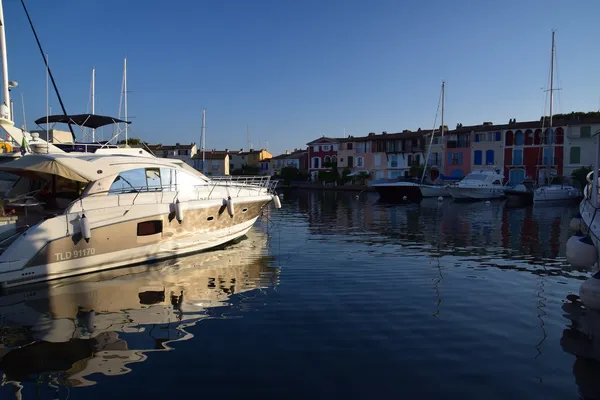
Behind the citadel lies La Darse, the old 17th-century harbour built for the Duke of Savoy's galleys. Today it is a marina with yacht maintenance businesses, and it is also home to an oceanographic observatory affiliated with Sorbonne Université and the French research council CNRS. The buildings around the harbour are protected as historic monuments.
The depth of the bay has made it a strategic harbour for centuries. During the 19th century it was a base for the Russian Imperial Navy, and between 1948 and 1966 Villefranche was home port to the American Sixth Fleet, until Charles de Gaulle withdrew France from NATO's integrated military command. Today, the town is France's most visited port of call for cruise ships.
The scenery has long attracted filmmakers. Hitchcock's To Catch a Thief, Never Say Never Again and Dirty Rotten Scoundrels all have scenes shot here. And at Villa Nellcôte, a belle époque villa in the hills, the Rolling Stones recorded what became the album Exile on Main St. (1972).
Plage des Marinières – finish with a swim
The walk ends where it began: at the water. Plage des Marinières, the town's main beach, stretches around 700 metres along the northern part of the bay, below the railway towards Italy. The water is clear and the view goes straight across to Cap Ferrat. If you want to continue the day, Saint-Jean-Cap-Ferrat lies on the other side of the bay and Monaco is a short train ride away. You can find more destinations along the coast at metromode.co.
Chapelle Saint-Pierre
The fishermen's chapel, painted by Cocteau
The 16th-century chapel that Jean Cocteau decorated in 1957 – his first chapel.
Quai de l’Amiral Courbet, Villefranche-sur-Mer
Insider tipBelongs to the Prud’homie des pêcheurs.
Hôtel Welcome
Cocteau's hotel on the quay
The hotel on the quay where Jean Cocteau stayed from the 1920s. The corner room facing the harbour, room 22, is called the Cocteau Room.
3 quai de l’Amiral Courbet, Villefranche-sur-Mer
Rue Obscure
The covered street from 1260
Vaulted, almost underground medieval passage beneath the houses along the harbour.
Église Saint-Michel
The Baroque church with the organ from 1790
Italian Baroque from the 1750s, with the "Galley Slaves' Christ" and one of the county's oldest working organs.
Place Félix Poullan, Villefranche-sur-Mer
Citadelle Saint-Elme
The fortress from 1557
Savoyard fortress with the town hall, an open-air theatre, the Musée Volti and the Musée Goetz-Boumeester – and the town's best view over the bay.
La Darse
The duke's galley harbour
The old harbour from the 1600s, today a marina and the seat of an oceanographic observatory.
Plage des Marinières
The town's main beach
Around 700 metres of beach along the northern part of the bay, with views towards Cap Ferrat. Lifeguards on duty during the season.