Aix-en-Provence was founded by the Romans at warm springs in 123 BC and became the capital of Provence, a university town and Cézanne's hometown. Here's how to spend two days in the city of a thousand fountains.
In this story · 6 sections
Aix-en-Provence in Bouches-du-Rhône is Provence's most elegant city. The Romans founded it as Aquae Sextiae in 123 BC, named after the warm springs that still flow beneath the streets. In 1501, the city was given Provence's parliament, which remained until the Revolution in 1789, and it is from that period that the grand town houses, the hôtels particuliers, and the many fountains date.
Aix has also been a university town since 1409 and is the birthplace of Paul Cézanne. Here is our plan for two days. The property market in the town, address by address, can be found on VERA PI's page about Aix-en-Provence.
Aix in numbers
- Founded
- 123 BC as Aquae Sextiae
- University
- Since 1409
- Opera festival
- Since 1948, in July
- Flats, median per m²
- 4,756 euros (VERA PI)
- Villas and houses, median per m²
- 6,078 euros (VERA PI)
01Day 1, morning: Cours Mirabeau
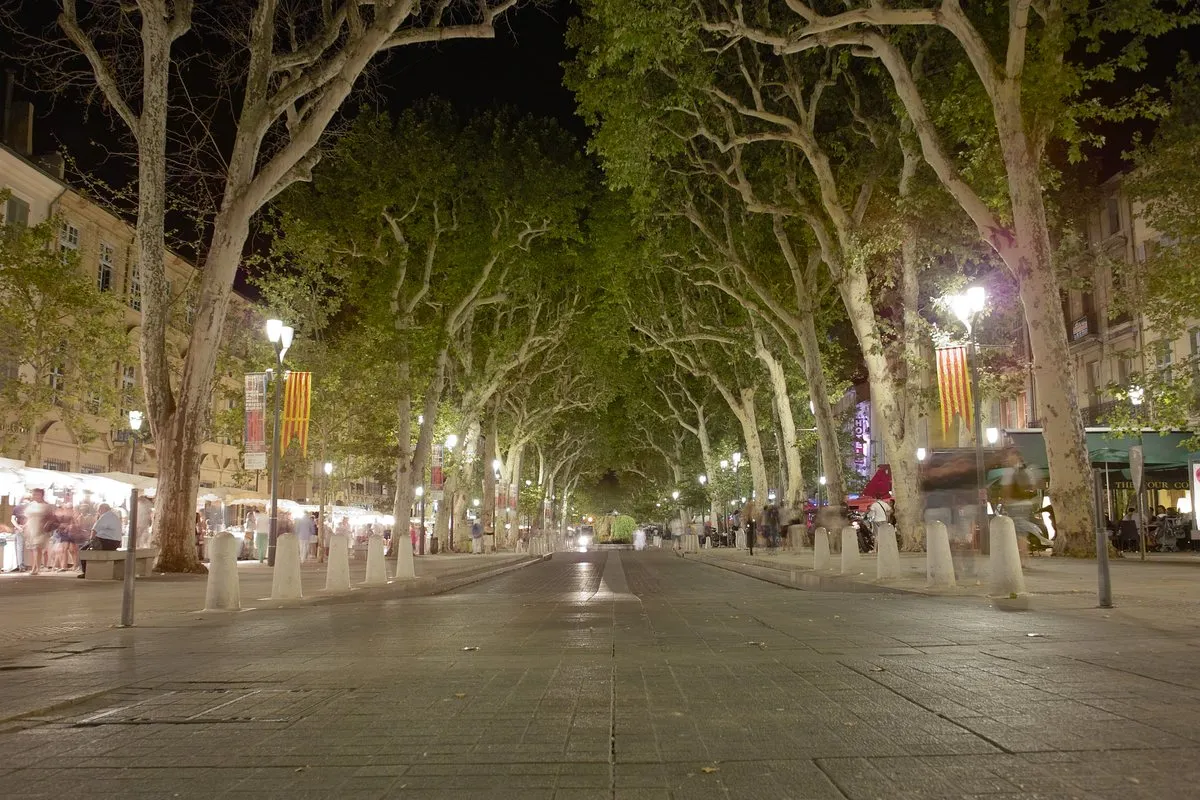
Start at Cours Mirabeau, the wide street with double rows of plane trees that separates the old town in the north from the Quartier Mazarin in the south. The street has three fountains that tell the story of the city: at the top, a 19th-century fountain with King René, who according to tradition brought the muscat grape to Provence; halfway along, a moss-covered fountain with naturally warm water, 34 degrees, from Roman times; and at the bottom, by La Rotonde, the great fountain from 1860.
The café Les Deux Garçons, which opened in 1792, was a haunt of Cézanne, Émile Zola and Ernest Hemingway. It was destroyed in a fire in November 2019. Have your morning coffee on a terrace along the street and watch the city wake up.
02Day 1, late morning: the old town and the market
Head north into the old town, towards Place de l'Hôtel de Ville with its bell tower from 1510 and the former grain hall from 1759–1761. The squares around it are filled with a market in the mornings – fruit, vegetables, cheese and flowers – and in the alleys there are shops selling calissons, the city's almond confectionery, interiors and fashion.
03Day 1, afternoon: Quartier Mazarin and Musée Granet
South of Cours Mirabeau lies the Quartier Mazarin, the district laid out in the 17th century with straight streets and town palaces. In its middle stands the Fontaine des Quatre Dauphins, the 17th-century fountain of the four dolphins. Here, too, is the Musée Granet, the city's art museum of European painting and sculpture, with works by Cézanne in the collection.
04Day 1, evening: dinner and the festival
If you're travelling in July, your evening could be the opera. The Festival d'Aix-en-Provence was founded in 1948, and the first performance was Mozart's Così fan tutte in the courtyard of the old Archbishop's Palace. Today, the festival is one of Europe's major opera festivals, with performances at the Archevêché, the Grand Théâtre de Provence and the Théâtre du Jeu de Paume. Book tickets early.
05Day 2, morning: Cézanne's studio
Walk or drive up to the hill of Les Lauves in the northern part of the town. In November 1901, Cézanne bought a small 0.7-hectare farm here, with pine trees, olive trees and fig trees, and had a bastide built with a large glass wall in the studio on the upper floor. Here he painted from 1901 until his death in 1906. The studio is now a museum, with his belongings left as they were.
Just above the studio lies the Terrain des Peintres, the spot where he painted the mountain Sainte-Victoire. Cézanne painted the mountain in 44 oil paintings and 43 watercolours. A route through the town connects the places from his life, among them his childhood home, the Jas de Bouffan.
06Day 2, afternoon: Sainte-Victoire or Château La Coste
In the afternoon, leave the city. One option is the mountain itself: Sainte-Victoire, the white limestone ridge east of the city, has hiking trails to the summits and views over the whole of Provence. The other is Château La Coste in Le Puy-Sainte-Réparade, the wine estate with architecture by Tadao Ando, Jean Nouvel, Frank Gehry and Renzo Piano, half an hour north by car.
The prices apply from January 2021 to June 2026, with 12,510 properties sold. Compare with Le Puy-Sainte-Réparade, where Château La Coste is located. Further north-west, read our guides to Saint-Rémy-de-Provence and the Luberon villages, and find more among metromode.co's destinations.