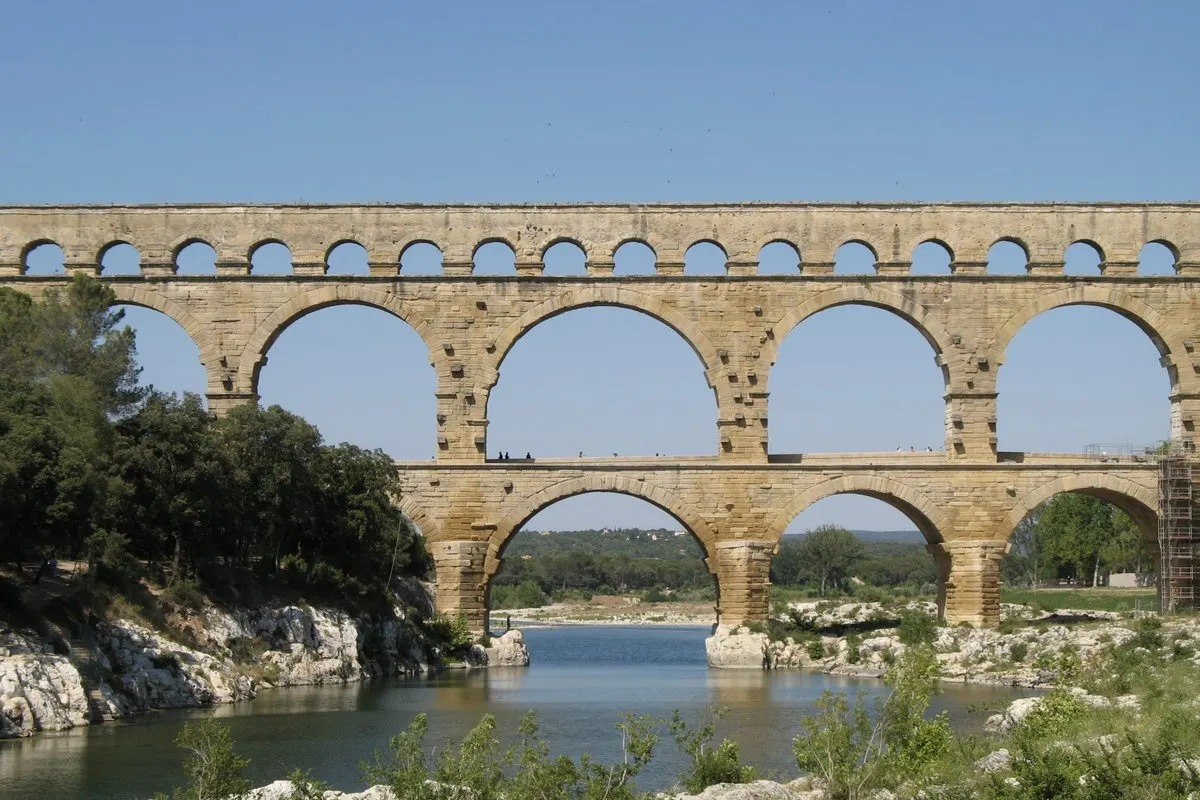
Built in the first century AD to carry the springs of Uzès to Roman Nîmes, the Pont du Gard still spans the Gardon on three tiers of shelly limestone. It is a monument to patience as much as power: its builders made water flow across a gradient almost too gentle to measure.
In this story · 3 sections
The Pont du Gard crosses the river Gardon at Vers-Pont-du-Gard, next to Remoulins and not far from Uzès and Nîmes. It is one of the best-preserved Roman aqueduct bridges anywhere, the highest known in the Roman world, and one of France's most popular sights. UNESCO added it to the World Heritage list in 1985 for its preservation, history and engineering. For the local property picture, see VERA PI's Vers-Pont-du-Gard guide.
Pont du Gard
Monument · Vers-Pont-du-Gard
Three tiers over the Gardon; UNESCO World Heritage since 1985.
01Water for Nemausus
Roman Nîmes – Nemausus – needed water, and the only practical source lay to the north, at the Fontaine d'Eure near Uzès. The straight-line distance is only about 20 kilometres, but the hills of the Garrigues de Nîmes were too rugged to tunnel through, so the aqueduct took a winding course of around 50 kilometres. The spring stands only 17 metres above the distribution basin in Nîmes, which is still visible on the rue de la Lampèze. To make that work, the engineers varied the gradient along the route; on the bridge itself the channel falls just 2.5 centimetres over 456 metres. At its height the aqueduct delivered an estimated 40,000 cubic metres a day to the fountains, baths and houses of a city of 50,000.
Coins found in the Nîmes reservoirs suggest construction under Claudius, probably between AD 40 and 50. Maintenance lapsed from the 4th century, limestone deposits choked two-thirds or more of the channel, and the water stopped early in the 6th century.
02How it was built
The stone came from the ancient Estel quarry nearby. The bridge rises 48.8 metres above the Gardon at low water in three tiers; the top tier, which carried the covered channel 1.8 metres high and 1.2 metres wide, has 35 arches and is 275 metres long today, though it originally ran to 360 metres. The great arches are made of independent rings set side by side – four in the lowest tier, three in the middle – which let the structure absorb small movements over the centuries. You can still see the projecting stones that held the timber scaffolding and centring. The work is thought to have taken three to five years.
03Bridge, tollgate and monument
After Rome fell, the aqueduct became a quarry and the bridge a toll crossing: in the Middle Ages the piers of the second tier were notched so that carts could pass, and local lords and bishops levied tolls for its upkeep. A road bridge was added alongside in 1743–47. The monument was on France's first list of historic monuments in 1840, and in 2000 a programme of works removed traffic and buildings from the bridge and opened a new visitor centre.
For the cities at each end of the aqueduct, see VERA PI's Nîmes guide and its Uzès page, and our destination guides.