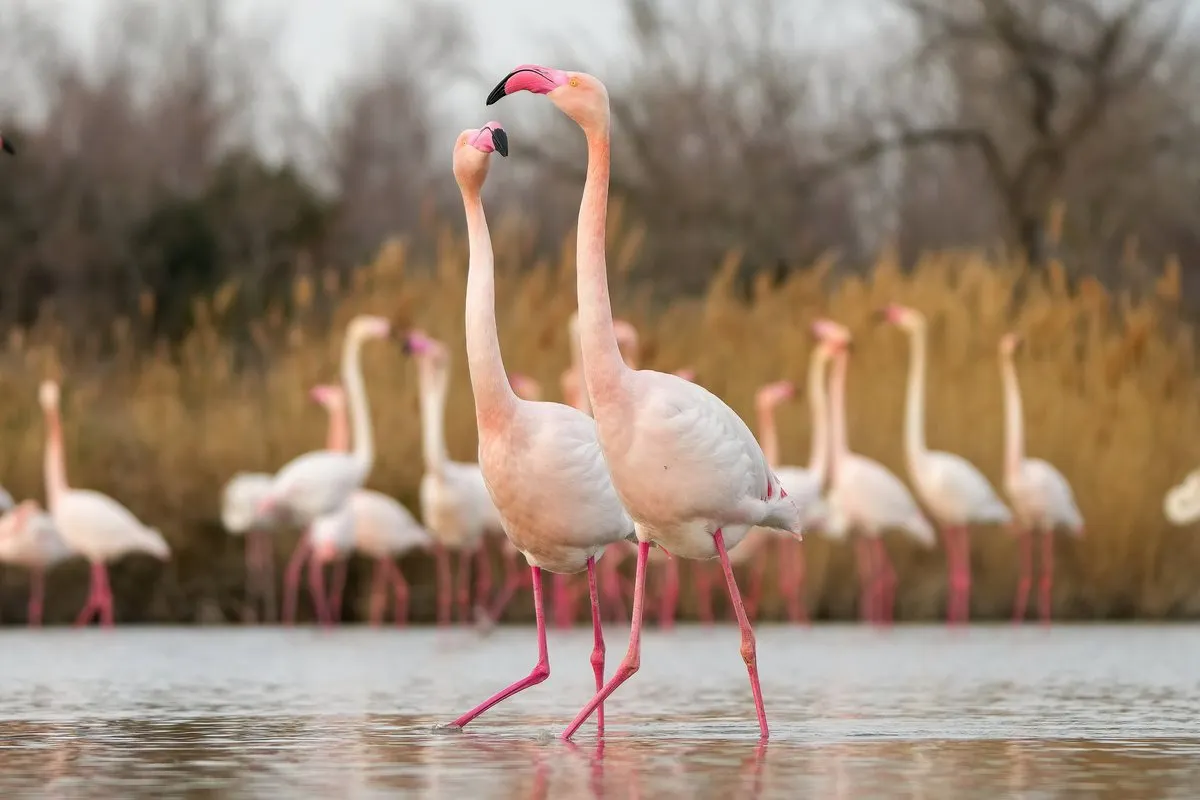
The Rhône delta is one of the few places in Europe where greater flamingos live and breed. Here is where to watch them, when the courtship dances begin, and how the Camargue's lagoons, white horses and black bulls fit together.
In this story · 4 sections
The Camargue lies south of Arles between the two arms of the Rhône, the Grand Rhône and the Petit Rhône. At more than 930 square kilometres it is one of western Europe's largest river deltas: a flat world of brine lagoons cut off from the sea by sandbars, ringed by reed marshes and then by cultivated land. About a third of it is water. More than 400 bird species have been recorded here, and its brine ponds are one of the few European habitats of the greater flamingo. For the town at the heart of it, see VERA PI's guide to Saintes-Maries-de-la-Mer.
Parc ornithologique du Pont de Gau
Nature · Saintes-Maries-de-la-Mer
© OpenStreetMap contributors · OpenFreeMap
- Address
- RD 570, 13460 Saintes-Maries-de-la-Mer
Flamingos all year, with a wildlife care centre.
01A protected delta
The shores of the Étang de Vaccères, the great central lagoon, have been protected for their birds since 1927. The Parc naturel régional de Camargue was established in 1970 and covers 820 square kilometres; the delta is also a national nature reserve, a UNESCO biosphere reserve and, since 1 December 1986, a Ramsar wetland of international importance. The park is twinned with Doñana in Spain, another delta of birds, semi-wild horses and a pilgrimage town.
02When to go
Flamingos are present all year. Their pink comes from carotenoid pigments in the organisms they feed on, and in the breeding season they spread secretions from a gland near the tail over their feathers to intensify it – a habit biologists have described as applying make-up. The species is known for courtship displays in large mixed groups, and in the Camargue these run from December to late February. In summer the marshes hold close to 100,000 flamingos, according to the Bouches-du-Rhône tourist board, and over the year more than 150,000 birds pass through the Camargue.
Insider tipOpen daily; dogs not allowed.
03Pont de Gau: the easiest close-up
Just before Saintes-Maries-de-la-Mer on the D570, the Parc ornithologique du Pont de Gau has 60 hectares of marsh and 7 kilometres of footpaths, open every day. Flamingos can be seen here all year, along with teal and the firecrest, among the smallest birds in Europe. The park runs a care centre that takes in more than 600 injured birds a year. Admission was €8 for adults and €5 for children aged 4 to 12 at the time of writing; parking is free and dogs are not allowed.
For a wilder alternative, the Marais du Vigueirat covers more than 1,200 hectares and has recorded more than 350 bird species; in winter, guided walks go out to watch cranes.
04Horses, bulls and salt
The delta's other residents are the white Camargue horse, a breed of unknown origin, and the black bulls raised for the bloodless course camarguaise. Both live in semi-feral herds called manades and are worked by the gardians on horseback. Near the coast, salt has been gathered since prehistory; in the Middle Ages it enriched the Cistercian “salt abbeys”, and it is still harvested today.
Arles is the gateway; VERA PI's Arles guide covers the town. For more of the south, see our destination guides and Metro Mode Travel.