Versailles is too large to see in a rush and too beautiful to see badly. A considered itinerary for a full day: the Hall of Mirrors before the crowds, a long walk through Le Nôtre's gardens, and Marie Antoinette's private world at the Trianons.
In this story · 7 sections
Versailles defeats the casual visitor. The Palace of Versailles, southwest of Paris in the Yvelines, is not a single building but an estate: a château of roughly 2,300 rooms, a formal park of around 815 hectares, two smaller palaces, a canal and a mock village. Louis XIV conceived it to glorify the French monarchy, and from 6 May 1682 until 6 October 1789 the king, the court and the government lived here. Treat it as a full day and plan the order carefully, and it becomes one of the great experiences in Europe.
Château de Versailles
Palace · Versailles, Yvelines
© OpenStreetMap contributors · OpenFreeMap
- Address
- Place d'Armes, 78000 Versailles
- Distance from Paris
- About 20 km southwest
- Royal residence
- 1682–1789
- Rooms
- About 2,300
- Park
- About 815 hectares
- Allow
- A full day
The royal palace with the Hall of Mirrors, Le Nôtre's gardens, the Grand and Petit Trianon and the Queen's Hamlet.
01Before you go
Buy a timed ticket online for the earliest entry slot, and choose the ticket that covers the estate as well as the palace, so that the Trianons are included. The palace is closed on Mondays. Trains run from central Paris: the RER C to Versailles Château–Rive Gauche is closest to the gates, while SNCF trains from Saint-Lazare reach Versailles Rive Droite and from Montparnasse reach Versailles Chantiers. Wear comfortable shoes; you will walk several kilometres.
029.00: The State Apartments and the Hall of Mirrors
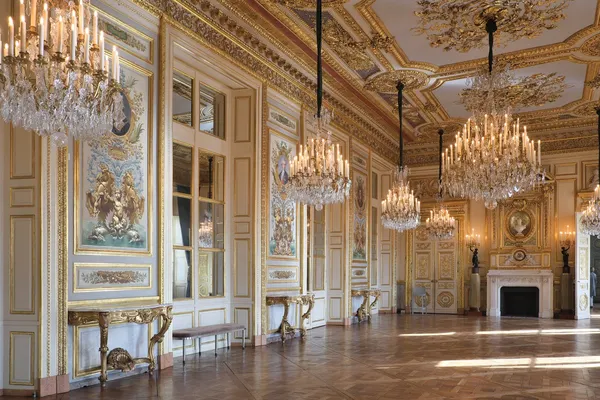
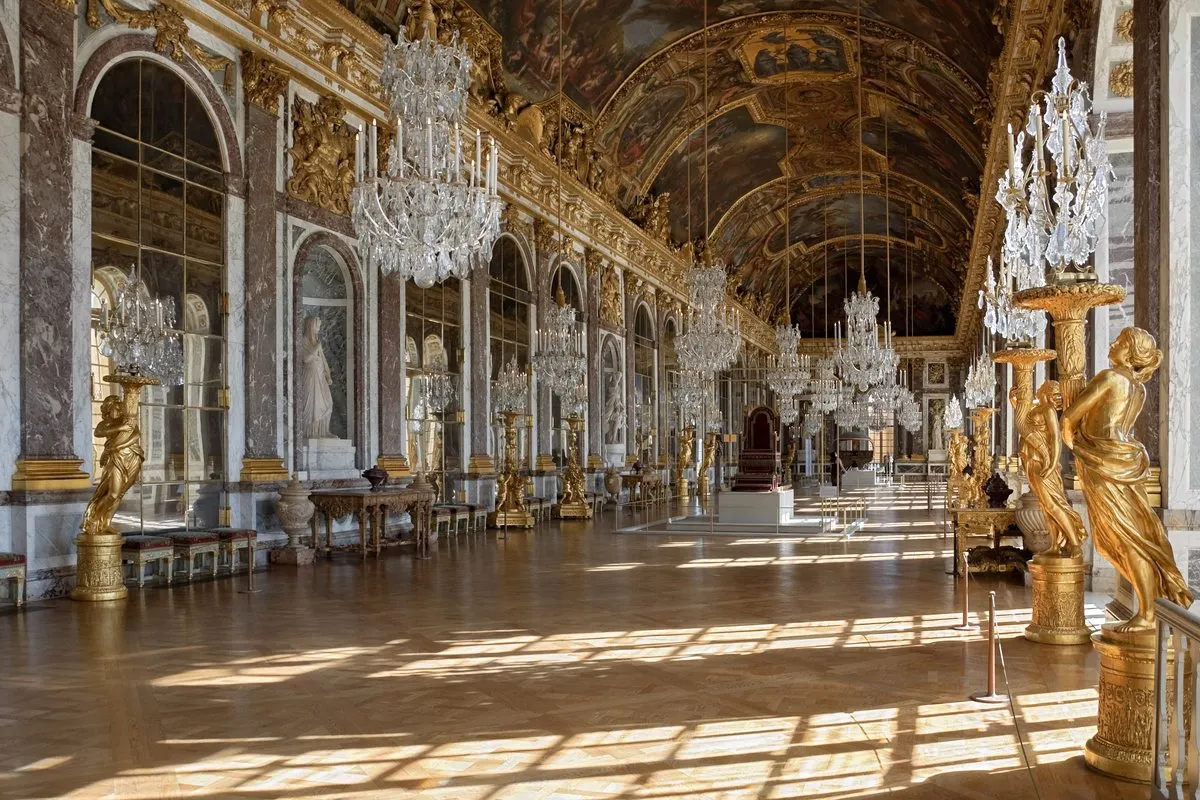
Be at the gates before opening and go straight to the palace. The route leads through the chapel and the King's State Apartments, a sequence of salons named after the planets and dedicated to Apollo, the Sun King's emblem. It culminates in the Hall of Mirrors, the long gallery added by Jules Hardouin-Mansart from 1678, where seventeen arched windows facing the gardens are answered by seventeen arcades of mirrors. Charles Le Brun painted the vaulted ceiling with the triumphs of Louis XIV's reign.
Insider tipThe palace is closed on Mondays. Book a timed entry.
History has passed through this room repeatedly. The German Empire was proclaimed here in January 1871, and in June 1919 the Treaty of Versailles, which formally ended the First World War, was signed beneath the chandeliers. In the first hour of the day you may have it almost to yourself; by late morning it is shoulder to shoulder. Continue through the Queen's Apartments and the King's private rooms before leaving the main palace.
0311.00: Le Nôtre's gardens
Step out onto the terrace behind the palace and the gardens unroll towards the horizon, laid out by André Le Nôtre with parterres, avenues, bosquets and fountains on a scale that still astonishes. Walk down past the Latona Fountain and along the central axis towards the Grand Canal, exploring the hidden groves on either side. On certain days from spring to autumn the fountains play to music, and the gardens then require a separate ticket; check the calendar when booking.
0413.00: Lunch by the Grand Canal
The Grand Canal, a cross-shaped stretch of water where the court once staged naval displays, is the natural place to stop. There are restaurants and kiosks at its head, and rowing boats and bicycles can be hired in season. A picnic on the lawns beyond the formal gardens is the more Parisian choice.
0514.30: The Grand Trianon
From the canal, walk north to the Grand Trianon, the pink marble palace Louis XIV built as a retreat from the formality of the court. Its open peristyle and garden façade feel almost Italian, and the interiors, later used by Napoleon and by Louis-Philippe, are far quieter than the main palace.
0615.30: The Petit Trianon and the Queen's Hamlet
A short walk away stands the Petit Trianon, built between 1762 and 1768 by Ange-Jacques Gabriel for Louis XV and intended for Madame de Pompadour, who died before it was finished. In 1774 the young Louis XVI gave it to Marie Antoinette for her exclusive use, and it became her refuge from Versailles. Beyond its English garden, with a temple of love and a grotto, lies the Hameau de la Reine, the Queen's Hamlet: a cluster of thatched farmhouses, a mill and a dairy around a lake. In the late-afternoon light it is the most enchanting corner of the estate.
0717.30: Back to Paris
Walk back through the park or take the little train that links the Trianons to the palace, and catch a train into the city for dinner. For your evenings, our street guide to Paris covers every arrondissement, and Metro Mode's Paris guide (in Swedish) has more ideas. Other cities are collected among the Metro Mode destinations.